EU AI Act Article 50 for Online Stores: Chatbots, AI Images and AI Text Since August 2026
The EU AI Act transparency rules in Article 50 apply since 2 August 2026. What online stores must do about chatbots, AI images and AI text, what the Digital Omnibus changed, and a checklist.
 Rupak NepaliPublished Nov 26, 2026
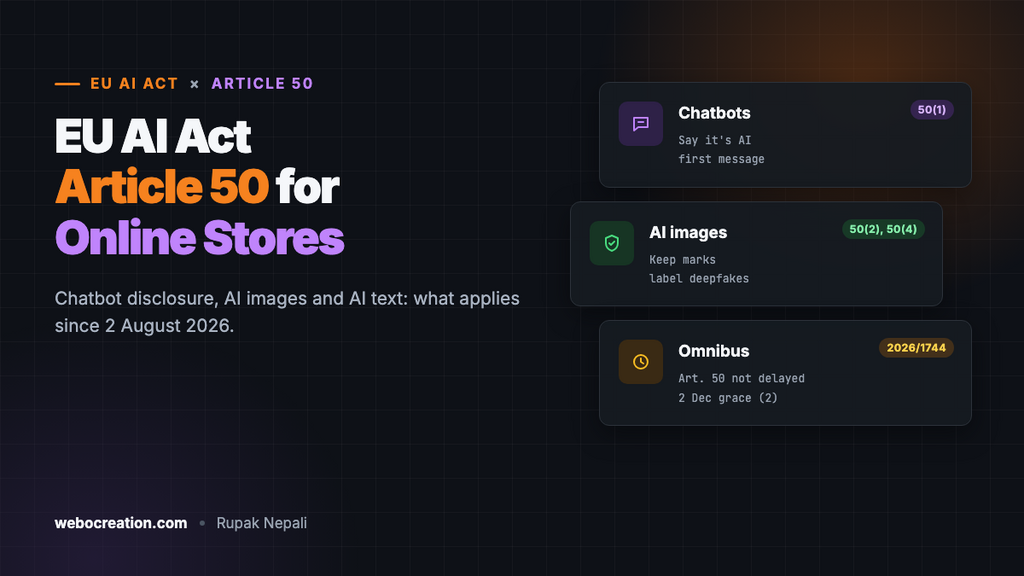
Your store’s chat widget answers questions with an AI model. Your product photos were touched up, or made entirely, with an image generator. Your blog posts start as AI drafts. Since 2 August 2026, the EU AI Act’s transparency rules apply to exactly these uses, and an AI Act “Digital Omnibus” adopted in July 2026 delayed much of the AI Act but not those rules.
This guide explains EU AI Act Article 50 for online stores in plain terms: what it requires of chatbots, AI images and AI text, what the Digital Omnibus changed (and didn’t), and a checklist for an OpenCart, WooCommerce or Shopify store selling to EU customers. It’s based on the regulation text and the amending regulation published in the Official Journal. It isn’t legal advice.
The dates that matter
| Date | What applies |
|---|---|
| 2 August 2026 | Article 50 transparency obligations apply (the AI Act’s general application date in Article 113) |
| 27 July 2026 | The Digital Omnibus on AI, Regulation (EU) 2026/1744 of 8 July 2026, entered into force |
| 2 December 2026 | Deadline for providers of generative AI systems that were already on the market before 2 August 2026 to comply with the machine-readable marking duty in Article 50(2) |
| 2 December 2027 / 2 August 2028 | The high-risk AI obligations, moved back by the Omnibus (Annex III and Annex I systems) |
So the Omnibus gave breathing room to high-risk AI and to AI providers marking their outputs, not to stores that use AI to talk to customers or to publish content.
Providers and deployers: which one is your store?
The AI Act splits duties between providers, who develop an AI system or put it on the market (OpenAI, Anthropic, Google, the maker of your chatbot app), and deployers, who use an AI system in their business. A store that adds a chatbot or generates images with a tool is usually a deployer. A store that builds and sells its own AI product can also be a provider, and some duties fall on whoever designs the system the customer interacts with.
What EU AI Act Article 50 requires
1. Chatbots must say they’re AI
Article 50(1) requires that AI systems “intended to interact directly with natural persons” are designed so people “are informed that they are interacting with an AI system”, unless that’s obvious to a reasonably well-informed person from the context. This duty is written for providers, but a store that sets up the chat experience controls what customers see, so in practice you make sure it happens.
A chat window titled “Chat with Emma” with a human photo isn’t obvious. “AI shopping assistant” in the header, with a line such as “I’m an AI assistant. I can make mistakes; ask for a human at any time” is.
2. AI-generated content must be machine-detectable
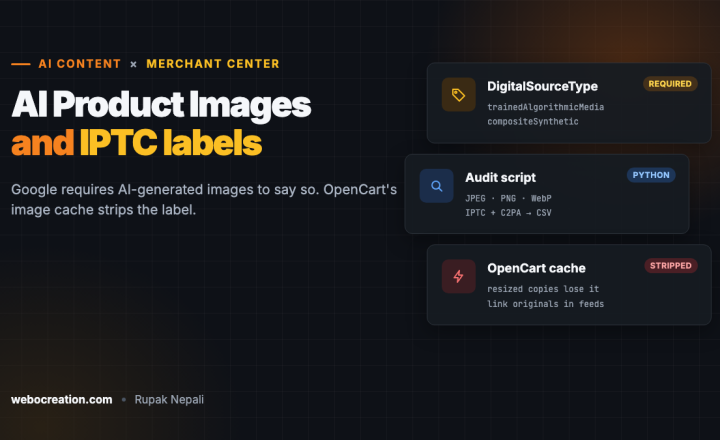
Article 50(2) requires providers of AI systems that generate synthetic audio, images, video or text to mark the outputs “in a machine-readable format and detectable as artificially generated or manipulated”, with an exception for tools that only assist standard editing or don’t substantially alter the input. That’s the image generator’s job (metadata such as C2PA content credentials or watermarks), not yours. Your part is not to strip it: some image pipelines remove metadata when they resize, as we found with OpenCart’s image cache and IPTC labels.
3. Deepfakes must be disclosed
Article 50(4) requires deployers of AI that creates deep fakes, realistic images, audio or video of people, objects or places that falsely appear real, to disclose that the content was artificially generated or manipulated. For evidently artistic, creative or satirical work the disclosure can be lighter, so it doesn’t spoil the work.
For a store: an AI-generated photo of a model wearing your jacket in a real-looking street is the kind of image this targets. A product cut-out on a white background, cleaned up with AI, is much less likely to be a “deep fake”. When in doubt, a short “AI-generated image” caption costs nothing.
4. AI text on matters of public interest
Also in Article 50(4): deployers who publish AI-generated or manipulated text “with the purpose of informing the public on matters of public interest” must disclose it, unless the content “has undergone a process of human review or editorial control” and someone holds editorial responsibility for it. Product descriptions and typical store blog posts aren’t usually “matters of public interest”, and an editor reviewing AI drafts takes text out of the duty anyway. A store publishing AI-written news or health and safety information should take this paragraph seriously.
5. How and when to disclose
Article 50(5): the information must be given “in a clear and distinguishable manner at the latest at the time of the first interaction or exposure”, and it must meet accessibility requirements. A disclosure buried in the privacy policy doesn’t count; it belongs in the chat window, next to the image or at the top of the text, and it should be readable by screen readers.
A checklist for online stores
- List your AI uses: chat and support bots, voice assistants, AI-generated or edited images and video, AI-written descriptions, emails and blog posts, AI product recommendations.
- Chatbots: label them as AI in the first message and in the window header; give a way to reach a person.
- Images and video: keep the content credentials your tools add; label realistic AI images of people and scenes as AI-generated; don’t present AI images as photos of the actual product when they aren’t.
- Text: keep a human editor responsible for anything published; disclose AI text that informs the public on public-interest topics and isn’t reviewed.
- Write it down: a short page or internal note of which tools you use and how disclosures are shown helps if a customer or authority asks.
- Check your vendors: ask your chatbot and image tool providers how they meet Article 50(1) and 50(2).
How this connects to other rules
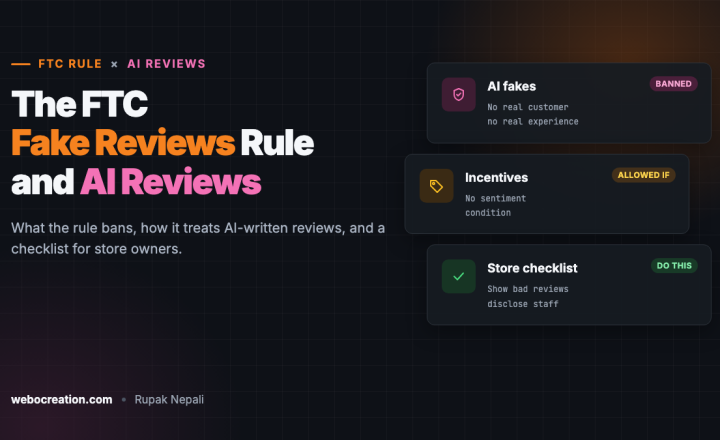
- Consumer protection: independent of the AI Act, presenting AI-generated reviews, people or results as real is misleading. Our post on the FTC fake reviews rule covers the US side.
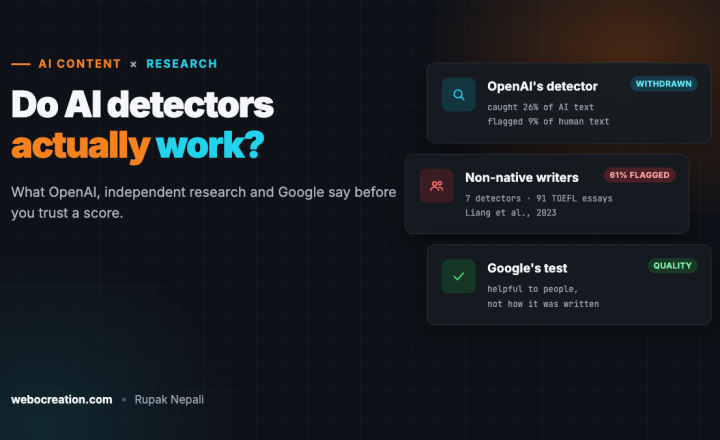
- Search: Google doesn’t require AI labels on store content but expects helpful, accurate pages, as our summary of Google’s rules for AI-generated content explains.
- Security: a chatbot that’s clearly labeled can still be manipulated. See the OWASP LLM Top 10 checked against a store chatbot.
Where to read the text
The AI Act is Regulation (EU) 2024/1689 and the Digital Omnibus on AI is Regulation (EU) 2026/1744, both on EUR-Lex. The European Commission publishes guidance and a code of practice on Article 50; check its AI Act pages if your use is borderline, for example AI-edited product photos or personalized AI emails.
Related posts
- Add an AI shopping assistant to OpenCart 4
- Prompt injection through product reviews
- The EU withdrawal button rule for online shops

Rupak Nepali is a web developer, manage Webocreation website and the author of six books:
Getting Started with OpenCart Module Development (Packt, 2013),
OpenCart Theme and Module Development (Packt, 2015),
OpenCart 4: Dev Guide for Themes & Extensions (2024),
OpenCart 4: User Manual (2025),
Cloudflare for the Enterprise Website (2026) and
The Technical Web Guide for Marketers (2026).
Rupak has built OpenCart stores and extensions since 2010, has published more than 600 tutorials on Webocreation, and shares free OpenCart extensions on GitHub.
Find Rupak on
GitHub | Amazon | LinkedIn | X | YouTube.