Chapter 20: Three End-to-End Case Studies
This chapter applies the whole series to three very different businesses: a B2B software company, an online store, and a local service business. Each case follows the same structure: the situation, the strategy, the channel plan, the AI and…
 Rupak NepaliPublished Nov 10, 2026
How to use this chapter
This chapter applies the whole series to three very different businesses: a B2B software company, an online store, and a local service business. Each case follows the same structure: the situation, the strategy, the channel plan, the AI and agent setup, measurement, and the results and lessons. The companies are fictional composites, and the numbers are illustrative, designed to show realistic reasoning rather than to promise specific outcomes. Read them as worked examples, then use the exercises at the end to build a case study for your own business.
Case study 1: Ledgerly, a B2B SaaS company
The situation
Ledgerly sells cloud invoicing and payment-reminder software to small accounting firms (5 to 50 employees). A subscription costs $99 to $399 per month, and the average customer lifetime value is about $7,200. The marketing team is three people: a head of marketing, a content marketer, and a demand generation specialist. They have a $25,000 monthly budget.
Problems:
- Paid search costs were rising; cost per qualified demo had climbed from $210 to $340 in a year.
- Organic traffic was flat, and informational blog traffic was falling as AI Overviews answered simple accounting questions.
- Sales complained that many leads were too small or not decision-makers.
- The team produced content slowly and reported results manually every Monday.
Goal: grow qualified demos from 120 to 200 per month within nine months while holding blended CAC under $1,800.
The strategy
The team used the integrated planning framework (Chapter 14).
- Insight: customer interviews and an AI analysis of 400 sales call transcripts (Chapter 2) revealed that the trigger for buying was not “invoicing” but late payments hurting cash flow during tax season. Firms searched for, and asked AI assistants about, “how to get clients to pay faster.”
- Positioning: “Ledgerly helps accounting firms get paid 2x faster, with automated reminders clients actually respond to.” (The 2x claim was supported by anonymized, aggregated customer data reviewed by legal.)
- Audience: firm owners and operations managers at firms with 5 to 50 staff.
The channel plan
| Channel | Role | Key actions | Budget |
|---|---|---|---|
| SEO and AI search (Chapters 3 and 4) | Capture high-intent research | Shifted from generic accounting tips to bottom-of-funnel content: comparisons, “how to reduce late payments” guides, a free late-payment cost calculator, an annual “State of Client Payments” report with original data | $3,000 (content and design freelancers) |
| Google Ads (Chapter 5) | Capture demand | Restructured into tightly themed ad groups around pain points; added 600 negative keywords; imported qualified-demo conversions from the CRM so Smart Bidding optimized for quality, not form fills | $10,000 |
| LinkedIn Ads (Chapter 6) | Create demand among the right roles | Document ads promoting the payments report to firm owners; Thought Leader ads from the CEO; Lead Gen Forms; retargeting report readers with demo offers | $8,000 |
| Email (Chapter 13) | Nurture | Seven-email nurture for report downloaders, segmented by firm size; webinar invitations | Included in tools |
| Content and webinars (Chapter 10) | Authority and pipeline | Monthly webinar with a well-known accounting practice consultant | $1,500 |
| Tools and AI (Chapter 17) | Efficiency | Claude Team for content and analysis, HubSpot (existing), automation platform | $2,500 |
The AI and agent setup
- Knowledge base and assistants: a Claude Project loaded with the positioning, personas, approved claims, product documentation, and the best-performing content, used by everyone for drafting and review.
- Sales call insight agent (Level 2): monthly, an agentic workflow summarized new sales call transcripts (stored in the CRM with consent), extracted objections and customer language, and proposed updates to messaging. The head of marketing approved changes.
- Content brief agent (Level 2): produced briefs for each new bottom-of-funnel article, including follow-up questions for AI search coverage (Prompt 4.2).
- Weekly reporting agent (Level 3): pulled HubSpot, Google Ads, LinkedIn, and GA4 data, drafted the report, and posted it for approval (Chapter 18).
- Lead routing (Level 4 within limits): a router classified inbound leads by firm size and role using form and enrichment data, routing qualified leads to sales instantly and small firms to a self-serve nurture. Edge cases went to a person.
Measurement
- Qualified demos and pipeline value, tracked in HubSpot, as the primary KPIs.
- Offline conversion imports so Google Ads and LinkedIn optimized for qualified demos, not raw leads.
- An “AI assistants” channel group in GA4 and an attribution question on the demo form (Chapter 4).
- A LinkedIn incrementality check: a four-week pause in one region (Chapter 9).
Results after nine months (illustrative)
- Qualified demos rose from 120 to 214 per month.
- Cost per qualified demo fell from $340 to $255 as Smart Bidding optimized on CRM-qualified conversions and negatives cut waste.
- The payments report earned coverage in two accounting trade publications and became one of the most frequently cited sources when the team asked AI assistants about late client payments.
- AI assistants became a measurable referral source, with visitors converting to demos at more than twice the site average.
- Reporting time fell from five hours to under one hour per week; the saved time went into the webinar program.
- The LinkedIn holdout showed demo volume dropping in the paused region, confirming the channel’s incremental value despite its high CPCs.
Lessons
- Fix the conversion signal before scaling spend. Optimizing ad platforms on qualified demos instead of form fills changed lead quality more than any creative change.
- Original data is the best GEO strategy for B2B. The payments report won links, press, and AI citations at once.
- Agents worked best on internal processes first: reporting, briefs, and routing, before anything customer-facing.
Case study 2: Brightleaf Coffee Co., an online store
The situation
You know Brightleaf from the exercises throughout this series: a direct-to-consumer specialty coffee brand selling subscriptions ($20 per month) and one-off bags. It has 8,000 email subscribers, 1,200 active subscribers, a two-person marketing team (a marketing manager and a content and social coordinator), and a $10,000 monthly budget.
Problems:
- Subscriber growth had stalled, and churn after the third month was high.
- Meta ads performance was declining because the same three ads had been running for months.
- The team had no time for consistent video.
- Leadership didn’t trust the marketing numbers because Meta, Google Ads, and Shopify all disagreed.
Goal: grow active subscribers from 1,200 to 3,000 in 12 months with blended CAC under $35 and month-3 churn reduced by a third.
The strategy
- Insight: review mining (Chapter 2) of 3,000 reviews showed the most loved moment was “discovering a coffee I’d never have picked myself,” while churn reasons centered on “too much coffee piling up” and “didn’t like one of the roasts.”
- Positioning: “Fresh, small-batch coffee matched to how you brew, with discoveries you’ll love and full control to skip, swap, or pause.”
- Strategic bets: a quiz-driven, personalized subscription experience (zero-party data, Chapter 9) and a creative pipeline to fix Meta performance (Chapter 11).
The channel plan
| Channel | Role | Key actions | Budget |
|---|---|---|---|
| Meta and TikTok (Chapter 6) | Create demand | Consolidated Meta into one broad Advantage+ sales campaign plus a testing campaign; launched TikTok with creator Spark Ads; ten new concepts a month from the creative pipeline | $4,000 |
| Google Ads and Shopping (Chapter 5) | Capture demand | Brand, non-brand subscription terms, and Performance Max with a cleaned product feed | $3,000 |
| Creators (Chapters 11 and 12) | Content and trust | 12 micro-creators per quarter; best videos reused as ads with permission | $1,200 |
| Email and SMS (Chapter 13) | Convert and retain | Quiz-personalized welcome flow; pre-shipment “swap or skip” emails; month-2 and month-3 retention flows with brewing guides matched to each roast | $500 (tools) |
| SEO and AI search (Chapters 3 and 4) | Long-term demand | Brew guides with original test data; honest comparison pages; review program to strengthen off-site presence | $800 |
| Tools and AI | Efficiency | ChatGPT Business for images and ideation, Claude for long-form writing and analysis, Canva, automation platform | $500 |
The AI and agent setup
- Creative pipeline (Chapter 11): weekly insight from ad results and comments; concepts from a creative matrix; scripts drafted with AI and edited by the coordinator; real product photography combined with AI-generated scenes; AI editing for captions and versions; structured testing.
- Personalization: quiz answers stored as profile properties in the email platform; dynamic blocks showing roasts and brewing guides by brew method; AI-drafted variants for each segment, reviewed before launch.
- Comment triage agent (Level 3, then 4 for praise replies): as described in Chapter 18.
- Email QA agent (Level 2): checked every campaign for links, UTMs, personalization fallbacks, and compliance before sending.
- Weekly reporting agent (Level 3): reconciled Shopify revenue, GA4, and ad platforms, showing blended MER and CAC alongside platform-reported numbers.
Measurement
- Single source of truth: Shopify orders and subscription data for revenue and customer counts.
- Blended metrics reported weekly: MER, blended CAC, new subscribers (Chapter 9).
- Holdout group for the personalized welcome flow: 10% of new subscribers received the generic version.
- Geo holdout for Meta in the second quarter to calibrate platform reporting.
- Post-purchase survey (“How did you hear about us?”) including creators and AI assistants as options.
Results after 12 months (illustrative)
- Active subscribers grew from 1,200 to 3,100.
- Blended CAC averaged $33; Meta cost per new subscriber fell 28% after the creative pipeline launched.
- The personalized welcome flow lifted first-purchase conversion by 11% against the holdout.
- Month-3 churn fell from 24% to 15% after introducing swap-or-skip emails and roast-matched brewing guides.
- The Meta geo holdout showed platform reporting overstated Meta’s contribution by about a third, so the team shifted some budget to creators and email list growth.
- Leadership adopted the blended weekly report as the single view of marketing performance.
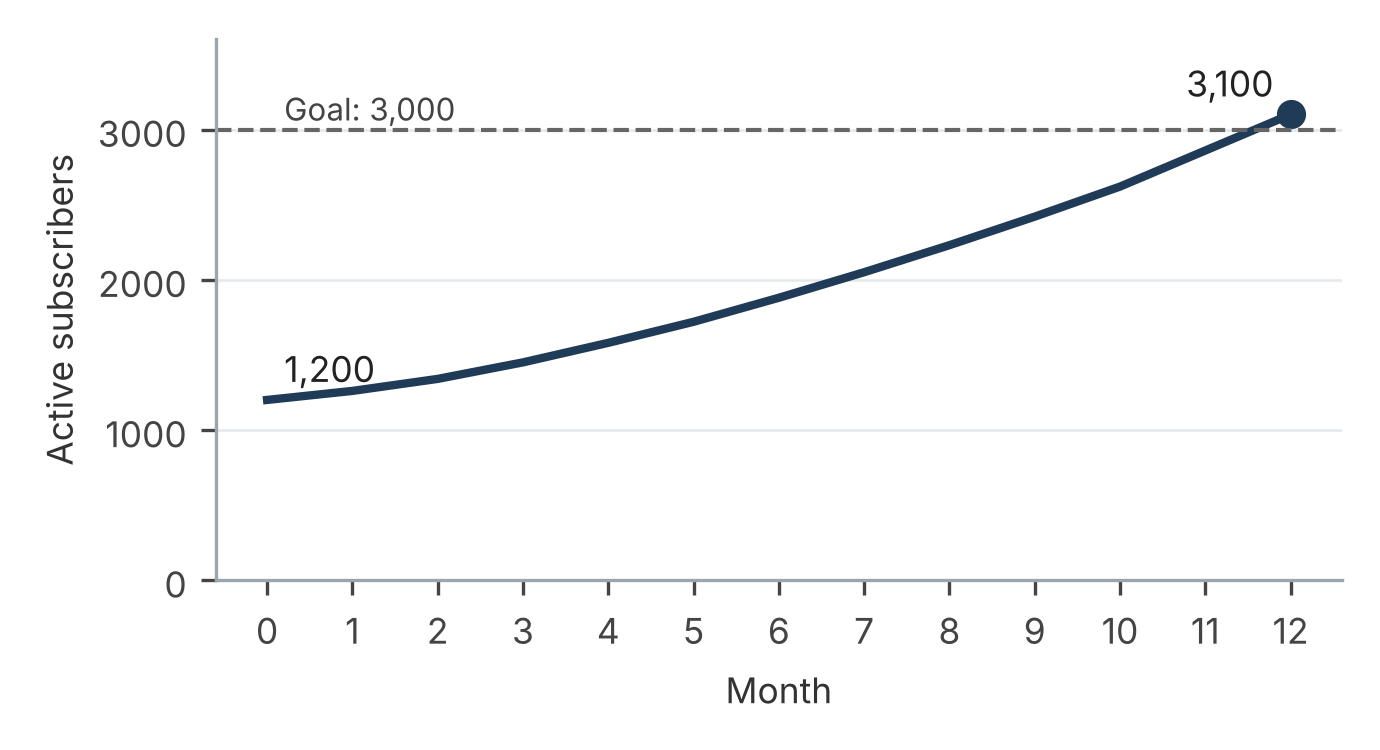
Figure 20.1: Brightleaf passed its 3,000-subscriber goal in month 12 (illustrative)
Lessons
- Retention multiplied acquisition. Reducing churn did as much for growth as the paid media improvements, at far lower cost.
- Creative volume fixed paid social. The algorithm didn’t need narrower targeting; it needed more, better, and more diverse creative.
- Blended metrics ended the numbers argument. One reconciled view built trust with leadership.
Case study 3: Greenline Plumbing & Heating, a local service business
The situation
Greenline is a family-owned plumbing and heating company with 14 technicians serving a metropolitan area of about 600,000 people. The average job value is $450, with higher-value boiler and water heater installations averaging $4,500. Marketing is handled by the office manager, a few hours a week, with a $4,000 monthly budget, mostly spent on a lead marketplace that sold shared leads to multiple competitors.
Problems:
- Shared leads were expensive and often lost to competitors who called first.
- The Google Business Profile was incomplete, with 60 reviews versus competitors’ 400 or more.
- The website was slow and had no service-area pages.
- Calls went unanswered after hours.
Goal: generate 40% more booked jobs from owned channels within six months and reduce dependence on lead marketplaces.
The strategy
- Insight: call recordings and reviews showed customers chose the company that answered fastest and showed up when promised, and that emergencies (“no hot water,” “burst pipe”) drove the most valuable first jobs, many of which led to later installations.
- Positioning: “Real people answer 24/7, and we arrive in your two-hour window or the call-out fee is free.”
- Focus: local search, Google Business Profile, local service ads, reviews, and speed to lead. No need for every channel.
The channel plan
| Channel | Role | Key actions | Budget |
|---|---|---|---|
| Google Business Profile and local SEO (Chapter 3) | Visibility in local and map results | Completed every profile field; weekly photo and post updates; service-area pages for each neighborhood; consistent name, address, and phone across directories | Owner time |
| Reviews (Chapter 4) | Trust and AI recommendations | Automated review request by text after every completed job; owner replies to every review | $100 (review tool) |
| Google Local Services Ads and search ads (Chapter 5) | Capture emergency demand | Local Services Ads (pay per lead, with Google’s screening badge) plus a small search campaign for emergency terms with call assets and call tracking | $2,600 |
| Website and CRO (Chapter 8) | Convert visitors | Faster mobile site; click-to-call buttons; online booking; guarantee prominently displayed | $600 (one-time and hosting) |
| Email and SMS (Chapter 13) | Retention and repeat business | Annual boiler service reminders; seasonal maintenance tips; financing offers for installations | $100 (tools) |
| Remaining marketplace spend | Reduced and monitored | Kept only for high-value installation leads | $600 |
The AI and agent setup
The office manager had little time, so the setup focused on a few high-leverage automations:
- AI assistant (Gemini for Google Workspace, since the company already used Google Workspace): drafts Google Business Profile posts, service-area page content (from technician notes, reviewed for accuracy), review replies, and email reminders.
- After-hours answering: a professional answering service combined with an AI-assisted intake form and text-back for missed calls, with every emergency escalated to the on-call technician by phone. The company chose human escalation for emergencies deliberately (Chapter 18’s autonomy ladder).
- Review request automation (Level 4): when a job is marked complete in the field service software, a text with a review link is sent automatically, within limits set by the owner.
- Monthly report (Level 2): an automation compiled calls, booked jobs, review count and rating, Local Services Ads leads, and revenue by source into a one-page summary drafted with AI.
Measurement
- Call tracking with separate numbers for the website, Google Business Profile, and ads, linked to booked jobs in the field service software.
- Booked jobs and revenue by source, not just leads.
- Review count, average rating, and response time.
- AI visibility check: each month, the office manager asked ChatGPT, Gemini, and Claude “Who’s a reliable emergency plumber in [city]?” and recorded whether Greenline was mentioned (Chapter 4).
Results after six months (illustrative)
- Booked jobs from owned channels (Google Business Profile, website, search, Local Services Ads) rose 52%.
- Reviews grew from 60 to 310, with an average rating of 4.8.
- Marketplace spend fell from about $3,500 to $600 per month.
- Missed after-hours calls fell sharply after the text-back and answering service setup, and after-hours emergency jobs became a significant share of new customers.
- Greenline began appearing in AI assistant answers for local emergency plumbing questions, which the team attributed mainly to the review growth and consistent business information.
- Annual service reminder emails generated a steady stream of repeat maintenance jobs, which led to several installation sales.
Lessons
- Local businesses win on trust signals. Reviews, a complete Google Business Profile, and consistent information drove both map visibility and AI recommendations.
- Speed to lead beats more leads. Answering every call quickly was worth more than additional ad spend.
- Keep humans where stakes are high. AI handled drafting and routine follow-ups; emergencies always reached a person.
Comparing the three cases
| Ledgerly (B2B SaaS) | Brightleaf (e-commerce) | Greenline (local service) | |
|---|---|---|---|
| Core insight | Buyers care about cash flow, not invoicing | Customers love discovery; churn comes from lack of control | Customers choose whoever answers fastest and is trusted |
| Most important channels | SEO and AI search, Google Ads, LinkedIn, email | Meta and TikTok, email and SMS, Google Shopping | Google Business Profile, reviews, Local Services Ads |
| Biggest AI lever | Sales call insight and qualified-conversion optimization | Creative pipeline and personalization | Review automation and missed-call response |
| Key measurement move | Offline conversion imports from the CRM | Blended metrics and holdouts | Call tracking tied to booked jobs |
| Autonomy level used most | Levels 2 to 3 | Levels 2 to 4 | Levels 2 and 4, with human escalation for emergencies |
The common thread: in every case, the breakthrough came from a customer insight, not a tool. AI and agents then made it possible for small teams to execute the strategy at a scale and speed that wouldn’t otherwise have been possible, with measurement honest enough to know what was really working.
Prompt 20.1: Build your own case study plan Act as a fractional CMO. Using the structure situation, strategy, channel plan, AI and agent setup, measurement, and expected results, build a 12-month plan for my business: [description, audience, unit economics, team, budget, current channels, main problems, goal]. Identify the single most important customer insight we should validate first and how to validate it. Choose only the channels that fit our resources, specify autonomy levels for any agents, and include honest measurement methods. Present it in the same format as a case study, with expected results stated as ranges and clearly labeled assumptions.
Prompt 20.2: Case study critique Here is my marketing plan written as a case study: [paste]. Act as a panel of three reviewers: a CFO focused on unit economics, a customer researcher focused on insight quality, and a marketing measurement expert focused on whether the results could be proven. Each reviewer should give their three biggest concerns and one improvement. Then summarize the top five changes I should make.
Hands-on exercises
Exercise 20.1: Find the insight (45 minutes). For your business, gather 30 to 50 pieces of customer evidence (reviews, support tickets, sales notes, survey answers). Use an AI assistant to find the most important buying trigger and the most common reason people leave. Write each as one sentence.
Exercise 20.2: Choose your channels (30 minutes). Using the comparison table above, decide which case your business most resembles. Choose the three channels that matter most and justify the choice against your budget and team.
Exercise 20.3: Agent shortlist (30 minutes). Identify the three agentic workflows that would save your team the most time, and assign each an autonomy level using Chapter 18.
Strategic assignment: your own case study
Write your business’s plan as a forward-looking case study using the structure in this chapter: situation, strategy (with your core customer insight), channel plan with budget, AI and agent setup with autonomy levels, measurement plan, expected results as ranges, and the lessons you expect to learn. Critique it with Prompt 20.2 and revise. After six months of execution, rewrite it with actual results; that document will be the most valuable thing this series helps you create.
Key takeaways
- The same principles apply to B2B, e-commerce, and local businesses, but the channel mix and AI levers differ sharply.
- Every successful plan starts with a validated customer insight.
- Choose few channels and execute them well; small teams win through focus.
- Use AI and agents to amplify the strategy, starting with internal processes and keeping humans in control where stakes are high.
- Measure honestly with a single source of truth, blended metrics, and incrementality tests, so you know what’s really working.