The FTC Fake Reviews Rule and AI-Written Reviews: What Online Stores Can and Can’t Do
The FTC's rule on fake reviews has applied since October 2024 and covers AI-generated reviews. What it bans, what stores can still do, and a checklist for OpenCart and WooCommerce stores.
 Rupak NepaliPublished Nov 24, 2026
Writing twenty glowing product reviews with an AI tool takes a minute. So does asking only your happiest customers for a review, or quietly unpublishing the one-star ones. All three make a product page look better, and in the United States all three can now cost real money. The FTC fake reviews rule has been in force since October 21, 2024, and the FTC said when it announced the rule that it is meant to deter AI-generated fake reviews.
This guide explains the FTC fake reviews rule in plain terms for store owners: what it bans, how it treats AI-written reviews, what is still allowed, and a checklist for an OpenCart, WooCommerce or Shopify store. It’s based on the FTC’s announcement, the rule as published in the Federal Register, and the FTC’s business Q&A. It isn’t legal advice; if your situation is unusual, ask a lawyer.
The FTC fake reviews rule in one paragraph
Its full name is the Trade Regulation Rule on the Use of Consumer Reviews and Testimonials (16 CFR Part 465). It was published in the Federal Register on August 22, 2024 and took effect on October 21, 2024. Because it’s a trade regulation rule, the FTC can seek civil penalties from businesses that knowingly break it, on top of the usual orders to stop. The maximum penalty per violation is set in law and adjusted for inflation every year.
What the rule bans
1. Fake reviews and testimonials, including AI ones
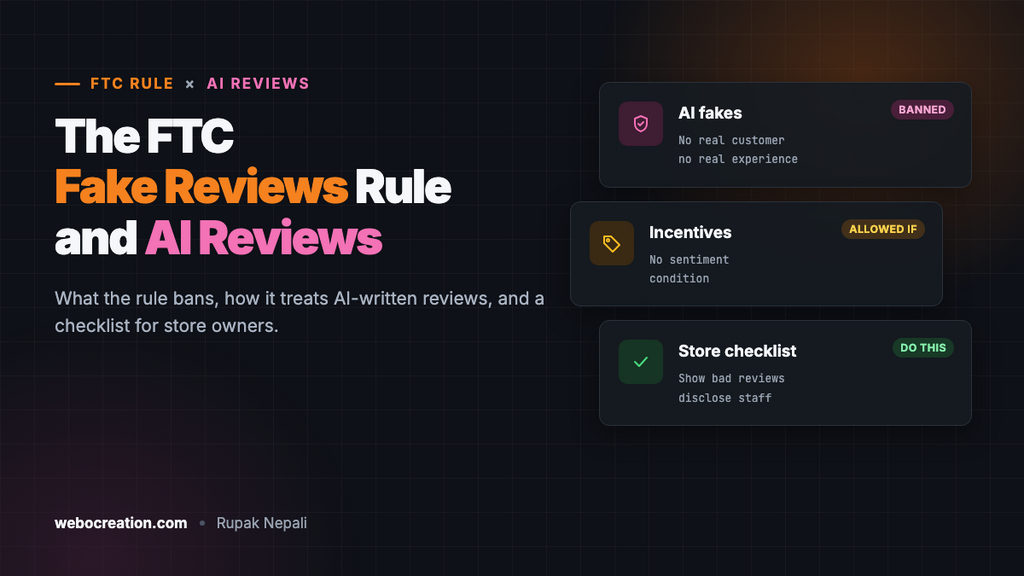
The rule covers reviews and testimonials that misrepresent that they are by someone who doesn’t exist, “such as AI-generated fake reviews”, or by someone who didn’t have actual experience with the business or its products. That covers writing them, buying them, and selling them. The Federal Register text says plainly that AI-generated reviews are covered by the final rule.
For a store owner this means: a review must come from a real customer who used the product. A review “drafted” by AI for a product nobody has bought is a fake review, however realistic it reads.
2. Paying for positive (or negative) reviews
The rule prohibits giving compensation or other incentives conditioned on the review expressing a particular sentiment, positive or negative, whether that condition is stated or implied. The FTC’s Q&A is clear that incentives as such are not banned: “10% off your next order for leaving a review” is fine, “10% off for a five-star review” is not.
3. Undisclosed insider reviews
Reviews and testimonials by your officers, managers, employees or agents, or their relatives, need the connection clearly disclosed. It also reaches some cases where managers ask employees, or employees’ relatives, for reviews that then go up without that disclosure.
4. Fake “independent” review sites
You can’t run a website or entity that claims to give independent reviews of a product category when it’s actually controlled by you and favors your products.
5. Review suppression
Two behaviors are covered:
- Using unfounded or groundless legal threats, physical threats, intimidation, or certain false public accusations to prevent or remove a negative review.
- Saying or implying that the reviews on your site represent all or most of the reviews submitted, when you’ve suppressed reviews because of their rating or negative sentiment.
Moderating reviews is still allowed: removing spam, abuse, personal data or reviews unrelated to the product. Hiding reviews because they’re negative, while showing the rest as the full picture, is what the rule targets.
6. Fake social media influence
Buying or selling fake followers, views or other indicators of social media influence, when you know or should know they’re fake and use them to misrepresent your importance for a commercial purpose.
What is still allowed
- Asking every customer for a review, including with an incentive that doesn’t depend on what they write.
- Using AI to help real customers, for example offering writing prompts. The words and the experience have to be the customer’s.
- Moderating spam, abuse and off-topic reviews, with the same standard for positive and negative ones.
- Replying to negative reviews publicly and politely. A good reply often helps more than the review hurts; our review replies extension for OpenCart 4 adds exactly that.
- AI avatars in ads: the FTC’s Q&A says the rule has no blanket ban on AI-generated avatars in marketing. Presenting one as a real customer giving a real testimonial is a different matter.
Where AI makes this easy to get wrong
- “Seeding” new products. A product with zero reviews is tempting to fill with AI-written ones. That’s the textbook case the rule bans. Send samples to real customers instead, and disclose free samples in the review.
- Importing reviews. Copying reviews of a similar product, or of the same product from another seller, misrepresents who reviewed what you sell. Only show reviews of the product the reviewer actually got.
- AI review summaries. A summary of real reviews isn’t a fake review, but if it leaves out the common complaints it can mislead in the same way suppression does. Check summaries against the reviews.
- Agencies and plugins. “Review generation” services vary a lot. If a vendor delivers reviews from people who never bought from you, the rule covers the business that buys them, not only the seller.
A checklist for store owners
- Show only reviews from real customers of the specific product. Where you can, mark verified purchases.
- Ask all customers for reviews the same way and at the same time after delivery, not just the ones you expect to be happy. An automatic email X days after the order, like our review request emails for OpenCart 4, does this by design.
- Never tie a discount, entry or gift to the rating or tone of the review.
- Have staff and family disclose their connection, or not review at all.
- Write down your moderation rules (spam, abuse, personal data, off-topic) and apply them to every rating.
- Answer negative reviews instead of removing them.
- Stop spam and bot reviews at the door, for example with Cloudflare Turnstile on the review form.
- If you run an AI shopping assistant that quotes reviews, treat review text as untrusted input. Our post on prompt injection through product reviews explains why.
Does it apply outside the US?
The FTC rule applies to businesses selling to US consumers. Other places have their own rules: the EU’s consumer protection law requires traders to say whether and how they check that reviews come from real buyers, and the UK’s Digital Markets, Competition and Consumers Act 2024 lists fake reviews among banned practices. If you sell internationally, the safe standard is the same everywhere: real customers, real experiences, no filtering by rating.
Can AI detectors catch fake reviews?
Not reliably. The tools that claim to spot AI text are wrong often enough that we wouldn’t remove a review based on one, as we found in do AI content detectors work? Verified purchase checks and moderation rules do more than detectors.
Related posts
- Google’s rules for AI-generated content in 2026
- Photo reviews for OpenCart 4
- Automate reviews, social proof and referrals

Rupak Nepali is a web developer, manage Webocreation website and the author of six books:
Getting Started with OpenCart Module Development (Packt, 2013),
OpenCart Theme and Module Development (Packt, 2015),
OpenCart 4: Dev Guide for Themes & Extensions (2024),
OpenCart 4: User Manual (2025),
Cloudflare for the Enterprise Website (2026) and
The Technical Web Guide for Marketers (2026).
Rupak has built OpenCart stores and extensions since 2010, has published more than 600 tutorials on Webocreation, and shares free OpenCart extensions on GitHub.
Find Rupak on
GitHub | Amazon | LinkedIn | X | YouTube.