The Senior Frontend Engineer Interview Guide: The Complete 18-Part Series
A free 18-part handbook for senior frontend interviews: 401 questions and model answers covering JavaScript, React 18, micro frontends, security, accessibility, testing, payments, databases, AI and system design.
 Rupak NepaliPublished Nov 9, 2026
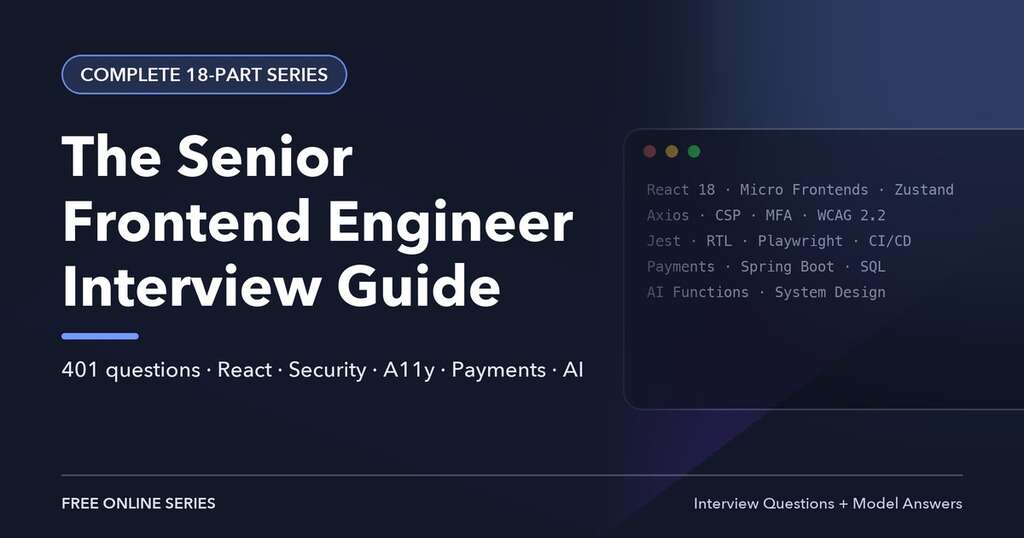
React 18, Micro Frontends, Security, Accessibility, Testing, FinTech Payments, Databases, and AI Functions, with Interview Questions and Model Answers.
This is a free, 18-part preparation handbook for senior and enterprise frontend roles, with 401 interview questions and model answers. Each part stands on its own, so start with whichever topic your next interview leans on.
Frontend engineering interviews for enterprise roles have changed. A decade ago, a candidate who knew the DOM, a framework, and some CSS could expect a fair chance. Today, a typical job description for a senior frontend engineer at a bank, an insurer, or a fintech company reads like a table of contents for a small library: React 18, modern JavaScript, micro frontends and Module Federation, HTML and CSS with SCSS and CSS Modules, responsive and reusable components, state management with Zustand and React Context, REST integrations with Axios, authentication and multi-factor authentication, frontend security, WCAG accessibility, internationalization, Jest, React Testing Library, Playwright, Git, CI/CD, payment systems such as ACH, RTP, and wire transfers, Java and Spring Boot, relational and NoSQL databases, and, most recently, AI functions.
This book was written for exactly that job description. Each chapter maps to one of those requirements, explains the concepts an interviewer expects you to understand, shows realistic code in the style used by enterprise teams, and ends with interview questions and model answers. The answers are written the way a strong candidate would speak: direct, structured, and grounded in trade-offs, not memorized definitions.
Who This Book Is For
- Mid-level engineers preparing for their first senior role, who need to fill gaps and organize what they already know.
- Senior engineers moving into financial services, who need the domain knowledge (payment rails, money handling, compliance, security expectations) that fintech interviewers assume.
- Full-stack and backend engineers moving toward the frontend, who need a structured tour of modern React and the browser platform.
- Hiring managers and interviewers, who can use the question banks to design consistent, fair interview loops.
What Makes This Book Different
Most interview books focus on algorithms or on a single framework. This book is organized around the real skill set enterprise teams hire for. It emphasizes:
- Breadth with depth where it matters. Every requirement in a typical job description gets its own chapter, with deeper treatment of the topics that come up most in senior interviews: React’s rendering model, state management, security, accessibility, and testing.
- The enterprise and financial context. Examples use accounts, transactions, payees, and transfers. You will learn why money is never a floating-point number, why instant payments change UX requirements, and how regulations shape the interface.
- Trade-offs over trivia. Interviewers for senior roles want to hear why you would choose an approach. The answers in this book model that reasoning.
- Modern, accurate practices. The content reflects React 18 and the surrounding ecosystem as used in production today, including notes where newer versions change things.
A Note on Accuracy
The web platform, payment networks, and regulations evolve continuously. Limits, dates, and version numbers mentioned in this book were accurate at the time of writing. When a detail matters for production work or compliance, confirm it against the official source. In an interview, it is perfectly acceptable, and often impressive, to say, “The last figure I saw was X; I would confirm the current value in the documentation.”
Good luck with your interviews. More importantly, enjoy the learning: everything in this book will make you a better engineer, whether or not an interviewer asks about it.
All Chapters
- Part 1: Modern JavaScript (ES6+) (28 questions)
- Part 2: React 18 Fundamentals and Hooks (28 questions)
- Part 3: Advanced React 18: Concurrency, Suspense, and Performance (25 questions)
- Part 4: Micro Frontends and Module Federation (22 questions)
- Part 5: HTML, CSS, SCSS, and Responsive Design (25 questions)
- Part 6: CSS Modules and Reusable UI Components (22 questions)
- Part 7: State Management: Zustand, Context, and Asynchronous Data (22 questions)
- Part 8: REST APIs, Web Services, and Axios (23 questions)
- Part 9: Authentication, MFA, and Frontend Security (24 questions)
- Part 10: Accessibility and WCAG Compliance (22 questions)
- Part 11: Internationalization and Localization (20 questions)
- Part 12: Testing with Jest, React Testing Library, and Playwright (22 questions)
- Part 13: Git and CI/CD Pipelines (22 questions)
- Part 14: Financial Applications and Payment Systems (20 questions)
- Part 15: Java and Spring Boot for Frontend Engineers (18 questions)
- Part 16: Relational and NoSQL Databases (18 questions)
- Part 17: AI Functions in Frontend Applications (18 questions)
- Part 18: Frontend System Design and Behavioral Interviews (22 questions)
How to Use This Guide
Structure of Each Chapter
Every chapter follows the same pattern:
- An opening page listing the topics covered and the number of interview questions included.
- Explanatory sections that build understanding from fundamentals to advanced topics, with code examples and comparison tables.
- Interview Questions and Answers, numbered, with model answers you can adapt to your own words and experience.
- Key Takeaways, a short summary to review the night before an interview.
Suggested Study Paths
If you have four weeks or more, read the book in order and follow the study plan in the Four-Week Study Plan below. Build a small practice project (for example, a mini banking dashboard) as you go: implement a Zustand store, an Axios client with interceptors, an accessible modal, a Playwright test, and a Module Federation remote. Hands-on experience makes answers far more convincing.
If you have one week, start with the chapters most relevant to the role, usually Chapters 2, 3, 7, 9, 10, and 12, then skim the Key Takeaways and practice the questions in the remaining chapters. Read Chapter 18 before any system design round.
If you have one day, read the Key Takeaways of every chapter, review the Last-Minute Review Checklist below, and rehearse answers to ten questions you find hardest, out loud.
How to Practice the Questions
- Answer out loud before reading the model answer. Speaking reveals gaps that silent reading hides.
- Time yourself. Most answers should take one to two minutes. Lead with the direct answer, then add detail, an example, and a trade-off.
- Personalize. Replace generic examples with stories from your own projects. Interviewers remember specifics.
- Go one level deeper. For each question, ask yourself the likely follow-up (“Why?”, “What would you do differently at ten times the scale?”, “How would you test it?”).
- Practice with a partner. Take turns playing interviewer using the question banks.
Conventions
- Code examples use modern JavaScript or TypeScript with React 18 unless noted. Imports are sometimes omitted for brevity.
- Monetary amounts in examples are represented as integer minor units (cents) or decimal strings, never floating-point numbers.
- “MFE” abbreviates micro frontend; “BFF” abbreviates backend-for-frontend; “RTL” refers to React Testing Library in Chapter 12 and to right-to-left text in Chapter 11, as context makes clear.
- Short tables summarize comparisons; they are designed to be easy to recall in an interview.
Mapping Requirements to Chapters
| Job requirement | Chapters |
|---|---|
| React (18.x), JavaScript (ES6+), modern frontend development | 1, 2, 3 |
| Micro frontends and Module Federation | 4 |
| HTML, CSS/SCSS, CSS Modules, responsive design, reusable UI components | 5, 6 |
| State management with Zustand, React Context, asynchronous data | 7 |
| REST APIs, web services, third-party platforms with Axios | 8 |
| Authentication, MFA integration, frontend security | 9 |
| Accessible, WCAG-compliant, internationalized, localized applications | 10, 11 |
| Jest, React Testing Library, Playwright | 12 |
| Git and CI/CD pipelines | 13 |
| Financial applications, ACH, RTP, wire transfers | 14 |
| Java/Spring Boot environments | 15 |
| Relational and NoSQL databases | 16 |
| AI functions | 17 |
| System design and behavioral interviews | 18 |
Four-Week Study Plan
This plan assumes about ninety minutes on weekdays and three hours on weekend days. Adjust it to the role: if the job emphasizes payments, spend extra time on Chapter 14; if it emphasizes platform work, on Chapters 4 and 13.
Week 1: Language and React Foundations
| Day | Reading | Practice |
|---|---|---|
| 1 | Chapter 1, sections through Prototypes and Classes | Implement debounce, throttle, and memoize from memory |
| 2 | Chapter 1, remaining sections and questions | Implement Promise.all and Promise.allSettled; explain event loop output for three snippets |
| 3 | Chapter 2, through Effects | Build a transactions list with filtering and an effect that aborts stale requests |
| 4 | Chapter 2, remaining sections and questions | Build a TextField with forwardRef and useId; write a custom hook |
| 5 | Chapter 3, through Suspense | Add useTransition to a large filtered list; add React.lazy routes |
| 6 | Chapter 3, remaining sections and questions | Profile your app with the React Profiler; virtualize the list |
| 7 | Review | Answer all Chapter 1 to 3 questions out loud; note weak areas |
Week 2: Architecture, Styling, State, and APIs
| Day | Reading | Practice |
|---|---|---|
| 8 | Chapter 4 | Create a host and one remote with Module Federation; share React as a singleton |
| 9 | Chapter 5 | Build a responsive dashboard layout with Grid and container queries |
| 10 | Chapter 6 | Build compound Tabs with CSS Modules and design tokens; write stories |
| 11 | Chapter 7, Context and Zustand | Implement a transfer wizard store with Zustand and persist (non-sensitive fields only) |
| 12 | Chapter 7, async data | Replace effects with TanStack Query; add a mutation with invalidation |
| 13 | Chapter 8 | Build an Axios client with token refresh queue, retries, and error normalization |
| 14 | Review | Answer Chapter 4 to 8 questions; draw your practice app’s architecture |
Week 3: Security, Accessibility, i18n, and Testing
| Day | Reading | Practice |
|---|---|---|
| 15 | Chapter 9, authentication and MFA | Sketch the Authorization Code with PKCE flow; build an OTP input |
| 16 | Chapter 9, web security | Write a CSP for your app; sanitize rich text with DOMPurify |
| 17 | Chapter 10 | Build an accessible modal and error summary; test with a screen reader |
| 18 | Chapter 11 | Add react-i18next with plurals and currency formatting in two locales |
| 19 | Chapter 12, Jest and RTL | Write component tests with MSW for success and error states |
| 20 | Chapter 12, Playwright | Write an end-to-end test with authentication setup and axe checks |
| 21 | Review | Answer Chapter 9 to 12 questions; run a mock interview with a friend |
Week 4: Delivery, Domain, Backend, Data, AI, and Interviews
| Day | Reading | Practice |
|---|---|---|
| 22 | Chapter 13 | Write a GitHub Actions workflow for lint, test, build, and sharded Playwright |
| 23 | Chapter 14 | Explain ACH versus RTP versus wire aloud; implement amount parsing to cents |
| 24 | Chapter 15 | Run a sample Spring Boot API locally; read its controller and security config |
| 25 | Chapter 16 | Write keyset pagination SQL; compare document and relational models for one feature |
| 26 | Chapter 17 | Build a streaming AI response component with cancellation (mock the backend) |
| 27 | Chapter 18 | Do two timed system design exercises; write five STAR stories |
| 28 | Final review | Read every Key Takeaways section and the Last-Minute Review Checklist below; rest |
Last-Minute Review Checklist
Use this list the day before an interview. If you cannot explain an item in one or two sentences, revisit its chapter.
JavaScript and React
- Closures, the temporal dead zone, the five rules of
this, and prototypes versus classes. - Event loop order: synchronous code, all microtasks, render, next macrotask.
- Promise combinators:
all,allSettled,race,any; cancellation withAbortController. - React renders are pure; effects synchronize with external systems and clean up.
- React 18:
createRoot, automatic batching, transitions,useDeferredValue, Suspense,useId,useSyncExternalStore, Strict Mode double effects. - Keys, reconciliation, memoization trade-offs, error boundaries, portals,
forwardRef. - Performance method: measure LCP, INP, CLS; profile; fix the largest cost; add budgets.
Architecture, Styling, and State
- Micro frontends solve team scaling; Module Federation shares dependencies at runtime; React must be a singleton; use an async bootstrap.
- Remote loading failures need error boundaries, retries, and manifest rollbacks.
- Specificity, cascade layers, Flexbox versus Grid, container queries,
dvh, logical properties. - CSS Modules scope class names at build time with zero runtime cost.
- Reusable components: composition, pass-through props, ref forwarding, accessibility, tokens.
- Classify state: local, shared, global, server, URL, form. Context for low-frequency values; Zustand selectors for shared client state; TanStack Query for server state.
APIs and Security
- HTTP methods, idempotency, 401 versus 403, CORS preflights, ETags.
- Axios instances, interceptors, single-flight token refresh, retries with backoff and jitter only for idempotent requests.
- Authorization Code with PKCE; BFF pattern; token storage trade-offs; refresh token rotation.
- MFA factors and phishing resistance; passkeys; step-up authentication.
- XSS sinks and defenses, CSP with nonces, CSRF and SameSite cookies, clickjacking, security headers, supply chain.
Accessibility, i18n, and Testing
- WCAG 2.2 AA; POUR; contrast ratios 4.5:1 and 3:1; focus management; live regions; first rule of ARIA.
- Accessible modals, forms with error summaries, data tables, and route change focus.
Intlfor numbers, currencies, dates, plurals, collation; ICU messages; RTL with logical properties; business dates versus instants.- Testing trophy; RTL query priority;
userEvent; MSW; Playwright locators, auto-waiting, storage state, tracing; flaky test causes.
Delivery, Domain, Backend, Data, and AI
- Merge versus rebase, revert versus reset, reflog, bisect,
--force-with-lease. - Trunk-based development, feature flags, CI stages, build once and deploy many, caching headers, canary and blue-green, DORA metrics.
- ACH (batch, returnable), RTP and FedNow (instant, irrevocable), wires (high-value, final); money as minor units or decimals; idempotency keys; honest status models.
- Spring Boot layers, DTOs, validation, Problem Details, resource server JWT validation, CORS configuration, OpenAPI contracts.
- ACID, isolation anomalies, indexes, keyset pagination, NoSQL families, eventual consistency, browser storage security.
- Function calling loop; validate, authorize, execute, audit; never expose keys; prompt injection mitigated by architecture; streaming UI with safe Markdown.
Interview Day
- Clarify before answering design questions; state assumptions.
- Lead with the answer, then explain, then give a trade-off or example.
- Use STAR for behavioral questions, with numbers in the result.
- It is fine to say what you would verify and how.
- Prepare three thoughtful questions for your interviewers.

Author of four Opencart book.
The recent are Opencart 4 developer book and Opencart 4 user manual