Introduction: Who Owns the Website? Closing the Delivery Gap
Why enterprise website management fails without a clear owner, who this series is for, what it covers, and the fictional company, Webocreation Group, that every chapter follows.
 Rupak NepaliPublished Nov 26, 2026
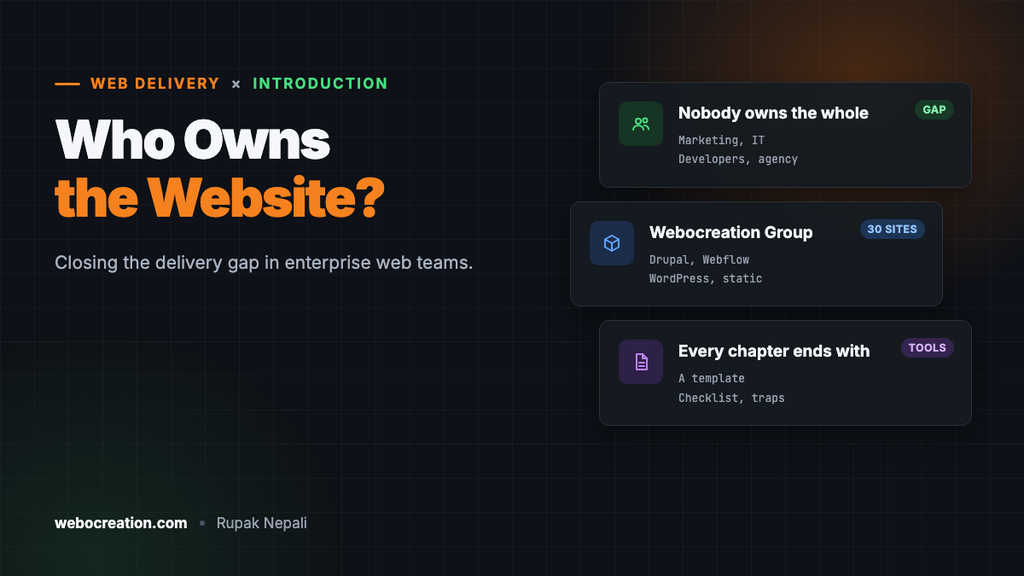
This is the introduction to The Web Delivery Manager’s Playbook. It explains why enterprise website management so often fails without a single owner for delivery, and how the series fixes that one habit at a time.
Every company with a website has someone who keeps it running. Sometimes that person has a title. More often, the job is spread across a marketing manager who owns the brand, a developer who knows where the code lives, an IT engineer who controls the DNS, and an agency that built the last redesign. Each of them does good work. Nobody owns the whole.
That gap is where websites get into trouble. A product launch slips because nobody knew legal had to review the pricing page. A microsite goes down because its SSL certificate expired and the person who set it up left two years ago. A simple banner change takes three weeks because it sat in someone’s inbox. None of these are technology problems. They are delivery problems.
This book is about closing that gap. It is written for the person who is responsible for getting web work from “someone asked for this” to “it is live, it works, and we can prove it.” In some companies that person is called a web delivery manager. In others they are a web manager, a digital product owner, a marketing operations lead, or a senior developer who slowly became the person everyone asks. The title matters less than the job.
Who this book is for
You will get the most out of this book if you are in one of these situations:
- You manage a corporate website, or a portfolio of them, and the work feels like constant firefighting.
- You were a developer or designer and you have been handed responsibility for “the website” with no playbook.
- You run marketing operations and you need a dependable way to get web changes shipped.
- You lead a digital team and want a shared operating model that IT, security, legal and marketing all understand.
- You work at an agency and want to understand how your enterprise clients run web work, so you can fit into it.
You do not need to be a programmer. You do need to be comfortable talking to programmers. The book explains technical topics such as environments, deployments, DNS and caching at the level a delivery manager needs: enough to ask the right questions and spot a bad estimate, not enough to do the engineering yourself.
What this book covers
The book follows the life of web work from the first request to the day a site is retired. It is organized into five parts.
Part 1, The Role, defines the job, the operating model that connects all the teams around a website, the inventory of platforms you are responsible for, and a plan for your first 90 days.
Part 2, Intake and Planning, turns scattered requests into a single visible queue, then shows how to prioritize, estimate and build a roadmap that people trust.
Part 3, Delivery, covers the engine room: running web work through ServiceNow, choosing a delivery rhythm, release management, quality assurance, launch day and incidents.
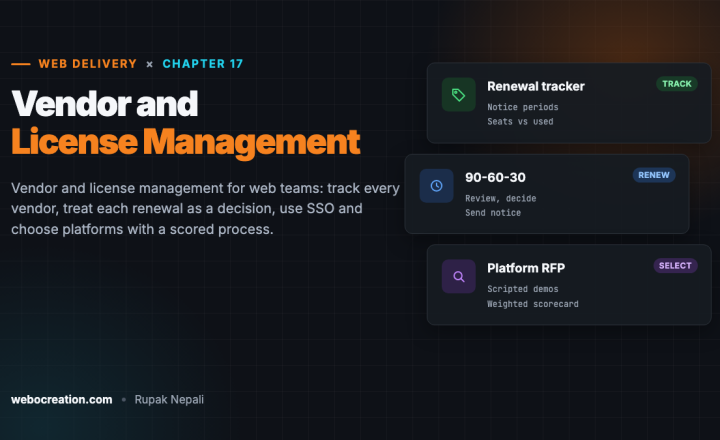
Part 4, People, deals with stakeholders, agencies, vendors and your own team, the part of the job no tool can fix.
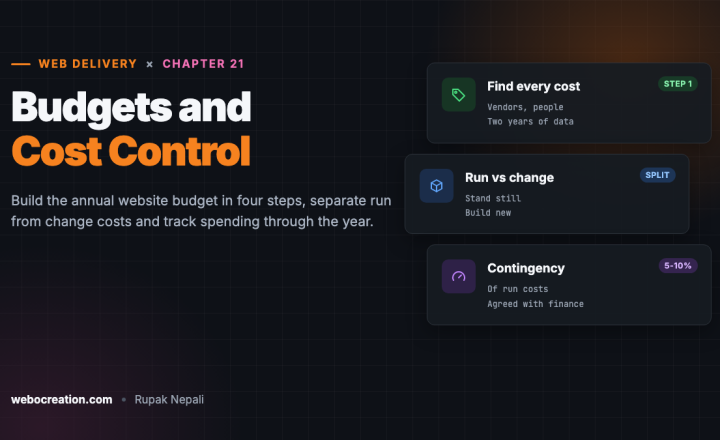
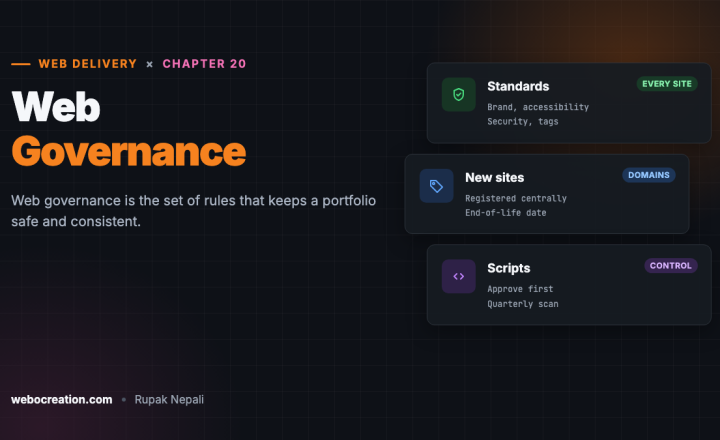
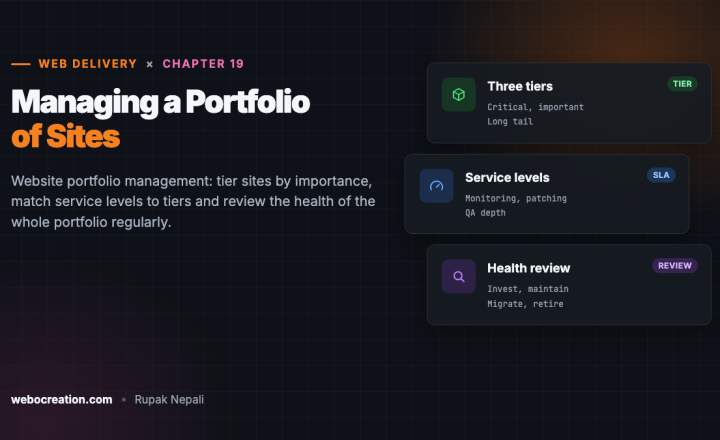
Part 5, Running the Portfolio, zooms out to many sites at once: governance, budgets, metrics, risk, migrations and sunsetting, and finally how AI is changing the work.
ServiceNow and other tools
Most large companies run IT work through an IT service management (ITSM) platform, and ServiceNow is the most common one. Web teams often treat it as an obstacle: a form to fill in before the real work can start. This book takes the opposite view. When you set it up well, ServiceNow gives a web team a front door, an audit trail, approvals that run on their own, and reports that make your case to leadership.
ServiceNow is used as the worked example throughout, because it is what most readers will meet. If your company uses Jira Service Management, Freshservice or another tool, the same ideas apply. The record types, approval flows and metrics have close equivalents in every serious ITSM platform.
The book is otherwise tool-neutral. Whether your sites run on Drupal, WordPress, Webflow, Adobe Experience Manager or a headless CMS, the delivery problems are the same.
Meet Webocreation Group
Every chapter applies its ideas to a fictional company, Webocreation Group. It is a mid-sized company with 30 websites, which is a typical number once you count everything:
- One corporate site on Drupal, hosted on a managed cloud platform
- Eight product microsites built in Webflow
- Six regional sites in four languages
- A careers site connected to the HR applicant tracking system
- Five campaign landing-page sites spun up by marketing over the years
- Nine legacy sites, a mix of old WordPress installs and static HTML on AWS
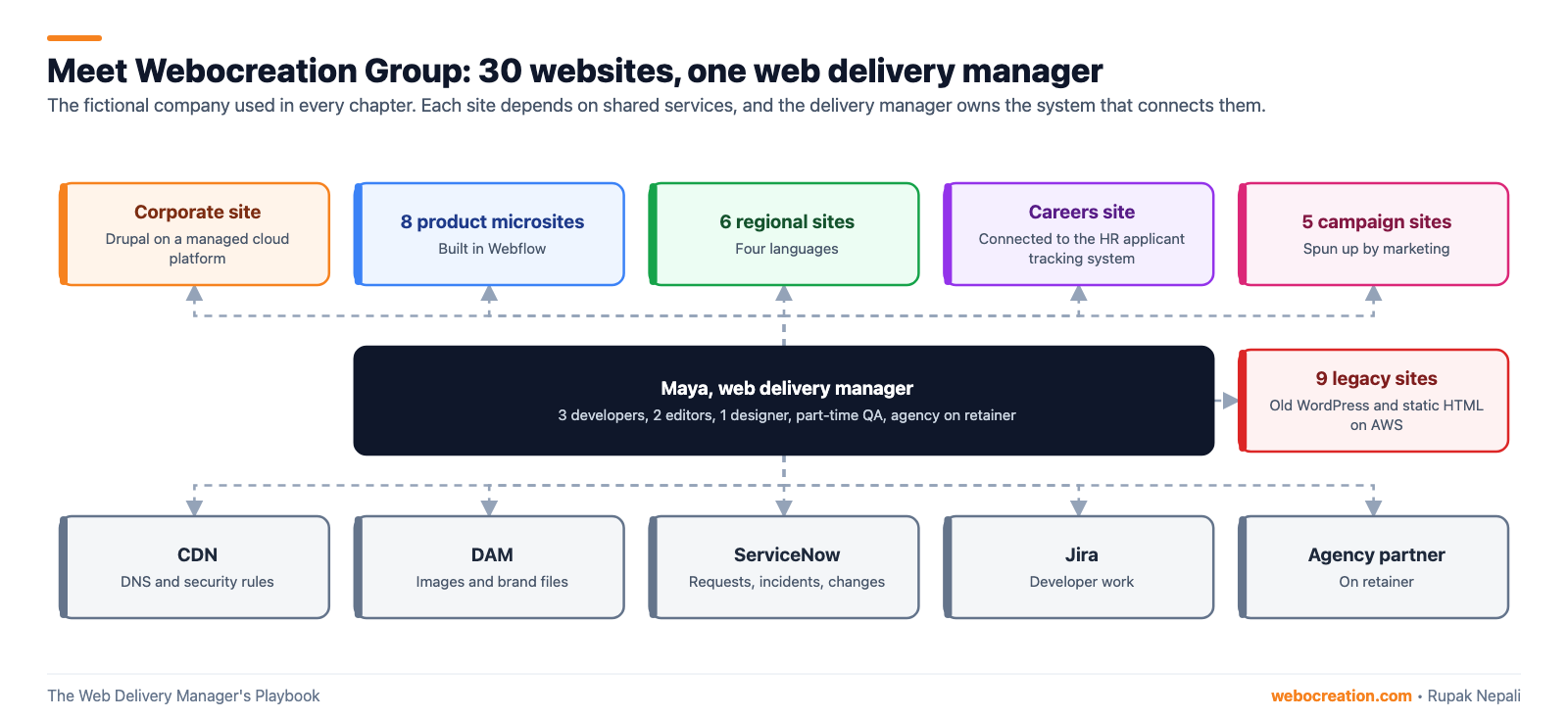
Traffic runs through a CDN that also handles DNS and security rules. Images and brand files live in a digital asset management (DAM) system. IT runs ServiceNow for requests, incidents and changes, and the developers track their work in Jira.
The web team is small: three developers, two content editors, one designer, a part-time QA analyst and an agency partner on retainer. At the start of the book, Webocreation Group has just hired its first web delivery manager, Maya. We will follow her as she builds the operating model this book describes.
Webocreation Group and its people are invented. Any resemblance to a real company is a sign that these problems are universal.
How to use this book
You can read the book from start to finish, and Part 1 is written to be read first. After that, each chapter stands on its own. If your most painful problem is releases, jump to Part 3. If it is a stakeholder who changes priorities every week, go to Chapter 15.
Every chapter ends the same way:
- A template you can copy into your own tools and adapt. All templates are also collected in the template library on the series page.
- A checklist of actions to take after reading.
- A Common Traps box listing the mistakes that most often undo the chapter’s advice.
Do not try to roll out everything at once. Pick the chapter that addresses your biggest pain, apply its template for a month, and then move on. An operating model is built one habit at a time.
Start reading
Part 1 is written to be read first. Begin with Chapter 1: What a Web Delivery Manager Actually Does, or open the complete series and jump to the chapter that matches your biggest pain.

Rupak Nepali is a web developer, manage Webocreation website and the author of six books:
Getting Started with OpenCart Module Development (Packt, 2013),
OpenCart Theme and Module Development (Packt, 2015),
OpenCart 4: Dev Guide for Themes & Extensions (2024),
OpenCart 4: User Manual (2025),
Cloudflare for the Enterprise Website (2026) and
The Technical Web Guide for Marketers (2026).
Rupak has built OpenCart stores and extensions since 2010, has published more than 600 tutorials on Webocreation, and shares free OpenCart extensions on GitHub.
Find Rupak on
GitHub | Amazon | LinkedIn | X | YouTube.