Chapter 15: Managing Stakeholders and Executives
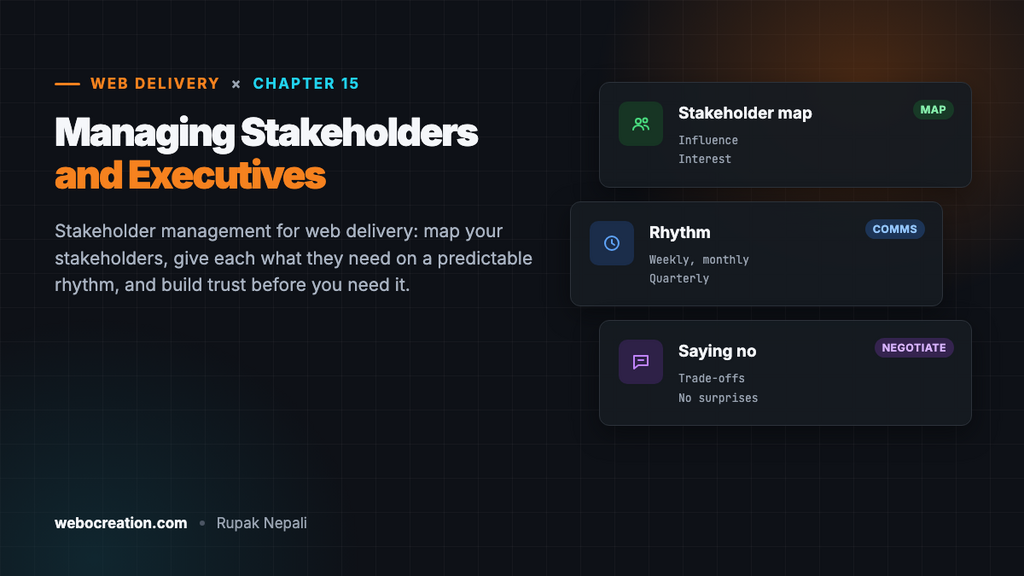
Stakeholder management for web delivery: map your stakeholders, give each what they need on a predictable rhythm, and build trust before you need it.
 Rupak NepaliPublished Nov 26, 2026
This is Chapter 15 of The Web Delivery Manager’s Playbook, a free series on running enterprise websites from request to release. Stakeholder management for web delivery: map your stakeholders, give each what they need on a predictable rhythm, and build trust before you need it.
Six months into the job, Maya had a working intake process, a roadmap and safe releases. Most stakeholders were happy. One was not. The head of a business unit, Daniel, had a habit of going directly to developers, asking for “small favors,” and announcing launch dates in leadership meetings before anyone on the web team had heard of the project. When his requests were ranked behind others, he complained to the CMO that the web team was slow and bureaucratic.
Maya’s first instinct was to escalate. Instead, she asked Daniel for coffee. In 30 minutes, she learned what nobody had asked him before: his business unit had missed its targets two quarters in a row, his job was under pressure, and he believed the website was one of the few things he could change quickly. He was not trying to break the process. He was trying to survive.
Stakeholder management is not about controlling people. It is about understanding what they need, and helping them get it through a process that also works for everyone else.
Stakeholder management with a simple map
Who your stakeholders are
A stakeholder is anyone who affects, or is affected by, the web program. For a corporate web program, the list is long:
- Executives: the CMO, CIO or CTO, business unit heads, sometimes the CEO’s office.
- Requesters: marketing managers, product marketers, communications, HR, regional teams.
- Gatekeepers: legal, compliance, privacy, security, brand.
- Partners: IT infrastructure, the service desk, the ServiceNow team, data and analytics.
- External parties: agencies, vendors, and sometimes regulators or auditors.
- Your own team: developers, editors, designers and QA.
You cannot give everyone the same attention. You need a way to decide who needs what.
Mapping stakeholders
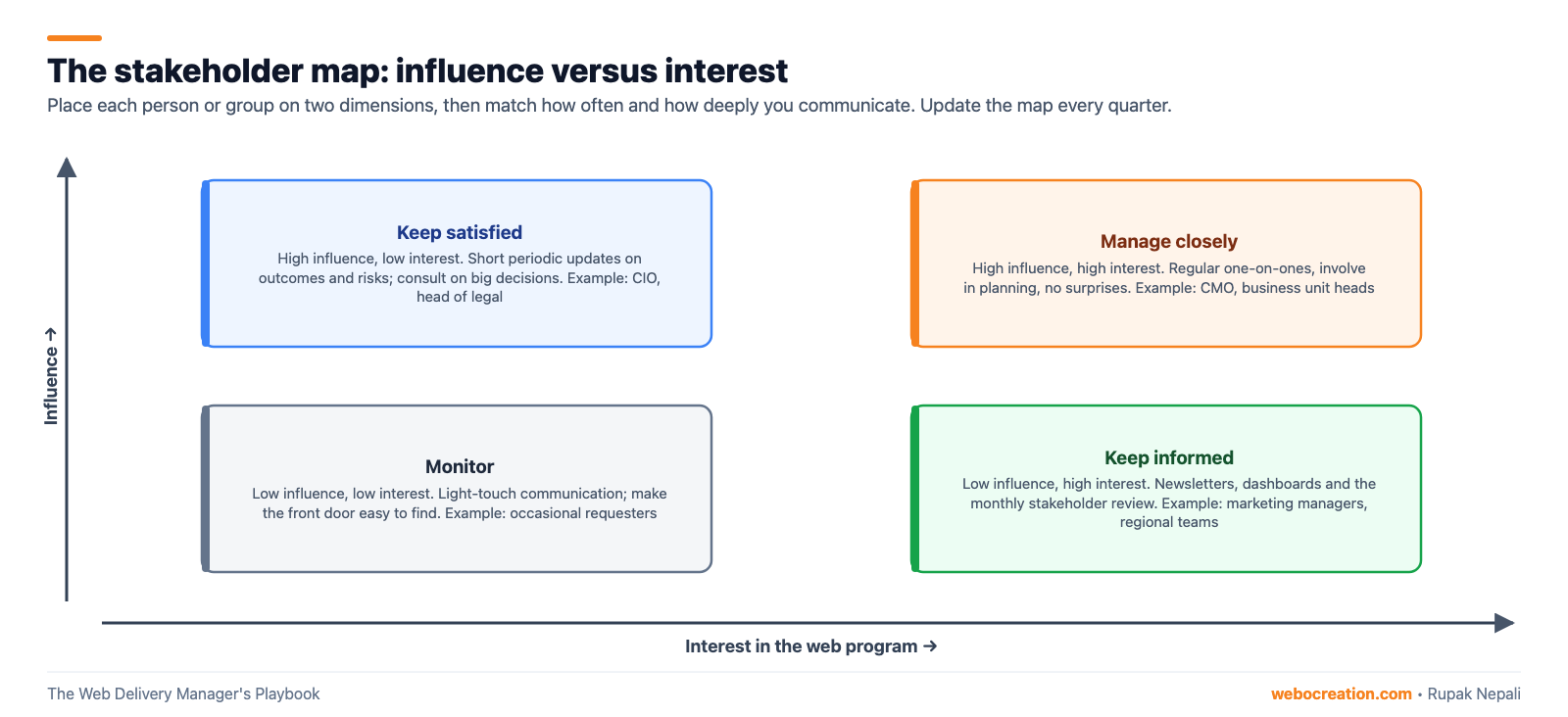
A stakeholder map places each person or group on two dimensions: how much influence they have over the web program, and how much interest they have in it. This creates four groups, each with a different approach.
| Group | Influence | Interest | Approach |
|---|---|---|---|
| Manage closely | High | High | Regular one-on-ones; involve in planning; no surprises. Example: CMO, main business unit heads |
| Keep satisfied | High | Low | Short, periodic updates focused on outcomes and risks; consult on big decisions. Example: CIO, head of legal |
| Keep informed | Low | High | Regular updates through newsletters, dashboards and the stakeholder review. Example: marketing managers, regional teams |
| Monitor | Low | Low | Light-touch communication; make the front door easy to find. Example: occasional requesters |
Build your map in the first 90 days (Chapter 4) and update it every quarter. People move roles, and influence shifts. A new executive with a digital agenda can move from “monitor” to “manage closely” overnight.
Understanding what each stakeholder needs
For every stakeholder in the “manage closely” and “keep satisfied” groups, write a short profile:
- What do they care about? Their goals, targets and pressures.
- What does the website do for them? Leads, applications, brand, compliance, investor relations.
- What worries them? Missed launches, outages, legal risk, cost.
- How do they like to communicate? Short emails, dashboards, meetings, chat.
- What have they experienced before? A past failure can shape how someone sees the web team for years.
Daniel’s profile changed everything. Once Maya understood that he needed visible wins quickly, she could help him plan smaller, faster releases instead of one large microsite. The requests did not stop. They became better requests.
The communication rhythm
Stakeholders want different information at different frequencies. A simple rhythm covers most needs:
| Communication | Audience | Frequency | Content |
|---|---|---|---|
| Request notifications | Requesters | Per request | Status changes in plain language (Chapter 9) |
| Release notes | Requesters, interested stakeholders | Each release | What went live, with links |
| Monthly web update | All stakeholders | Monthly | Delivered work, upcoming work, metrics, risks, decisions needed |
| Stakeholder review meeting | Manage-closely and key requesters | Monthly | Discuss priorities, trade-offs and roadmap changes |
| Executive summary | Executives | Monthly or quarterly | One page: outcomes, risks, decisions, asks (Chapter 22) |
| One-on-ones | Manage-closely stakeholders | Every two to six weeks | Their priorities, concerns and upcoming needs |
The monthly web update is the backbone. Keep it to one screen. Lead with what was delivered and what it achieved, then what is coming, then any risks or decisions. Link to the roadmap and dashboards for people who want detail.
Running the monthly stakeholder review
The monthly stakeholder review is where trade-offs are decided. Without it, every conflict between business units comes to you to settle privately, which puts you in an impossible position.
Keep the meeting to 45 minutes, with a standing agenda:
- Delivered last month (5 minutes): highlights, with outcomes where known.
- Performance (5 minutes): key site and delivery metrics.
- Coming next (10 minutes): this month’s planned work and roadmap changes.
- Decisions needed (20 minutes): conflicts between priorities, scope changes, overrides, budget.
- Risks (5 minutes): anything stakeholders should know.
The decisions section is the most important. Prepare it carefully: for each decision, present the options, the trade-offs and your recommendation. Then let the stakeholders decide. When two business units compete for the same capacity, the decision belongs to the person accountable for both, not to you.
Handling common stakeholder situations
The surprise launch date
An executive announces a launch date in a leadership meeting without checking with the web team. Do not say it is impossible in public. Within a day, go to the executive with a short plan: what can be delivered by that date, what cannot, and what it would take to deliver everything. Offer a phased launch if possible: a simple version on the announced date, with more to follow.
Then work on prevention. Ask executives to check dates with you before announcing them, and make it easy: “Send me a two-line message and I’ll tell you within a day if the date works.”
The HiPPO
HiPPO stands for “highest paid person’s opinion.” When a senior leader wants a design or content decision that conflicts with data, brand standards or accessibility, start by understanding the goal behind the request. Often there is a good reason. Offer evidence, such as analytics, test results or accessibility requirements, and suggest a test where possible. If the leader still wants their way and it does not create legal, accessibility or security risk, it is often right to do it and measure the result. Choose your battles. Hold firm on risk, not on taste.
The “make the logo bigger” request
Some requests reflect personal preferences rather than business needs. Route them through brand standards and the RACI. If brand is accountable for visual identity, brand decides. Your job is to make sure the right person decides, not to have an opinion on the logo.
The stakeholder who bypasses the process
Like Daniel, some stakeholders go directly to developers or skip the front door. Start with a private conversation to understand why. Usually the process is not meeting their need, and you can adjust it. If they continue after that, ask the developers to redirect them kindly, and back the developers up. If necessary, raise the pattern with their manager or the CMO, presented as a problem to solve rather than a complaint.
The unhappy executive
When an executive is frustrated with the web team, do not defend. Listen, ask for specific examples, and look at the data together. Often the frustration comes from one bad experience or a lack of visibility. Fix what is real, show progress, and add them to your one-on-one rhythm.
Saying no to senior people
Chapter 6 covered saying “not now” with data. With senior people, a few extra points help:
- Never say no in public. Take the conversation offline and come back quickly with options.
- Lead with what you can do. “We can deliver the first two pages by Thursday and the rest the following week” lands better than “We can’t do all of it by Thursday.”
- Make the trade-off theirs. “To do this, we would need to move the product launch pages. Is that the right call?”
- Put it in writing afterwards. A short follow-up email records the decision and its cost.
Building trust before you need it
The best time to build relationships with stakeholders is when nothing is going wrong. Some simple habits help:
- Share wins that matter to them, not just to the web team.
- Ask about their upcoming plans before they become urgent requests.
- Admit mistakes quickly and explain what you are doing about them.
- Keep promises, especially small ones. Reliability on small things earns trust on big ones.
- Give credit to their teams when launches go well.
Webocreation Group: Daniel, six months later
After the coffee, Maya added Daniel to her monthly one-on-one rhythm and helped his team plan a series of small, quick releases: updated product pages, a new lead form, a comparison tool. Each one launched within three weeks. His business unit’s web leads grew steadily, and he began presenting the results in leadership meetings, crediting the web team by name.
The side-channel requests stopped. When the CMO asked how she had managed it, Maya said, “I stopped treating him as a problem and started treating him as a customer.”
Template: Stakeholder map and communication plan
| Stakeholder | Influence | Interest | Group | What they care about | Channel and frequency | Owner |
|---|---|---|---|---|---|---|
| CMO | High | High | Manage closely | Brand, leads, launch dates | One-on-one every 2 weeks; monthly summary | Delivery manager |
| Head of legal | High | Low | Keep satisfied | Regulatory risk, review workload | Short email, monthly | Delivery manager |
| Business unit head | High | High | Manage closely | Targets, speed, visibility | One-on-one, monthly | Delivery manager |
| Marketing managers | Low | High | Keep informed | Request status, timelines | Notifications; monthly update | Content lead |
| Regional teams | Low | Medium | Keep informed | Local content, translations | Monthly update | Content lead |
Checklist
- Build a stakeholder map using influence and interest.
- Write a short profile for every “manage closely” and “keep satisfied” stakeholder.
- Set up the communication rhythm, starting with a monthly web update.
- Run a monthly stakeholder review with a standing agenda and a decisions section.
- Prepare a playbook for surprise launch dates and executive overrides.
- Schedule regular one-on-ones with key stakeholders, even when nothing is wrong.
- Review the stakeholder map every quarter.
Common traps
- Treating difficult stakeholders as enemies. Most are under pressure you cannot see. Ask.
- Deciding trade-offs yourself. When business units compete, the accountable leader decides.
- Saying no in public. Take it offline and come back with options.
- Communicating only when there is a problem. Build trust when things are going well.
- Fighting about taste. Hold firm on risk; let others decide on preference.
Related reading
- AI adoption: from pilots to scaled business value
- Chapter 14: Incidents, Outages and Post-Mortems
- Chapter 16: Working with Agencies and Contractors

Rupak Nepali is a web developer, manage Webocreation website and the author of six books:
Getting Started with OpenCart Module Development (Packt, 2013),
OpenCart Theme and Module Development (Packt, 2015),
OpenCart 4: Dev Guide for Themes & Extensions (2024),
OpenCart 4: User Manual (2025),
Cloudflare for the Enterprise Website (2026) and
The Technical Web Guide for Marketers (2026).
Rupak has built OpenCart stores and extensions since 2010, has published more than 600 tutorials on Webocreation, and shares free OpenCart extensions on GitHub.
Find Rupak on
GitHub | Amazon | LinkedIn | X | YouTube.