Do AI Content Detectors Work? What OpenAI, Independent Research and Google Say
OpenAI withdrew its own AI detector, independent studies show detectors are easy to fool and biased against non-native writers, and Google judges quality, not authorship.
 Rupak NepaliPublished Nov 24, 2026
Paste a paragraph into an AI content detector and you get a confident number: “87% AI”. Writers get rejected on that number, students get accused, and store owners run their product descriptions through detectors in case Google “catches” them. Before you act on such a score, it helps to know how detectors have performed when someone other than the vendor tested them, and what Google actually checks.
Short answer: AI content detectors are unreliable enough that a score on its own shouldn’t decide anything, and Google doesn’t use them to rank your pages. The evidence follows.
OpenAI withdrew its own AI detector
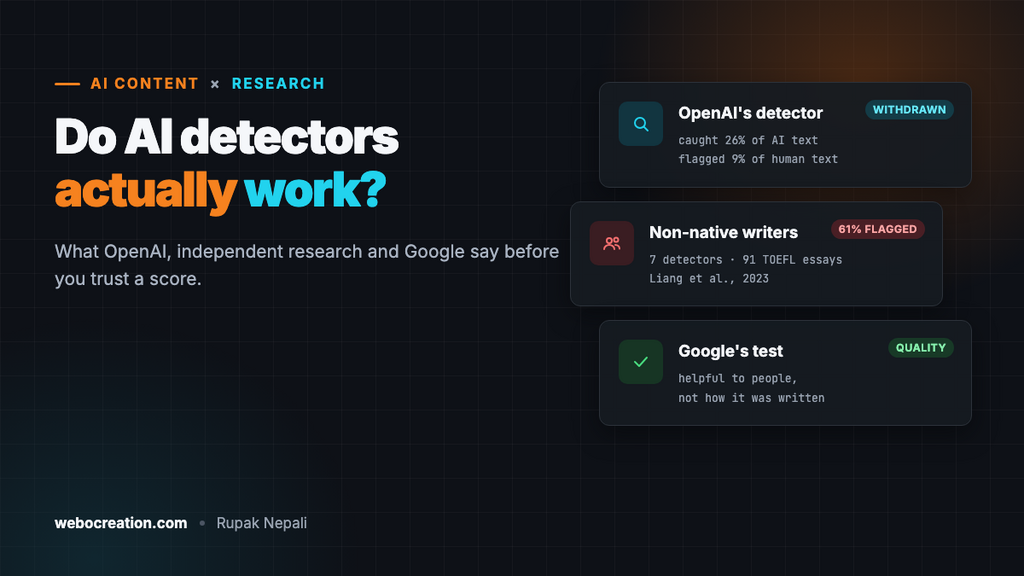
In January 2023 OpenAI, the company behind ChatGPT, released a classifier for spotting AI-written text. In its own evaluation it correctly identified 26% of AI-written text as “likely AI-written” and wrongly labelled human-written text as AI-written 9% of the time. OpenAI said it “should not be used as a primary decision-making tool” and that it was “very unreliable on short texts (below 1,000 characters)”. On July 20, 2023 it withdrew the tool “due to its low rate of accuracy” (OpenAI).
If the company with the most access to its own model’s output couldn’t make a dependable detector, treat any vendor’s accuracy claim with care.
AI content detectors and non-native English writers
The best-known independent study is Liang et al., “GPT detectors are biased against non-native English writers”, published in the journal Patterns in 2023 (arXiv). The researchers ran seven widely used detectors on 91 TOEFL essays written by non-native English speakers and 88 essays by US eighth-graders, all written by people:
- The detectors were near-perfect on the US students’ essays.
- They labelled more than half of the TOEFL essays as AI-generated, with an average false positive rate of 61.22%.
- 89 of the 91 TOEFL essays (97.8%) were flagged as AI by at least one detector, and 18 were flagged by all seven.
- When the essays were run through ChatGPT just to vary the word choice, the false positive rate dropped to 11.77%: the “more AI” versions looked less like AI to the detectors.
The reason: detectors look for predictable, low-variety wording, and that also describes careful writing in a second language, and much short technical text such as product specifications.
Detectors are easy to fool
The RAID benchmark tested 12 detectors on more than 6 million generated texts from 11 models, across 8 domains, 11 kinds of adversarial edits and 4 decoding settings. Its finding: “current detectors are easily fooled by adversarial attacks”, by changes in sampling settings, and by models they hadn’t seen. The authors also point out that many commercial detectors advertise 99% accuracy or more without testing on a shared benchmark RAID paper.
So detectors miss AI text that has been lightly edited or paraphrased, and they flag human text that happens to be plain and predictable. Both errors happen in normal use, without anyone trying to cheat.
What Google says about AI content
Google’s position hasn’t changed since February 2023. From its Search Central post on AI content:
- “Appropriate use of AI or automation is not against our guidelines.”
- “Using AI doesn’t give content any special gains. It’s just content.”
- Google focuses “on the quality of content, rather than how content is produced”.
- What breaks the rules is using automation, including AI, “with the primary purpose of manipulating ranking in search results”.
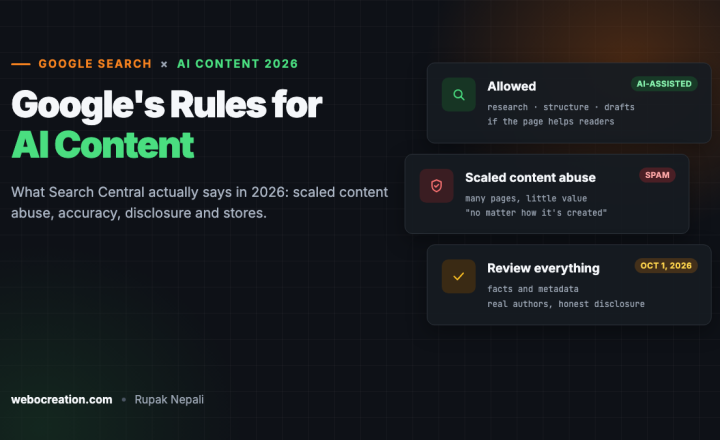
Google’s spam policies describe that as scaled content abuse: “many pages are generated for the primary purpose of manipulating search rankings and not helping users”, “no matter how it’s created”. The example they give is “using generative AI tools or other similar tools to generate many pages without adding value for users”.
Google judges whether a page helps the person searching. Running your pages through a third-party detector tells you nothing about that. We cover the rest of Google’s 2026 rules in Google’s AI content rules in 2026.
What this means for store owners
- Don’t rewrite good product copy to beat a detector. Making accurate text “less predictable” to lower a score can make it worse for shoppers and does nothing for Google.
- Check what matters instead: correct specifications, real dimensions and materials, answers to the questions customers ask, and your own photos. Add what you know that the manufacturer’s text doesn’t say.
- Avoid scale without value. Hundreds of near-identical AI pages for every color and city is the pattern Google’s spam policy describes, whoever wrote them.
- Use AI where it saves time and a person checks the result, for example a first draft of a description that you then correct. Our AI Description Generator for OpenCart works that way.
If you hire writers or review submissions
- Treat a detector score as a reason to look closer, never as proof. The Liang study shows the people most likely to be wrongly flagged are those writing in a second language.
- Look for evidence that is harder to fake: drafts and edit history, sources that check out, details only someone who did the work would know, and whether the writer can talk through the piece.
- Agree on rules up front: when AI help is fine (outlines, grammar) and when it isn’t.
Related
- AI-generated product images: Merchant Center’s IPTC label and why OpenCart’s image cache strips it.
- Catalog on autopilot: product imports, AI descriptions and feeds.

Rupak Nepali is a web developer, manage Webocreation website and the author of six books:
Getting Started with OpenCart Module Development (Packt, 2013),
OpenCart Theme and Module Development (Packt, 2015),
OpenCart 4: Dev Guide for Themes & Extensions (2024),
OpenCart 4: User Manual (2025),
Cloudflare for the Enterprise Website (2026) and
The Technical Web Guide for Marketers (2026).
Rupak has built OpenCart stores and extensions since 2010, has published more than 600 tutorials on Webocreation, and shares free OpenCart extensions on GitHub.
Find Rupak on
GitHub | Amazon | LinkedIn | X | YouTube.