Explain how search engines crawl, index, and rank pages, and how AI-generated answers change search.
Conduct keyword research and classify search intent using free tools and AI.
Build topic clusters that establish authority.
Optimize a page for on-page SEO and write titles and meta descriptions that earn clicks.
Run a basic technical SEO audit using Google Search Console and free crawlers.
Adapt your strategy for AI Overviews and answer engines (sometimes called generative engine optimization, or GEO).
Measure SEO performance and report it clearly.
How search works
Search engines do three things:
Crawl. Automated programs (Google’s is called Googlebot) follow links across the web and fetch pages.
Index. The engine analyzes each page’s content, structure, and signals, and stores it in an enormous database.
Rank. When someone searches, the engine selects and orders the most relevant, helpful, and trustworthy results from the index in a fraction of a second.
Google uses hundreds of signals, and the exact weightings are not public, but they cluster into a few understandable themes:
Relevance: Does the page actually address what the searcher wants?
Quality and helpfulness: Is it accurate, thorough, original, and written for people rather than to manipulate rankings?
Experience, expertise, authoritativeness, and trustworthiness (E-E-A-T): Google’s quality rater guidelines use this framework to describe content that demonstrates first-hand experience and comes from credible sources. It matters most for “your money or your life” topics such as health and finance.
Authority signals: Links from other reputable websites remain an important signal that a page is trusted.
Page experience: Mobile friendliness, security (HTTPS), reasonable speed, and an absence of intrusive interstitials. Google’s Core Web Vitals measure loading (Largest Contentful Paint), responsiveness (Interaction to Next Paint), and visual stability (Cumulative Layout Shift).
Context: The searcher’s location, language, device, and the freshness of information.
Search in the age of AI answers
The search results page has changed. For many queries, Google now shows an AI Overview: a generated summary at the top of the page with links to sources. Google also offers AI Mode, a conversational search experience. Meanwhile, ChatGPT, Gemini, Claude, Perplexity, and Microsoft Copilot answer questions directly, often citing web pages.
What this means for marketers:
Informational, simple queries get fewer clicks. If someone asks “how many grams of coffee per cup,” the answer may be given directly. Traffic to pages that only answer simple facts has declined for many publishers.
Being cited is the new ranking. AI answers draw on pages that are clear, well-structured, authoritative, and easy to extract facts from. Being the cited source builds brand visibility even without a click.
Commercial and complex queries still drive clicks. When people compare products, plan purchases, or need depth, they still visit websites, and they arrive better informed.
Brand matters more. When AI summarizes options, recognizable brands with consistent mentions across the web are more likely to be included.
The fundamentals still apply. Google states that the same SEO best practices that help pages rank also make them eligible to appear in AI features. There is no secret trick; there is helpful, well-structured, crawlable content from a credible source.
Keyword research
A keyword is a word or phrase people type (or speak) into a search engine. Keyword research is the process of discovering which phrases your audience uses, how often, how competitive they are, and what the searcher really wants.
The four types of search intent
Every query has an intent. Matching your page to the intent is the single most important on-page decision.
Intent
The searcher wants to…
Example queries
Best page type
Informational
Learn something
“how to brew pour over coffee,” “what is single origin coffee”
Guide, tutorial, explainer, video
Navigational
Go to a specific site
“brightleaf coffee login,” “starbucks menu”
Home page, login, specific page
Commercial investigation
Compare options before buying
“best coffee subscription,” “trade vs atlas coffee”
The fastest way to determine intent is to search the keyword yourself and look at what ranks. If the top ten results are all buying guides, Google has decided the intent is commercial investigation, and a product page will struggle to rank.
Key keyword metrics
Search volume: average monthly searches. Useful for prioritization, but estimates vary widely between tools.
Keyword difficulty: a tool’s estimate of how hard it is to rank, usually based on the strength of pages already ranking.
Cost per click (CPC): what advertisers pay in Google Ads. High CPC often signals commercial value.
Trend: whether interest is rising, falling, or seasonal (check Google Trends).
Head terms and long-tail keywords
Head terms are short, broad, high-volume, and competitive (“coffee beans”). Long-tail keywords are longer, more specific, lower volume, and usually easier to rank for, with clearer intent (“best low acid coffee beans for french press”). New websites should target long-tail keywords first; they convert well and build the authority needed to compete for head terms later.
Tools
Free: Google Search Console (your own site’s actual queries), Google Keyword Planner (inside Google Ads), Google Trends, Google’s autocomplete and “People also ask” boxes, AnswerThePublic (limited free use), and AI assistants.
Paid: Semrush, Ahrefs, Moz, and similar platforms provide volume, difficulty, competitor keyword data, and backlink analysis. Most offer free trials, which are worth using for your portfolio assignment.
AI-powered keyword research workflow
AI assistants do not have reliable search volume data on their own, so use them for expansion, classification, and clustering, and use dedicated tools for volume and difficulty.
Prompt 3.1: Seed expansion Act as an SEO strategist. My business is [description], targeting [audience]. Generate 60 keyword ideas a customer might search at different stages of their journey. Include informational, commercial, and transactional queries, and emphasize long-tail phrases with clear intent. Group them by journey stage. Do not invent search volumes.
Prompt 3.2: Intent classification and clustering Here is a list of keywords with monthly search volumes from [tool]: [paste list]. Classify each by search intent. Then group them into topic clusters where one page could rank for all keywords in the cluster. For each cluster, suggest a primary keyword, a page title, the page type, and a priority based on volume, intent, and relevance to a business that sells [product]. Output as a table.
Prompt 3.3: Question mining List 30 specific questions that [persona] asks before buying [product]. Phrase them exactly as a real person would type them into Google or ask an AI assistant. Mark which ones would likely get an AI Overview and which would likely lead to clicks.
Topic clusters and site architecture
Search engines reward sites that cover a subject comprehensively. A topic cluster model organizes content into:
A pillar page: a comprehensive guide to a broad topic (for example, “The Complete Guide to Brewing Coffee at Home”).
Cluster pages: detailed articles on subtopics (“How to Brew Pour-Over Coffee,” “French Press Ratio Guide,” “Best Grind Size for Each Brew Method”).
Internal links connecting the cluster pages to the pillar and to each other.
This structure helps search engines understand your expertise, helps users navigate, and spreads authority across related pages. For Brightleaf, sensible clusters might be: brewing methods, coffee origins, coffee subscriptions and gifting, and coffee gear.
On-page SEO
On-page SEO is everything you control on the page itself.
Checklist for every important page:
Title tag. Include the primary keyword near the start, keep it roughly 50 to 60 characters so it is not truncated, and make it compelling. Example: “Pour-Over Coffee Guide: Ratios, Grind & Technique | Brightleaf.”
Meta description. Not a direct ranking factor, but it influences clicks. About 140 to 160 characters, a clear benefit, and a reason to click. Google may rewrite it.
One H1 heading that matches the topic, and logical H2 and H3 subheadings that reflect the questions searchers ask.
Answer first. Give a direct answer to the core question early on, then go deeper. This serves impatient readers and makes your content easy for AI systems to cite.
Comprehensive, original content. Cover the subtopics competitors cover, then add something they don’t: original photos, test results, expert quotes, data, or first-hand experience.
Internal links to related pages with descriptive anchor text.
Images with descriptive file names, alt text for accessibility, and compression for speed.
Structured data (schema markup). Code that labels your content (Product, Review, FAQ, HowTo, Article, Organization, LocalBusiness) so search engines can understand it and potentially show rich results.
Author and trust signals. Author bios with real credentials, an About page, contact information, and clear sourcing.
Prompt 3.4: Title and meta description options Write 5 title tag options (under 60 characters) and 5 meta descriptions (under 155 characters) for a page targeting “[keyword].” The page is [description]. The audience is [audience]. Each option should include the keyword naturally, communicate a specific benefit, and differ in angle (for example, speed, expertise, completeness, price, freshness). Show the character count for each.
Prompt 3.5: Content brief Create an SEO content brief for an article targeting “[primary keyword]” with secondary keywords [list]. Include: search intent, target reader, recommended word count range, H1, a full H2/H3 outline based on the questions searchers ask, key points to cover in each section, opportunities to add original experience or data, internal links to include from this list [list of your URLs], an FAQ section with five questions, and suggested schema types.
Prompt 3.6: Content gap analysis I’ve pasted the headings from the top 5 ranking pages for “[keyword]” below. Identify the subtopics all of them cover (table stakes), the subtopics only some cover, and important questions none of them answer well. Recommend how my page can be meaningfully better, not just longer.
Technical SEO
Technical SEO makes sure search engines can find, crawl, render, and index your pages. You don’t need to be a developer, but you need to spot problems and explain them to one.
Core technical checks:
Indexing: Use the Pages report in Google Search Console to see which pages are indexed and why others are not.
XML sitemap: A file listing your important URLs, submitted in Search Console.
Robots.txt: A file telling crawlers which areas not to crawl. A mistaken rule can block your whole site. (It also controls access by many AI crawlers, which is now a strategic decision for publishers.)
Canonical tags: Tell search engines which version of a duplicate or similar page is the main one.
Redirects: Use 301 (permanent) redirects when URLs change; fix chains and loops.
Broken links and 404 errors: Fix or redirect.
Mobile usability: Google primarily uses the mobile version of a site for indexing (mobile-first indexing).
Page speed and Core Web Vitals: Check with PageSpeed Insights and the Core Web Vitals report in Search Console.
HTTPS: Every page should be secure.
JavaScript rendering: Content that only appears after complex scripts run can be missed or delayed.
Free tools: Google Search Console, PageSpeed Insights, the Rich Results Test, and Screaming Frog SEO Spider (free for up to 500 URLs).
Prompt 3.7: Technical audit triage I ran a crawl of my site with Screaming Frog. Here is a summary of the issues: [paste issue summary or CSV extract]. Prioritize these issues by likely SEO impact and effort to fix. For each high-priority issue, explain in plain language why it matters, how to fix it, and how I would explain it to a developer in a ticket.
Off-page SEO and link building
Links from other reputable sites remain a strong signal of authority. Earn them; don’t buy them. Paid links and link schemes violate Google’s spam policies and can trigger penalties.
Sustainable link-building tactics:
Create linkable assets: original research, surveys, data studies, free tools, calculators, and definitive guides that journalists and bloggers want to cite. (“We surveyed 1,000 home brewers about their morning routines” is far more linkable than another brewing guide.)
Digital PR: pitch stories and data to journalists. Services that connect journalists with expert sources can help.
Partnerships: suppliers, partners, and local organizations may link to you.
Unlinked brand mentions: find articles that mention your brand without linking and ask politely for a link.
Broken link building: find broken links on relevant sites and suggest your content as a replacement.
Local SEO matters for any business with a physical location or service area: claim and complete your Google Business Profile, keep your name, address, and phone number consistent across directories, gather reviews, and respond to them.
Optimizing for AI answers (GEO)
Generative engine optimization is an emerging practice focused on being included and cited in AI-generated answers. The field is young, best practices are still forming, and many claims you will read online are speculative. These principles are consistent with how the systems work and with Google’s own guidance:
This section introduces the essentials. Chapter 4 is devoted entirely to AI search and generative engine optimization.
Be the clearest answer. Use question-based headings and answer directly in the first sentence or two beneath them.
Structure for extraction. Use lists, tables, definitions, step-by-step instructions, and summary boxes.
Offer something original. First-hand testing, original data, expert perspective, and unique examples give AI systems a reason to cite you rather than the hundred similar pages.
Build brand presence across the web. Mentions in reputable publications, reviews, forums, and communities increase the chance an AI system associates your brand with a topic.
Keep facts current and consistent. Product details, prices, and company information should match across your site, your Google Business Profile, and third-party listings.
Make content crawlable. Ensure your pages are indexable, and make a deliberate decision about which AI crawlers you allow in robots.txt.
Track visibility. Regularly ask AI assistants the questions your customers ask and record whether your brand appears. Several SEO platforms now offer AI visibility tracking.
Prompt 3.8: AI visibility check I want to understand how AI assistants see my brand. Answer the following questions as you would for a typical user, and list any brands you would mention: [5 to 10 customer questions, such as “What’s the best coffee subscription for pour-over fans?”]. (Run this in multiple assistants, record results monthly, and note which sources are cited.)
Measuring SEO
Key SEO metrics:
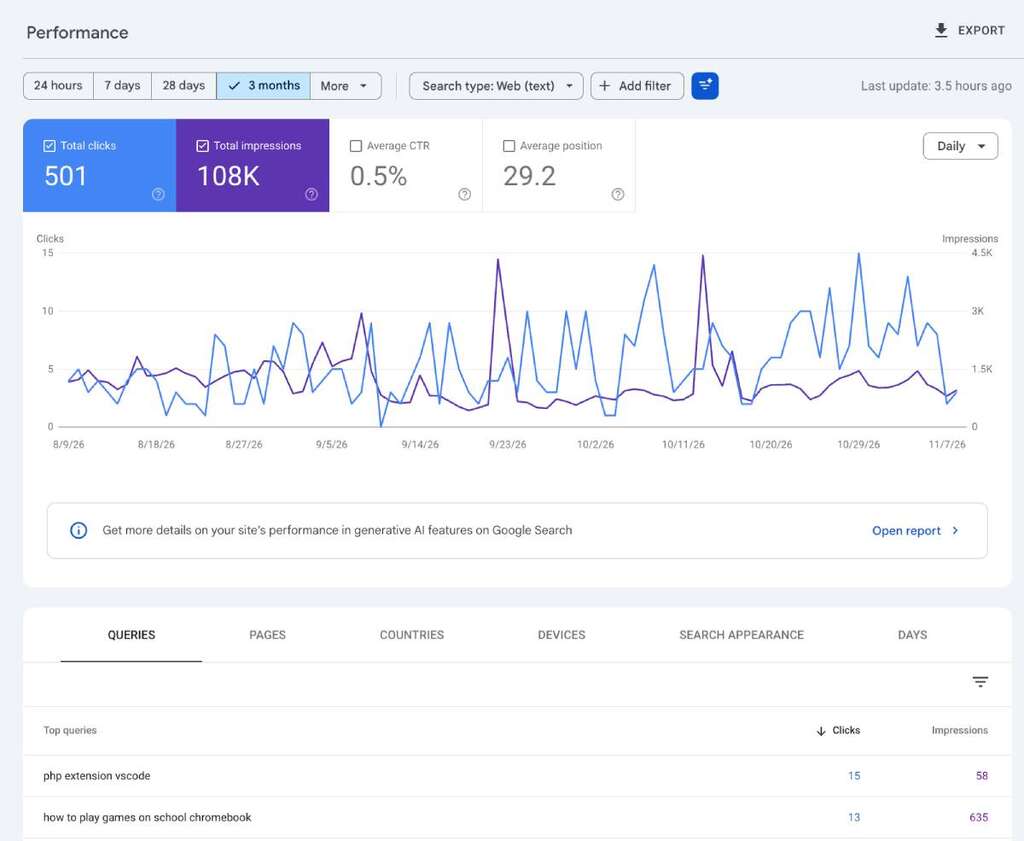
Impressions, clicks, CTR, and average position (Google Search Console).
Organic sessions, engagement, and conversions (Google Analytics 4, filtered to the Organic Search channel).
Keyword rankings for priority terms (a rank tracking tool).
Indexed pages and technical health.
Backlinks and referring domains.
AI visibility: citation and mention tracking in AI answers.
Remember that SEO is slow. New content often takes weeks to months to reach its potential. Report on trends over quarters, not days, and tie organic traffic to conversions and revenue whenever possible.
Hands-on exercises
Exercise 3.1: Intent detective (20 minutes). Search these five queries and note the type of pages that rank and whether an AI Overview appears: “coffee subscription,” “how to make cold brew,” “best burr grinder under 100,” “ethiopian yirgacheffe,” “brightleaf coffee.” Classify each by intent.
Exercise 3.2: Keyword list (45 minutes). Use Prompt 3.1 to generate keyword ideas, then check volumes in Google Keyword Planner or a free trial of an SEO tool. Build a spreadsheet of 50 keywords with volume, difficulty (if available), intent, and funnel stage.
Exercise 3.3: On-page audit (30 minutes). Choose any small business web page. Evaluate it against the ten-point on-page checklist. Rewrite its title tag and meta description using Prompt 3.4.
Exercise 3.4: Search Console tour (30 minutes). If you have access to any website’s Search Console (your own blog counts; Google also provides a demo account for Analytics but not Search Console, so a free blog on your own domain is ideal), find the top 10 queries by impressions and identify one with high impressions but low CTR. Write a new title tag to improve it.
Strategic assignment: SEO audit and keyword strategy
Produce an SEO Audit and Strategy report (8 to 12 slides or pages) for your chosen business:
Executive summary: three key findings and three priority recommendations.
Technical health: results of a crawl (Screaming Frog free version) and PageSpeed Insights, with prioritized fixes.
On-page review: audit of five key pages with specific rewrites.
Keyword strategy: 50+ keywords organized into 4 to 6 topic clusters with intent and priority.
Content plan: a pillar page and five cluster articles, each with a content brief (use Prompt 3.5 and then edit).
AI visibility baseline: results from Prompt 3.8 across two assistants.
Link-building ideas: three linkable asset concepts.
Measurement plan: KPIs and targets for 3, 6, and 12 months.
AI log: prompts used and how you verified the output.
Key takeaways
Search engines crawl, index, and rank. Help them at every step.
Search intent comes first: match the page type to what the searcher wants.
Use AI for expansion, classification, clustering, and briefs; use SEO tools for volume and difficulty data.
Build topic clusters to demonstrate depth and authority.
AI answers reward clear, structured, original, trustworthy content from recognized brands. The fundamentals have not changed; the bar has risen.
 Rupak NepaliPublished Nov 10, 2026