
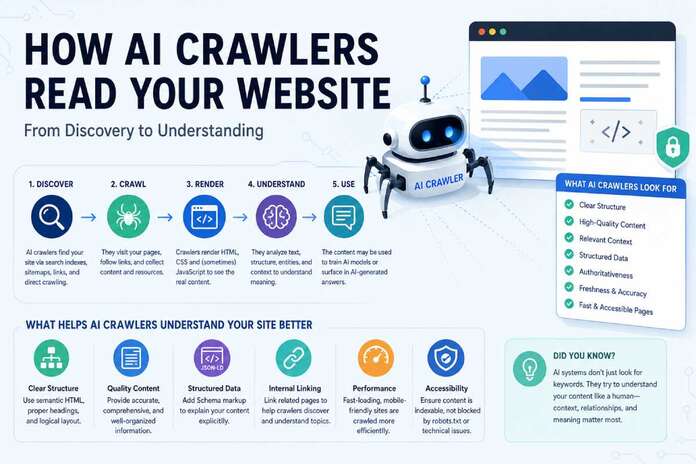

Search is changing.
Instead of typing a query into Google and clicking through a list of links, millions of users now ask ChatGPT, Claude, Gemini, Perplexity, and other AI assistants directly. These AI systems often summarize information, recommend products, compare services, and cite websites as sources.
For website owners, developers, and marketers, understanding how AI crawlers read your website has become just as important as understanding how Googlebot works.
In this guide, we’ll explain how AI crawlers work, what content they prefer, and how to make your website easier for large language models (LLMs) to understand.
What Are AI Crawlers?
AI crawlers (sometimes called AI bots or LLM crawlers) are automated programs that collect publicly available web content for:
- Training language models
- Keeping AI knowledge fresh
- Retrieving information for AI-generated answers
- Powering AI search engines
Unlike traditional search engines, AI systems don’t simply index pages for keyword matching—they aim to understand the meaning, context, relationships, and structure of your content.
Traditional Search Crawlers vs AI Crawlers
| Traditional Search | AI Crawlers |
|---|---|
| Index pages | Understand content |
| Match keywords | Understand meaning |
| Rank links | Generate answers |
| Focus on backlinks | Focus on authority and clarity |
| Return search results | Produce conversational responses |
Traditional SEO is still important, but AI introduces a new layer of optimization centered on content quality and machine readability.
Popular AI Crawlers
Several organizations operate crawlers that may access your site.
- OpenAI
- Anthropic
- Google AI
- Microsoft AI
- Perplexity AI
- Apple Intelligence
- Meta AI
Each platform has its own crawling, licensing, and retrieval policies, but they all rely on high-quality, structured, and accessible content.
How AI Crawlers Discover Your Website
Most AI systems discover websites through one or more of these methods:
Search Engine Indexes
Many AI assistants rely on search indexes from providers such as Google or Bing to locate relevant pages.
Direct Crawling
Some organizations maintain dedicated crawlers that fetch publicly accessible pages directly.
XML Sitemaps
A sitemap helps crawlers discover:
- new pages
- updated articles
- product pages
- documentation
- category pages
Always keep your sitemap current.
Internal Links
AI crawlers follow links similarly to traditional crawlers.
Good internal linking helps them understand:
- topic relationships
- page hierarchy
- important resources
External Links
Mentions from reputable websites reinforce topical authority and increase the likelihood that your content is discovered and trusted.
How AI Crawlers Read a Webpage
Once a crawler reaches your page, it evaluates much more than keywords.
1. HTML Structure
Semantic HTML helps machines understand the role of each element.
Prefer:
<article><section><header><main><nav><aside>
instead of generic nested <div> elements whenever appropriate.
2. Headings
A clear heading hierarchy provides context.
Example:
H1
 ├── H2
 │     ├── H3
 │     ├── H3
 ├── H2
 └── H2
Avoid skipping heading levels or using headings purely for styling.
3. Content Hierarchy
Well-organized pages are easier to interpret.
Use:
- introductions
- descriptive headings
- bullet lists
- comparison tables
- FAQs
- summaries
rather than long, unbroken paragraphs.
4. Context
AI models analyze how concepts relate to one another.
For example, a page about HubSpot Email Marketing should naturally reference related concepts such as:
- CRM
- workflows
- contacts
- automation
- personalization
- analytics
These relationships help AI build a richer understanding of the topic.
5. Entities
Modern AI identifies entities rather than just keywords.
Examples include:
- companies
- products
- people
- locations
- technologies
Instead of repeating a keyword unnaturally, clearly explain what the entity is and how it relates to other entities.
Structured Data Helps AI
Structured data provides explicit context.
Useful schema types include:
- Article
- BlogPosting
- Product
- Organization
- FAQ
- BreadcrumbList
- Person
- Review
- SoftwareApplication
Although schema doesn’t guarantee inclusion in AI answers, it makes content easier to interpret.
AI Loves Clear Writing
Large language models perform best with content that is:
- factual
- well organized
- complete
- easy to scan
- technically accurate
Avoid writing solely to satisfy search algorithms.
AI Prefers Complete Answers
Instead of writing: AI crawler
Write: An AI crawler is software that automatically visits websites to collect publicly available information for training language models or retrieving information used to answer user questions.
The second example provides context that machines can readily interpret.
Internal Linking Matters
AI systems often analyze relationships between pages.
A strong content cluster might look like:
AI SEO Guide
     │
     ├── llms.txt
     ├── AI Crawlers
     ├── AI Search
     ├── Structured Data
     ├── Robots.txt
     └── AI Analytics
This topical organization strengthens subject authority.
Technical Factors AI Crawlers Appreciate
Fast Websites
Slow pages reduce crawl efficiency.
Optimize:
- image sizes
- caching
- CDN usage
- JavaScript
- CSS delivery
Mobile-Friendly Design
Responsive layouts improve accessibility for both users and automated systems.
Clean HTML
Avoid unnecessary markup and ensure important content appears in the initial HTML whenever practical.
Stable URLs
Changing URLs frequently makes long-term discovery and referencing more difficult.
Can AI Read JavaScript?
Modern AI crawlers vary in their JavaScript rendering capabilities.
Server-rendered or statically generated content is generally easier to crawl than content that appears only after complex client-side rendering.
If critical content requires JavaScript, ensure it remains accessible and test how it appears to automated crawlers.
Can AI Read Images?
Yes—but AI still benefits from textual context.
Provide:
- descriptive alt text
- informative captions
- nearby explanatory content
- meaningful filenames where appropriate
Can AI Read PDFs?
Yes.
Many AI systems can process PDF documents, especially technical manuals, white papers, and documentation. Ensure PDFs contain selectable text rather than scanned images whenever possible.
Can AI Read Videos?
Indirectly.
AI systems rely on supporting information such as:
- transcripts
- captions
- titles
- descriptions
- chapter markers
Publishing transcripts improves accessibility and machine understanding.
Should You Block AI Crawlers?
Some publishers choose to block AI crawlers due to licensing or content concerns.
Others allow crawling to increase the likelihood that their content appears in AI-generated answers.
The right decision depends on your business goals, intellectual property strategy, and traffic model.
Best Practices for AI-Friendly Websites
Use this checklist to improve your site’s readability for AI systems:
- Write comprehensive, accurate content.
- Use semantic HTML.
- Keep heading structures logical.
- Publish descriptive titles.
- Add structured data.
- Maintain XML sitemaps.
- Strengthen internal linking.
- Improve page speed.
- Make content accessible.
- Update older articles regularly.
- Include clear author information.
- Demonstrate expertise with real examples and practical guidance.
Common Mistakes
Avoid these issues:
- Thin content
- Keyword stuffing
- AI-generated text without review
- Hidden text
- Broken internal links
- Poor HTML structure
- Missing metadata
- Duplicate content
- Outdated information
The Future of AI Crawling
AI systems are evolving beyond simply indexing web pages.
Increasingly, they evaluate:
- expertise
- originality
- freshness
- structured knowledge
- topical authority
- trustworthiness
Rather than optimizing for individual keywords, successful websites will organize information into connected knowledge hubs that answer real user questions comprehensively.
Final Thoughts
Traditional SEO isn’t disappearing—it is expanding.
The websites that perform best in AI-driven search are those that combine technical excellence with genuinely useful content. Focus on semantic structure, clear explanations, logical organization, and strong topical coverage.
If your content helps both humans and machines understand a topic, you’ll be well positioned for the next generation of search.
Frequently Asked Questions
What is an AI crawler?
An AI crawler is an automated program that collects publicly available web content to help train language models or retrieve information for AI-powered search and conversational systems.
Does ChatGPT crawl websites?
ChatGPT itself does not continuously crawl the web. Depending on the feature being used, OpenAI may use dedicated crawlers and retrieval systems to access publicly available content, while some responses rely on previously trained knowledge.
Do AI crawlers use robots.txt?
Many AI crawlers respect robots.txt directives, although support and policies vary by provider. Always review the documentation for the specific crawler if you intend to allow or restrict access.
Is structured data important for AI?
Yes. Structured data provides explicit information about your content, making it easier for AI systems to identify entities, relationships, and page purpose.
How can I optimize my website for AI search?
Publish high-quality content, use semantic HTML, implement structured data, maintain strong internal linking, improve page speed, and organize related content into topical clusters that demonstrate expertise.