20 AI Prompts to Improve Your eCommerce Website in 2026
 Rupak NepaliPublished Jul 16, 2026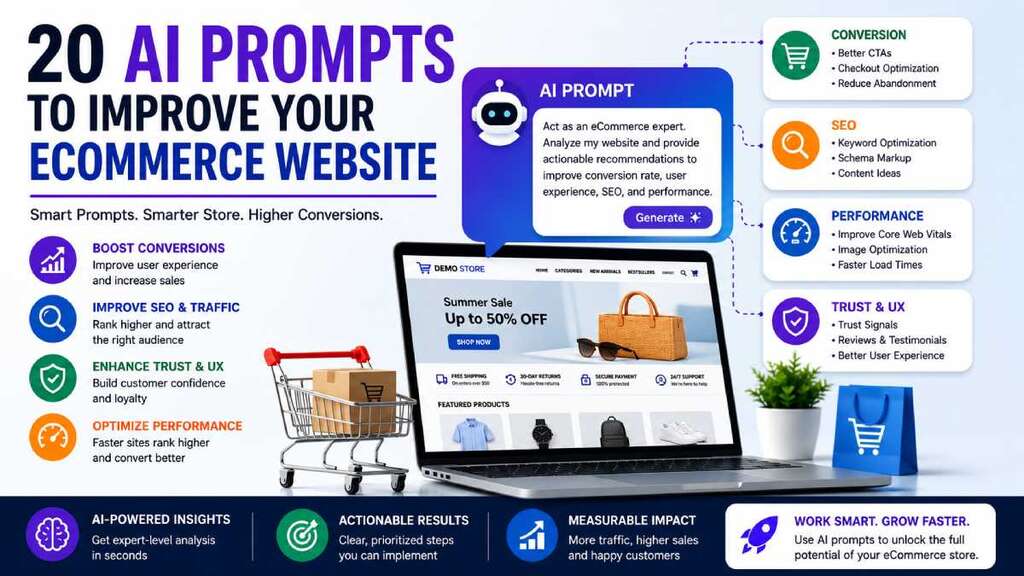
Artificial intelligence is quickly becoming one of the most valuable tools available to eCommerce store owners. Whether you run an online store on OpenCart, WordPress WooCommerce, Shopify, or another platform, AI can help you uncover usability problems, increase conversions, improve SEO, and optimize the customer journey.
The challenge isn’t whether AI can help your store — it’s knowing what questions to ask.
Below are 20 powerful prompts you can use with AI assistants such as ChatGPT, Claude, or Google Gemini to identify opportunities and improve your eCommerce website.
1. Homepage Conversion Audit
Prompt:
Analyze the homepage of my eCommerce store and provide 20 recommendations to improve conversion rate, trust signals, and user engagement.
Your homepage often determines whether visitors continue browsing or leave within seconds. AI can identify issues with messaging, layout, calls to action, and product presentation.
2. First-Time Visitor Experience Review
Prompt:
Pretend you are a first-time visitor arriving from Google search. What would confuse you, what would build trust, and what would prevent you from making a purchase?
Store owners know their websites too well. Viewing your site through the eyes of a new customer can reveal hidden friction points.
3. Call-to-Action Optimization
Prompt:
Review all CTA buttons on my website and suggest improvements to increase clicks and conversions.
Small changes such as button placement, wording, and color contrast can have a significant impact on sales.
4. Checkout Flow Analysis
Prompt:
Analyze my checkout flow and identify friction points that could cause cart abandonment.
Complicated checkouts remain one of the biggest causes of lost revenue for online stores.
5. Trust Signal Audit
Prompt:
What trust badges, guarantees, reviews, and policies should I add to increase customer confidence?
Trust signals reduce purchase hesitation and improve conversion rates.
6. UX Expert Review
Prompt:
Act as a senior UX designer and identify usability issues on my store. Prioritize fixes based on impact.
AI can often spot navigation issues and design inconsistencies that internal teams overlook.
7. Mobile Shopping Experience Audit
Prompt:
Review the mobile version of my website and list improvements for navigation, speed, and usability.
With mobile traffic accounting for the majority of eCommerce visits, mobile optimization is no longer optional.
8. Navigation and Category Optimization
Prompt:
Analyze my menu structure and recommend a better category hierarchy for easier product discovery.
Customers should be able to find products in just a few clicks.
9. Accessibility Review
Prompt:
Review my site for accessibility issues and provide fixes to improve WCAG compliance.
Accessibility improvements benefit all users and often improve SEO as well.
10. Visual Hierarchy Analysis
Prompt:
Evaluate whether users can easily identify important actions, products, and information on each page.
Good design guides visitors naturally toward conversion actions.
11. Technical SEO Audit
Prompt:
Perform a complete SEO audit of my website and identify technical, on-page, and content opportunities.
AI can quickly identify missing metadata, duplicate content, and technical issues.
12. Category Page Optimization
Prompt:
Suggest improvements for category pages to increase organic traffic and conversions.
Category pages are often some of the highest-value pages on an eCommerce website.
13. Product Page SEO Review
Prompt:
Review a product page and suggest improvements for titles, descriptions, schema, FAQs, and internal linking.
Well-optimized product pages improve both rankings and conversion rates.
14. Content Marketing Opportunities
Prompt:
Identify 50 blog topics that could attract customers interested in my products.
Content marketing remains one of the most cost-effective customer acquisition channels.
15. AI Search Optimization
Prompt:
How can I optimize my website for AI search assistants and conversational commerce experiences?
The future of product discovery is shifting from traditional search results toward AI-powered recommendations and conversational interfaces.
16. Performance and Speed Audit
Prompt:
Analyze my website performance and provide recommendations to improve Core Web Vitals.
Faster websites convert better and rank higher in search engines.
17. Security Review
Prompt:
Review my eCommerce store for common security issues and recommend improvements.
Security issues can impact customer trust, SEO, and payment processing compliance.
18. Image Optimization Analysis
Prompt:
Suggest improvements for image formats, lazy loading, responsive images, and CDN usage.
Large images continue to be one of the biggest causes of slow page loads.
19. Structured Data Audit
Prompt:
Identify all schema types that should be implemented to improve search visibility and rich results.
Proper schema implementation can improve click-through rates and visibility in search results.
20. Competitive Benchmarking
Prompt:
Compare my website with the top three competitors in my industry and identify areas where my store falls behind.
Understanding how competitors outperform your store provides a roadmap for improvement.
The Ultimate AI eCommerce Audit Prompt
If you only use one prompt from this list, make it this one:
Act as a team consisting of a conversion optimization expert, UX designer, SEO specialist, eCommerce manager, and performance engineer. Analyze my website and provide:
Top 10 issues hurting sales
Top 10 quick wins that can be implemented within one week
Top 10 long-term improvements
Estimated impact of each recommendation on revenue, SEO, and customer satisfaction
This approach gives you insights from multiple perspectives in a single analysis.
Final Thoughts
AI is not replacing eCommerce experts, designers, marketers, or developers. Instead, it acts as an always-available consultant capable of reviewing your store from different viewpoints and identifying opportunities for improvement.
The businesses that learn how to ask better questions will often receive better answers and make better decisions. Start with these prompts, apply the recommendations, measure the results, and continue refining your store experience. The next conversion increase may be just one prompt away.

Author of four Opencart book.
The recent are Opencart 4 developer book and Opencart 4 user manual