How AI Is Changing Legacy Application Modernization Forever
 Rupak NepaliPublished Apr 15, 2026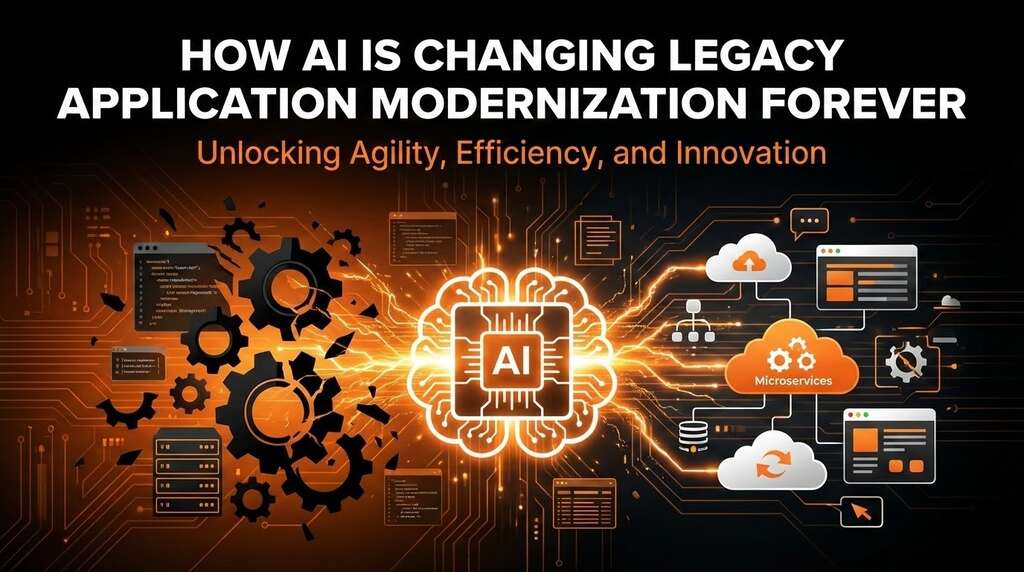
Think of a question that the vast majority of technology vendors will never ask you. Imagine that it was not about your budget, your team, or your desire to change, that your last modernization effort failed, or that you have never attempted to modernize the company at all? What about the fact that the process itself was ultimately flawed, and no money or planning could have helped to correct it by the old rules?
That is not a supposition. The legacy modernization of decades worked on a flawed model that had a structural weakness in the middle of it. It required flawless knowledge of imperfectly understood systems, by their nature. Undocumented code. Forgotten integrations. Rules in business that were only in the minds of the employees who had long since passed. Each project began with an information gap that became more costly to fill the further the teams went.
AI failed to enhance that model. It replaced it. And the business owners and decision-makers’ implications in 2026 are so great that they should be the reason to rethink the scope of what legacy system modernization services may potentially provide.
Compounding Cost of Delay.
The modernization market of the world had reached 29 billion in 2026. Analysts estimate that it will surpass 66 billion by 2031. The figures are indicative of organizations in all fields coming to the same conclusion that the annual cost of supporting legacy systems has forever exceeded the cost of substitution.
The definite pressures are properly documented. Sixty to 80 percent of IT budgets are consumed by maintenance. Eighty-seven percent of organizations have software with exploitable vulnerabilities. An ageing workforce of legacy-skilled developers who are retiring at a rate of 10 percent a year. The regulatory frameworks GDPR, HIPAA, the EU AI Act, and others, which place requirements that aging architectures lack the capacity to handle.
The least written about is the compounding nature of these costs. Each quarter of deferred modernization does not simply add to the total. It compounds it – the more technical debt a company has, the greater its vulnerability to security, and the more costly the remaining talent pool can be.
What AI Replaced – and Why It Matters.
Legacy modernisation refers to the process of upgrading old software to modern performance, security, scalability, and integration requirements. The strategies offered, such as cloud migration, refactoring, rebuilding, and API enablement, are established.
The approach has changed in the methodology of AI. There are three changes that are imminent.
Exposure was all-inclusive and quick. Smart-based tools of analysis can now generate entire inventories of systems, all applications, dependencies, data flows, and uncharted relationships, within weeks. A commercial laundry services company that operates in twelve locations was tested by artificial intelligence discovery and discovered that their route optimization system was taking scheduling information supplied by an abandoned HR platform via an integration that was turned off two years prior. The association was causing imaginary scheduling conflicts that had been attributed to operator error for a year and a half.
Translation was made computerized and testable. Production-scale Generative AI translates legacy code into modern programming languages and has been shown to reduce the timeline by 40 to 50 percent. More to the point, the output can be tested as soon as it is produced, removing the long periods of manual review that traditionally took months before.
Validation became exhaustive. AI testing tools are able to generate thousands of test scenarios automatically – with edge cases that human teams can hardly envision. In testing with AI, a regional credit union found out that their loan processing system had been charging an expired interest rate to loans opened prior to a change in their policies in 2018. This misalignment impacted about 340 accounts and was not detected in three years of manual audits.
A Six-Step Framework of Trustworthy Implementation.
Step 1 — Comprehensive discovery
Identify your entire technology environment with AI analysis tools. Add departmentalized discussions. During the discovery, an independent pharmacy chain realized that its prescription management system was exchanging patient information with an inventory system via a file-transfer operation that a former pharmacy technician had set up five years prior. The relationship breached their data handling procedures. By discovering it prior to migration, they were able to remedy a compliance exposure of which they were unaware.
Step 2 — Quantification of total costs.
Assemble a total financial image that encompasses emergency assistance, expert work, workaround, lost earning prospects, and capacity lapses. This exercise was completed by a family-owned moving and storage company that found that their legacy environment was costing them $9,100 per month to support it – almost the same amount they would have spent on monthly modernization. Their general manager summed up the discovery in a simple statement: “We are spending the same amount of money. One choice would leave things broken. The other choice would fix stuff.
Step 3 — Strategic triage
Classify all applications based on business impact, risk profile, and existing functionality. Contemporaryize what is actively hurting operations. Maintain constant systems. Retire dormant software. A chain of independent bookstores abandoned one of their legacy event management tools and an unused customer loyalty platform, and reclaimed $22,000/year in licensing fees, which were redirected immediately to updating their point-of-sale system.
Step 4 — First execution.
Start with the system that yields the most easily noticeable improvement when fixed. One of the specialty chemical distributors chose their order fulfillment platform – the root of their recurring shipping delays that had already led to official complaints by three of their top ten accounts. Eight-week AI-guided migration provided an automated warehouse allocation cloud-based replacement. The accuracy of shipping increased by 79 percent to 97 percent. Two out of the three complaining accounts had augmented their quarterly order volumes in sixty days.
Step 5 – Parallel operation and validation.
Concurrently run legacy and modernized systems until full AI testing is done to ensure behavioral equivalence in all scenarios. During the process of migrating to a new platform, a medium-sized event management company managed three weeks of parallel registration. More than 1,400 event registrations were made on both systems, with not a single discrepancy of data. The information about the transition was communicated to staff via an internal newsletter -the workflow was not interrupted.
Step 6 — Operational continuity
Implement monitoring, quarter reviews, and documentation maintenance as standard operating procedures. The difference between the organizations that maintain the benefits of modernization over the long-term and those that reestablish the previous legacy conditions over time is not technological. It is disciplinary. Regular practice yields regular results. The second crisis of modernization is caused by neglect.
Tangible Outcomes
Organizations completing AI-powered modernization report recurring system failures eliminated, processing capacity scaled to two to three times previous levels, customer-facing performance improved by 60 to 80 percent, infrastructure costs reduced by 35 to 45 percent, and development timelines compressed from quarterly cycles to weekly releases.
Addressing Practical Concerns
Cost. Phased modernization connects each investment to demonstrated returns. Positive ROI arrives within twelve to eighteen months for most organizations — roughly half the timeline of traditional full-scale rewrites.
Downtime. Parallel operation guarantees continuous business function. No system transition occurs without independent validation. Rollback is available at every stage.
Risk. AI-powered discovery and testing reduce unknowns systematically. In 2026, the measurable risk of modernization is substantially lower than the compounding risk of operating on aging, unpatched, and increasingly unsupportable systems.
How Sparkout Tech Enables This Transformation
Sparkout Tech executes legacy modernization using the framework outlined above — AI-powered discovery, business-driven prioritization, phased parallel execution, and ongoing operational stewardship.
Their legacy application modernization services are designed to deliver verified results on an initial system before any broader commitment. For organizations approaching modernization with justified caution, this model provides a structured, evidence-based entry point that minimizes exposure while maximizing early returns.
Begin With Clarity
Sparkout Tech offers a complimentary system assessment — a professional evaluation of your technology environment, risk profile, and modernization opportunities. No obligations. No lengthy proposals. A clear foundation for informed decision-making.
AI permanently changed what legacy modernization can deliver. The timelines contracted. The costs decreased. The risks became manageable. What did not change is the cost of inaction — and in 2026, that cost is accelerating faster than at any point in the last decade.
Organizations that act now build foundations for the future. Organizations that wait inherit the consequences. The distinction between the two begins with a single decision.

Author of four Opencart book.
The recent are Opencart 4 developer book and Opencart 4 user manual