Understanding Business Credit Scores: A Comprehensive Guide for Entrepreneurs

As an entrepreneur, you are familiar with the excitement of turning concepts into successful businesses. Whether you started your small business with your own money or with outside funding, you want to take it to new heights. And with the growth of your business comes the need for more funds. 

When funding your business, it’s important to understand business credit – how it factors into your business growth and potential, how it’s computed, what comprises it, and how important it is.

In this article, you will learn more about business credit scores.

What is a business credit score?

Your business credit score serves as a report card for your company’s financial behavior – it is a signal that shows if a company is suitable for getting a loan or becoming a business partner. This important credit data is primarily used by lenders, suppliers, and potential partners to assess your creditworthiness and gauge the level of risk they might encounter when dealing with your business.

Just like your personal credit score reflects your financial responsibility, your business credit score does the same for your business. It considers factors such as payment history, credit utilization, length of credit history, and any past financial mishaps.

Why is maintaining a good business credit score important?

Maintaining a good business credit standing is essential since suppliers frequently examine your business’ credit score before providing terms, and having a positive credit standing helps you secure favorable terms when negotiating. Banks also primarily rely on company credit scores and FICO scores when deciding on credit lines. Without a company credit score, a solid personal credit history is required to qualify for a small business loan based only on personal credit assessment.

How is a business credit score calculated?

Now that you understand the essential role of your business credit score let’s take a closer look at the factors that influence it.

  • Payment history. A critical foundation of your business credit score is your payment history. It’s all about when you pay your bills – on time or delayed. Consistently meeting your financial obligations creates a positive score, while missed payments can lower it.
  • Credit utilization. This is your credit balance divided by your credit limit. Maintaining a low ratio displays responsible credit usage, and maxing out your credit cards can signal financial strain. 
  • Credit history. The longer your record, the more reliable you appear. New businesses might face challenges here, but time can be your ally in building a solid credit foundation.
  • Credit variety. Lenders also consider the types of credit you’ve used. This could be credit cards, loans, or other financial arrangements. A mix of credit shows you can handle various financial responsibilities.
  • Public records. Bankruptcies and liens might have an impact on your credit score. Keeping a clean record here is crucial to maintaining a positive score.
  • Performance. Your credit performance is also measured against similar businesses. This comparison provides context, showing how your company stands in your industry.
  • Industry. Your business type and industry play a role too. Lenders take into account the unique risks and challenges your industry might face.

What is a good business credit score?

Different credit bureaus issue business credit reports. Let’s take Equifax, for example. Equifax provides three different scores: Payment Index, Business Credit Risk Score, and Business Failure Score.

Payment Index Score

This number, ranging from 1 to 100, reflects your business’s payment history. Scores from 90 to 100 indicate timely payments, while scores from 80 to 89 might result from a bill overdue by up to 30 days. Scores drop to 60-79 for bills late by 31 to 69 days, 40-59 for 61 to 90 days late, and 20-39 for 91 to 120 days late. Beyond that, scores range from 1 to 19.

Credit Risk Score

The score ranges from 101 to 992; a higher Equifax credit risk score signifies lower risk. Lenders use this score to assess payment likelihood, timing, potential financial difficulties, and suitable credit extension. Generally, a score above 556 is considered good, while 0 suggests bankruptcy.

Failure Risk Score

With scores between 1,000 and 1,610, lower Equifax failure risk scores indicate a higher likelihood of your business ceasing operations within a year. This score offers insight into your business’s future stability, calculated from commercial data, credit history, payment details, and legal records.

How can you strengthen your business credit score?

Here are ways in which you can proactively fortify your business credit score. 

  • Open a business credit card. Separate your personal and business finances by getting a dedicated business credit card. Use it wisely to establish good credit history.
  • Establish trade lines. Work with suppliers who report your payment history to business credit bureaus. Timely payments for goods and services can bolster your score.
  • Pay bills promptly. Make it a priority to settle your invoices on time. Consistent payments demonstrate your commitment to financial responsibility.
  • Monitor your credit report. Regularly review your business credit report for inaccuracies and inconsistencies. Dispute any errors promptly to ensure an accurate reflection of your creditworthiness.

Final thoughts

Now that you have learned more about business credit scores, you can have a better hold of it. Knowing and handling your business credit score can help you better manage and strengthen it and, in turn, drive business growth. 
For more insightful articles on a wide range of topics, such as eCommerce, online marketing, and web development, visit Webocreation.com’s blog.

Introduction of final year project on eCommerce or eShopping

0

CHAPTER ONE 

Introduction

1.1 Background of the Project

Nepal is a developing country and Information Communication and technology are playing their important roles in development of the country. By ecommerce we mean œbuying and selling of products or services over electronic systems such as the Internet and other computer networks. In truth in Nepal we have very less ways to pay our bills online or trade online. But that does not mean we cannot. There are new players on Nepali ground like Paybill and Esewa who wants to revolutionize the way Nepali ecommerce field is taken. With launch of these services many new startups can easily sell their products and services online. These services have lots of potential and we hope it will succeed and bring a change in the Nepali ecommerce field. There are big and old player like muncha.com in Nepal which is already popular for its money transfer and online shops.

E-commerce is fast gaining ground as an accepted and used business paradigm. More and more business houses are implementing web sites providing functionality for performing commercial transactions over the web. It is reasonable to say that the process of shopping on the web is becoming commonplace.

The objective of this project is to develop a general-purpose e-commerce store where any product (such as books, CDs, computers, mobile phones, electronic items, and home appliances) can be bought from the comfort of home through the Internet. However, for implementation purposes, this paper will deal with an online book store.

An online store is a virtual store on the Internet where customers can browse the catalog and select products of interest. The selected items may be collected in a shopping cart. At checkout time, the items in the shopping cart will be presented as an order. At that time, more information will be needed to complete the transaction.

Usually, the customer will be asked to fill or select a billing address, a shipping address, a shipping option, and payment information such as credit card number. An e- mail notification is sent to the customer as soon as the order is placed.

1.2 Objective of Project

The objectives for this project are:

  1. Create a set of requirements for a Website CMS for small businesses based on research
  2. Build and test a prototype of a Website CMS for small businesses based on the requirements found
  3. Knowing when an item was saved or not saved in the shopping cart.
  4. Returning to different parts of the site after adding an item to the shopping cart.
  5. Easy scanning and selecting items in a list.
  6. Effective categorical organization of products.
  7. Simple navigation from home page to information and order links for specific products.
  8. Obvious shopping links or buttons.
  9. Minimal and effective security notifications or messages.
    1. Consistent layout of product information.

1.3 Limitations of the Project:

There are some limitations for the current system to which solutions can be provided as a future development:

  1. The system is not configured for multi- users at this time. The concept of transaction can be used to achieve this.
  2. The Website is not accessible to everyone. It can be deployed on a web server so that everybody who is connected to the Internet can use it.
  3. Credit Card validation is not done. Third party proprietary software can be used for validation check.

As for other future developments, the following can be done:

  1. The Administrator of the web site can be given more functionality, like looking at a specific customer’s profile, the books that have to be reordered, etc.
  2. Multiple Shopping carts can be allowed.

1.4 Selection Method of Data Collection

There are two major approaches to gathering information in our final year project about the situation, person, problems or phenomenon and software about e-shopping.

  • Internal information
  • External Information

This information was collected with the help of both primary and secondary resources.

  1. a)      Primary Data:  They are collected by us on the concern topic, which are original. While studying, we have come across with the sources such as
  2. b)      Secondary Data: They are collected by us on the basis of the study of internet websites, interviews with friends, etc.

Next read: Final year project E-shopping, project design, data model and database design

Maximizing Your E-Commerce Success: The Power of Digital Marketing Strategies

In the fiercely competitive landscape of e-commerce, standing out from the crowd is essential. But how can you break through the noise and make your brand heard? By harnessing the power of digital marketing, you can elevate your e-commerce game and leave your competitors in the dust.

This article will discuss how you can do it. We will talk about the following:

  • Understanding your audience
  • Creating a strong website user experience
  • Leveraging SEO
  • Utilizing PPC advertising
  • Implementing e-mail marketing campaigns
  • Using social media marketing

Let’s go!

1. Understanding Your Audience

To succeed in e-commerce, you need to know your audience like the back of your hand! Market research is the key to unlocking valuable insights about your target market, including their age, interests, and shopping habits. This intel can help you create buyer personas, which are detailed profiles of your ideal customers. 

With buyer personas, you can craft marketing messages that hit the bullseye, inspiring more conversions and sales. But remember, your target market is always changing, so it’s crucial to keep your finger on the pulse of your audience. 

Regularly updating your market research and buyer personas will keep you relevant and ahead of the competition!

2. Creating a Strong Website User Experience

Your website is your storefront in the digital world, so make it pop! A visually stunning website that’s easy to navigate is essential for capturing the attention of potential customers. 

A great website design also builds trust with your audience and encourages them to stick around longer. But that’s not all – fast load times and mobile responsiveness are non-negotiable in today’s fast-paced world. If your website takes forever to load, you can kiss those potential sales goodbye! 

Also, don’t forget about checkout – a streamlined process can be the difference between a sale and a cart abandonment. Make it easy for your customers to buy your products, and they’ll keep coming back for more!

3. Leveraging Search Engine Optimization (SEO)

A staple of growth marketing strategies, SEO is the name of the game when it comes to e-commerce success. By optimizing your website for search engines, you can 

  • boost your visibility in search results; 
  • drive more traffic to your site;
  • and increase sales. 

The first step in SEO is conducting keyword research. Find out what words and phrases your audience is using to search for products like yours, and then start optimizing your content. Product descriptions, category pages, and blog posts should use your top keywords.

Moreover, pay attention to metadata! Optimizing your title tags, meta descriptions, and header tags can make a big difference in your search engine rankings.

Link building is another critical element of SEO for e-commerce businesses. Building backlinks from trustworthy sites helps improve your website’s authority and rankings. But how do you get those coveted links? Create high-quality, informative content that other websites will want to share and link to!

Stay on top of search engine algorithm updates to maintain and improve your search engine rankings. With Google and other search engines constantly changing their algorithms, it’s important to stay informed and adjust your SEO strategy accordingly.

If you keep up with the latest SEO trends and best practices, your traffic and sales can soar!

4. Utilizing Pay-per-click (PPC) advertising

In addition to SEO, PPC advertising can be a powerful tool for maximizing your e-commerce success. 

With Google Ads, Facebook Ads, and Instagram Ads, you can target your ideal audience and drive more traffic to your website. The best part? You only pay when someone clicks on your ad, making it a cost-effective way to drive qualified traffic to your site. 

But don’t just throw money at ads and hope for the best – crafting effective ads and targeting the right audience is critical. Test and refine your campaigns to maximize your return on investment (ROI). When executed properly, PPC advertising can give your e-commerce business a massive boost.

5. Implementing E-mail Marketing Campaigns

E-mail marketing is a strategy you should not ignore. With a strong list of subscribers and target campaigns, you drive more conversions. 

Using bold visuals, catchy subject lines, and tempting offers, you can capture your audience’s attention and encourage action. E-mail marketing is also excellent for building customer trust and loyalty. You can deliver informative newsletters to help your subscribers avoid marketing fraud and other malicious activity.

With the right email marketing strategy in place, you can build a powerful e-commerce brand that keeps customers wanting more. So start building your list today, and get ready to see the results roll in!

6. Implementing E-mail Marketing Campaigns

Social media marketing is a must-have tool in any e-commerce marketer’s toolkit. With billions of people using platforms such as Facebook, Instagram, and Twitter, it’s a massive opportunity to reach a vast audience of potential customers. 

A strong social media strategy can

  • build a loyal following for your brand;
  • Share compelling visuals;
  • and engage with your audience in an authentic way. 

Use social media to showcase your products, share customer reviews and testimonials, and run promotions to boost sales. Don’t forget to interact with your followers – respond to comments, run contests, and share user-generated content to build trust and establish your business as an authority in your industry.

Final Words

Maximizing your e-commerce success requires effective digital marketing strategies. The topics discussed above should give you insight into how you can use digital marketing to boost your business. However, you shouldn’t expect it to be a cakewalk.
If you want to work with a team that can help you develop and implement effective digital marketing strategies, look no further than Webocreation. Contact us today!

Project proposal presentation of hotel reservation system- eCommerce

3

In this project proposal presentation of the hotel reservation system, we are showing the outline, and table of contents which includes background, overview, features, phases, special requirements, and limitations, and make it ready for internship presentation.

Final year Project Proposal On E-shopping with affiliation


Outline for System Proposal
Of
Hotel Reservation and Information System

Preparing by
Ram KC and Ritesh Shrestha

Submitted to:

Nobel College
Sinamangal, Kathmandu

Date: July 2010


Table of Contents

  1. Background
  2. Overview of Hotel Reservation System
  3. Features of the HRIS
  4. Phases for Project Development
    4.1 Problem Analysis
    4.2 Feasibility Study
    4.3 Project Analysis
    4.4 Project Design
    4.5 Project Coding
    4.6 Testing Code
  5. Special requirements
  6. Limitations
  7. What are the requirements that we need?

1. Background

Nepal is a growing tourist destination, there has been a good rise in the number of hotels and resorts in Nepal and the tourist sector is broadening thus we have chosen this sector to do our project and we are making Hotel Reservation System. The rapid development and commercialization of Information and Communication Technologies (ICTs) for the travel and tourism industry have prompted hotels and other enterprises in this sector to increasingly adopt these technologies. The ICT-based products and processes help the hotels to enhance operating efficiency, improve the service experience as well as provide a means to access markets on a global basis. ICTs were used in the hotel industry since the late seventies in the form of Computerized Reservation systems and Global distribution systems.

2. Overview of Hotel Reservation System

Hotel Reservation System has all the dynamic versatile features required to run hotels, motels, and guest house businesses. Hotel Reservation System offers an operational integration between reservations, guest history, reception/ front desk, Sales Ledger, Accounting, and Reporting modules. The software has the facility to generate a report for analyzing your booking, checking, and checkout status.
Hotel Reservation System is the best suit for managing your resource in a very simple but effective manner with minimal effort or time so that it increases your revenue. Hotel Reservation System helps you to manage small to medium size boutiques, hotels, Inns, cottages, Beds, campgrounds and cabins, and Breakfasts. A hotel management or booking system is designed to help you manage your booking and use the gathered data in reports to help analyze your marketing and financial results. Hotel Booking software is a complete software suite consisting of integrated modules for various aspects of hotel management.

3. Main Features:

  1. Save the client’s information into the database prior to Booking or Check-in.
  2. Customize the type of Hotel rooms with prices.
  3. Booking for the customer for a specific date with advance payment.
  4. Check-in into the hotel for the duration.
  5. Check out from the hotel after payment operation.
  6. Each time make a reservation, the room status is updated and the customer details are added to your hotel database.
  7. The better option for expensive CRM.
  8. This system can be used by all of the hotels.
  9. This project is web-based and is using PHP and Mysql with other web technology.

The following sites are providing an online hotel booking system.
www.visitnepal.com
www.yakandyeti.com
www.nepalshotel.com
www.vaishalihotel.com
www.radisson.com

4. Phases for Project Development

Problem Analysis

In Nepal, there are more than 1000 hotels that are gaining their international customers but the online booking system is implemented by some renowned hotels only so the hotel reservation system is one of the projects that will be required in the Nepali tourist sector so we have chosen it.
Google Maps are also not in use and we are implementing it which will help the customer to find out the location of the hotel.
Customer Relationship Management is also established and we are maintaining it which will help to find out the customer repository.

Feasibility Study

There are many problems with the existing hotel reservation system in Nepal and the problems are stated in the problem analysis. It is economically feasible as we are making this for the partial fulfillment of the BCIS program and is operationally feasible as we are making this system by removing the threats and weaknesses of existing systems as well as it is technologically feasible as we are using open source coding with the use of PHP and MySql.

Project Analysis

In Project Analysis we collect data from different documents, manuals, and sites for the collection of the data we have interviewed different online booking use as well as the owners of the hotel.
Project Design

  • Account Manager
  • Administrators – The administrator can add/edit and manage administrator accounts.
  • Hotels Manager
    – Hotels – The administrator can manage hotels that will appear on the site with the hotel name, description, address, phone, and fax.
    – Room Types – The administrator can define the type of rooms in the hotels, and rooms’ prices, and upload an image for each room.
    – Hotel Rooms – For each hotel, the administrator can define the rooms available, room’s number, max occupants, and remarks on the specific room.
  • Bookings Manager
    – Bookings – All bookings and reservations made on the site are displayed with all booking details: arrival date, departure date, hotel name, room type, number of passengers, and price…
    – Available Rooms – The administrator can also search for room availability from the administrator’s panel and does not have to go on the site in order to look for hotels.
    – Bookings History – Administrators can view all bookings ever made on the site.
  • Reports
    – Bookings Statistics – The administrator can view statistics of booking on bar charts that show the difference in bookings according to months.
  • Options
    – Languages – Define the languages that will be viewed on the site with the language code.
    – Constants – For each language, the administrator can define the wording.

General

  • Panel Settings – Here the administrator can define the basic site name and header.
  • Menu Manager – Here the site administrator can rearrange the menu bar with the subpages of the administrator panel.
  • Site Settings – Here the administrator can define if to use pay pal on the site and if yes then what will be the pay-pal email address used, the administrator can also define the administrator email address where all reservation emails will be sent to.
  • Static Pages – Here the administrator can edit the content of the static pages on the site for each language: Area Information Page, Rooms Page…

Project Coding
With the use of programming languages, the system design is implemented to make the HRIS
Project Testing
The code that we will use will be tested and errors are debugged

July August September
Phases 1 week 2 week 3 week 4 week 1 week 2 week 3 week 4 week 1-4 weeks
Problem Analysis
Feasibility study
Project Analysis
Project Design
Project Coding
Project Testing
Project Implementation
GANTT chart representing time spans for project

5. Special requirements

Tools and techniques Name
HTML editor Macromedia Dreamweaver
Flash Dreamweaver Flash
Programming languages PHP, Mysql, Javascript, Facebook Markup Language, Paypal Code, Jquery, Ajax, Smarty templating, HTML, XML, DHTML, Style Sheets (CSS)
The guidance Hotel reservation system of other sites
Web Server Apache

6. Limitations

  • Periodically Changing the Hotel E-business Strategies
  • Hardware and Software errors may occur
  • Hacking and cracking may occur
  • Credit card scams may occur

7. What are the requirements that we need?

  • Reservation system.
  • Basic knowledge of Search Engine Optimization and other marketing strategies.
  • How PayPal Transactions works or the implementation of the sandbox.
  • Knowledge of JavaScript, Ajax, Jquery, and Flash.
  • Embedded code generation.
  • Knowledge about the other reservation system and the tourism sector

Internship final report sample, Introduction, SWOT analysis, and recommendation

Internship provision Internship letter

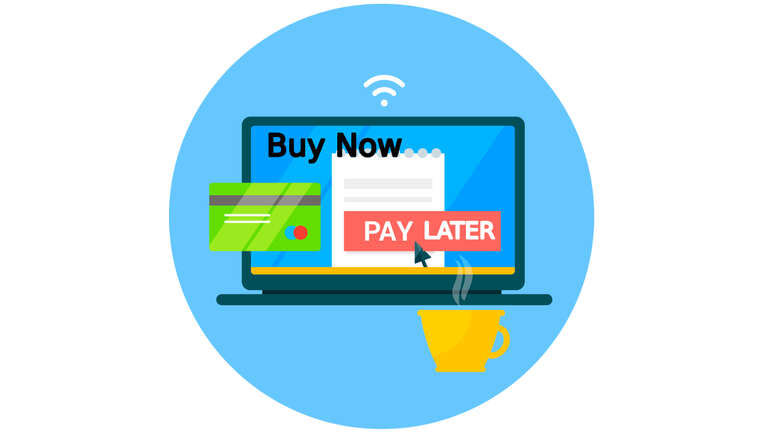
Buy Now Pay Later (BNPL) set up in Opencart Payment

As lot of our customers were asking for the Buy Now Pay Later setup so we researched how to setup BNPL payment method in Opencart eCommerce. With the rise of e-commerce, new payment options have emerged, and one of them is Buy Now Pay Later (BNPL). This option allows consumers to purchase items immediately but pay for them in installments over time, often with no interest or fees. We have listed some advantages and disadvantages of Buy Now Pay Later:

Advantages of Buy Now Pay Later

  1. Convenience: BNPL allows consumers to purchase items they may not be able to afford outright, spreading the cost over time in manageable installments. This can make expensive purchases more accessible and affordable.
  2. No interest or fees: Many BNPL services offer interest-free or fee-free payment plans, making them an attractive option for budget-conscious consumers.
  3. Easy to set up: Setting up a BNPL account is often quick and straightforward. Many retailers offer BNPL options during the checkout process, and consumers can apply for an account on the spot.
  4. Good credit not always required: Unlike traditional credit options, BNPL may not require a credit check, making it accessible to people with poor credit or no credit history.

Disadvantages of Buy Now Pay Later

  1. Potential for debt: BNPL can encourage overspending and lead to consumers accumulating more debt than they can afford to repay. Late or missed payments can result in additional fees and harm credit scores.
  2. Hidden fees: While many BNPL services are fee-free, some may charge hidden fees or penalties for missed or late payments.
  3. Impact on credit score: While BNPL may not always require a credit check, late or missed payments can still harm credit scores and make it harder to obtain credit in the future.
  4. Limited availability: Not all retailers offer BNPL options, and some may have restrictions or requirements that limit who can apply.

Opencart payment modules/extensions those support Buy Now Pay Later

Some companies that offer a BNPL service are Paypal, Klarna, Affirm, Perpay, Four, Flex, Splitit, etc.

Affirm BNPL for Opencart

With Affirm you can shop now pay later at all your favorite retailers. Split the purchase into installments and most options are interest free.

https://docs.affirm.com/platforms/docs/opencart-install-and-configure-affirm#install-affirm-on-opencart

Affirm Pre Qualify
  1. Download one of the modules: OpenCart 1.x extension / OpenCart 2.x extension (excluding 2.2) / OpenCart 2.2 extension / OpenCart 3.x extension
  2. Go to Extensions > Extension Installer and click Upload. Browse to the extension file downloaded in Step 1.
  3. Go to Extensions and select Payments from the dropdown.
  4. Find the “Affirm” payment method and click the green Install button.

Paypal BNPL for Opencart

Download the module and install it as other module. Then, while making the payment, you will see the Pay Later option in PayPal.

buy now pay later Paypal

Klarna Checkout for Opencart

Install the Klarna Checkout payment module which is by default in Opencart 3 and once you reached to Klarna payment you can make payment through BNPL which is interest free

Klarna BNPL

Conclusion

Buy Now Pay Later can be a convenient and attractive option for consumers who want to spread the cost of their purchases over time. However, it’s important to carefully consider the pros and cons before signing up for a BNPL account. If you’re disciplined with your finances and able to make payments on time, BNPL can be a helpful tool. But if you struggle with overspending or have trouble making payments, it’s best to avoid BNPL and explore other payment options. Providing Buy Now Pay Later option in your Opencart store can increase the conversions of you store so provide the BNPL payment options to your customers.

How to add categories for the HubSpot blog?

HubSpot supports tags for blog posts, there is no straight way to add categories for blogs in HubSpot, so to achieve that you need to create categories in the HubDB and assign the blog to those HubDB categories. Here are the steps:

Create the categories table in HubDB

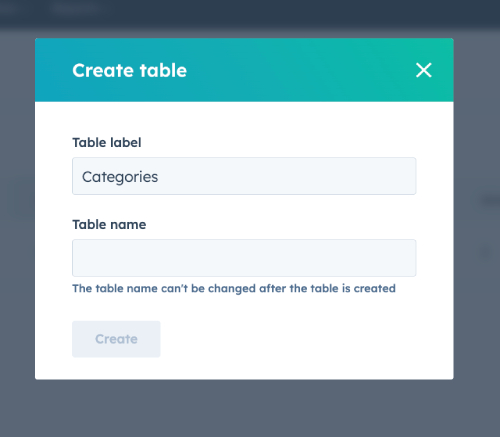
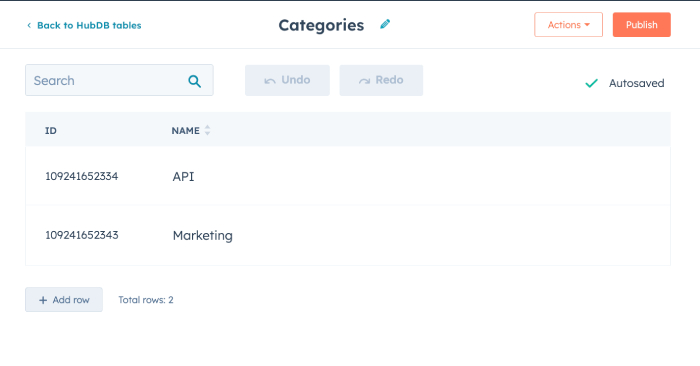
Go to Marketing >> Files and Templates >> HubDB >> Create Table and enter the “Table label”, here we entered Categories

Categories table in HubDB

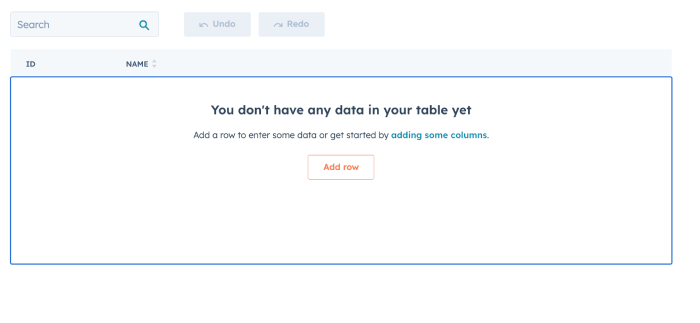
Once you create the table, you now add the row, which is the category name

HubDB add row categories

Click the “Add row” and enter the category name in the name column. Add multiple categories as per need.

Add category in HubDB

With these categories’ names in the HubDB, now let’s assign them to the HubSpot blog.

Assign categories to the HubSpot blog or article

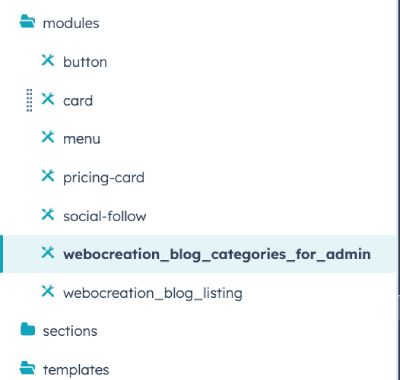
To assign categories to the HubSpot blog, we are taking an approach by creating the module. For that, we create a module inside ThEMENAME >> modules >> webocreation_blog_categories_for_admin

New Module in Hubspot

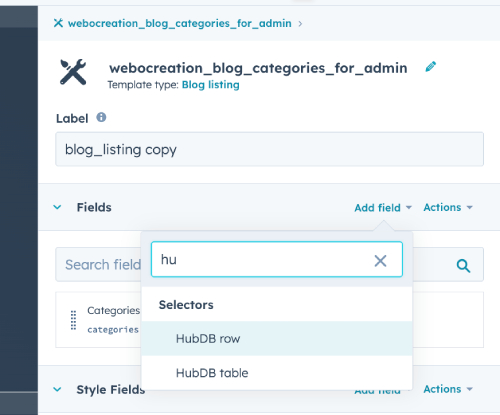
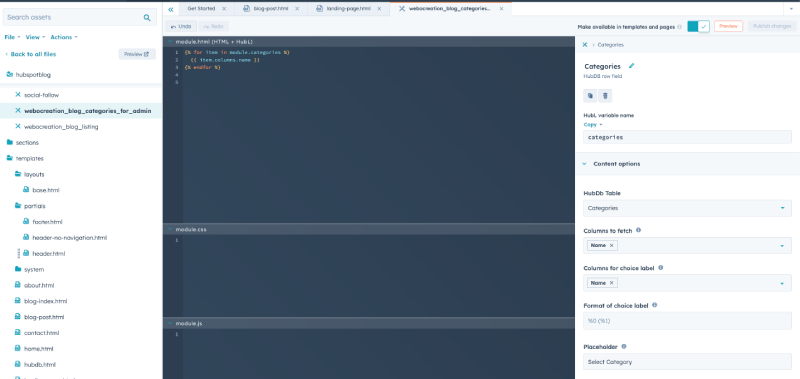
In the right column of the module, add the field and search for the HubDB row

HubDB row in module

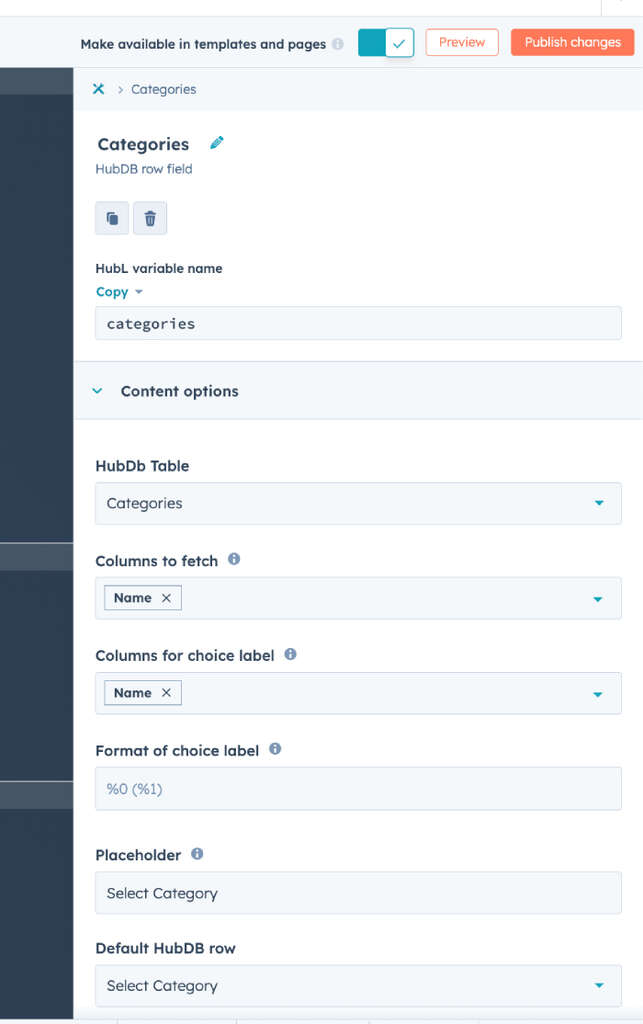
After that enter the name as categories, select the HubDB Table as Categories, Columns to Fetch as Name, Columns for the Choice label as Name, and enter the placeholder as “select a category”, the image is attached with settings:

Category field added

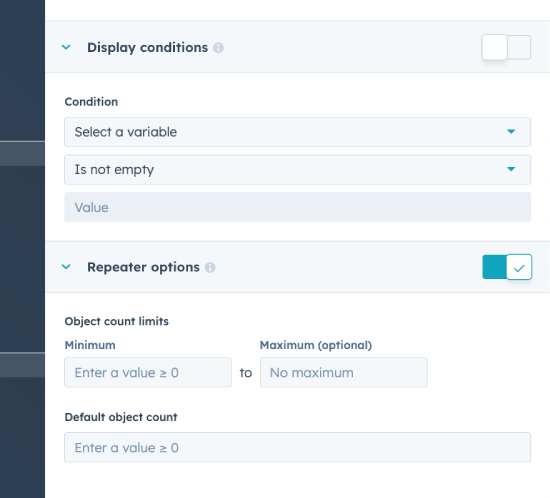
Likewise, enable the “Repeater Options”

Field repeaters in Hubspot

Now enter the following code in the module.html

{% for item in module.categories %}
	{{ item.columns.name }}
{% endfor %}
Module Code HubSpot blog categories

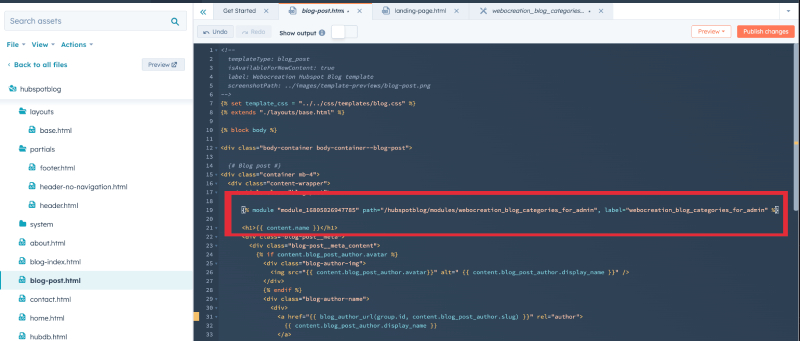
Now, add the module to the blog-post.html. Click the Publish changes on the blog post page. Our module code is like below, yours can be different. Just right-click the module and click “Copy snippet”

{% module "module_16805026947785" path="/hubspotblog/modules/webocreation_blog_categories_for_admin", label="webocreation_blog_categories_for_admin" %}
Category module to blog listing page

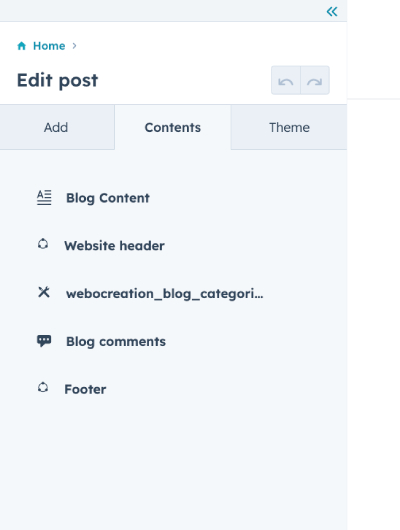
Now you are ready to assign the categories to the blog post. Create a new blog post and on the left side click the Content tab and you will see the module below:

Hubspot content tabs

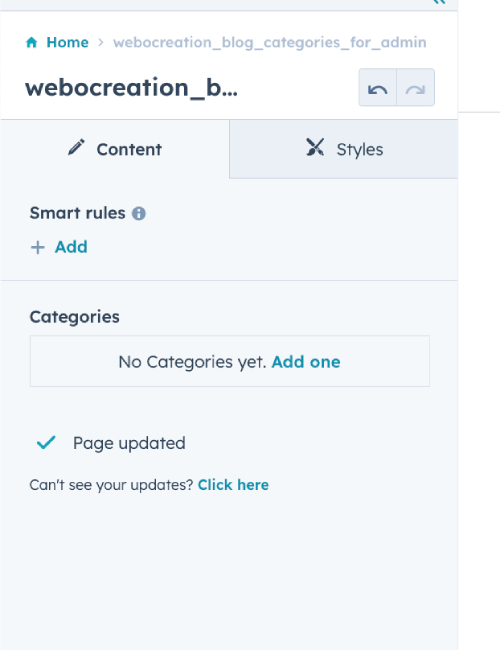
Click the module as ours is webocreation_blog_categories_for_admin, we clicked it and see the following input field

Category add section

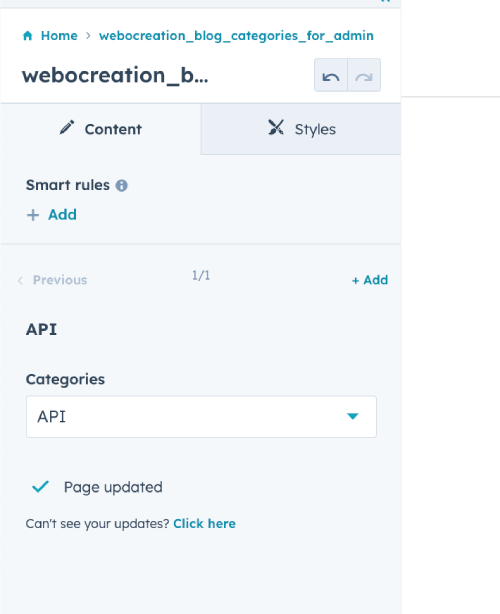
Click the “Add one” and select the category.

Category selected hubspot blog

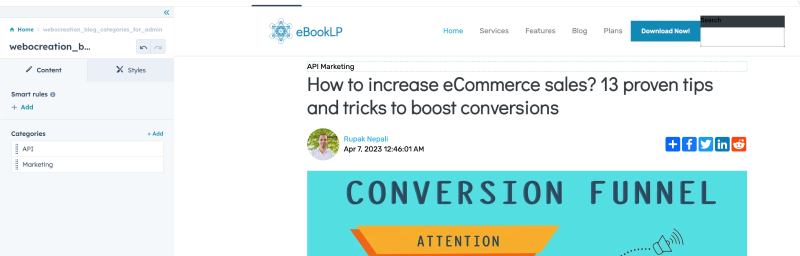
You can select multiple categories and it will be shown below:

Category above title Hubspot blog

In this way, you can assign the category for the HubSpot blog, in our next post we will show you how to list the blog posts as per the category and list all blog posts of that category and add SEO data for the categories. Our approach will be to pull posts with hubdb_table_rows and filter queries so we will dig more and see if there are other ways also, so till then please have a look at our other Salesforce, Marketo, Pardot, and Hubspot articles and you can also find us on YoutubeTwitter, and Facebook. Please let us know if you have any questions or concerns.

We are HubSpot-certified developers based in Phoenix Arizona USA, so if you have any projects about HubSpot please let us know or you can email us directly at webocreation.com@gmail.com

How to show the author’s image in the blog post on Hubspot?

We were designing the Hubspot theme and working on the blog listing and blog post of Hubspot, by default there was no author image shown, so we had to make some code changes to show the author’s avatar.

In the template type blog_post, we add the following code to show the author’s image, name, and published date of the HubSpot blog. You can get the author image URL with {{ content.blog_post_author.avatar}}

<div class="blog-post__meta">
  <div class="blog-post__meta_content">
      {% if content.blog_post_author.avatar %}
      <div class="blog-author-img">
        <img src="{{ content.blog_post_author.avatar}}" alt=" {{ content.blog_post_author.display_name }}" />
      </div>
      {% endif %}
      <div class="blog-author-name">
        <div>
          <a href="{{ blog_author_url(group.id, content.blog_post_author.slug) }}" rel="author">
            {{ content.blog_post_author.display_name }}
          </a>
          <time datetime="{{ content.publish_date }}" class="blog-post__timestamp">
            {{ content.publish_date_localized }}
          </time>
        </div>
      </div>
  </div>  
</div>

CSS added are below:

.blog-post__meta_content, .blog-post__meta{
  display: flex;
  flex: 1;
}
.blog-post__meta a{
  color: #01afd7 !important;
  text-decoration: none;
}

.blog-author-img img{
  width: 70px;
  border-radius: 50%;
  margin-right: 10px;
}
.blog-author-name{
  align-items: center;
  display: flex;
}

With these additions we are able to show the author section below:

Author image in hubspot blog

We are HubSpot-certified developers from Phoenix Arizona, USA, so if you guys need any help on HubSpot development, please contact us or email us directly at webocreation.com@gmail.com. Please let us know if you have any questions or suggestions, please subscribe to our YouTube Channel and you can see more in Salesforce, Marketo, Pardot, and Hubspot. You can also find us on Twitter and Facebook. Enjoy!

How to remove en-gb from the SEO URL of Opencart 4?

In Opencart 4, when we activate the SEO URL it contains the language as well and for the English language, it shows en-gb by default, which we don’t like so we looked to remove it and the easiest way to remove en-gb is by following code. The following code will not work if you have multiple languages, it works only for English because we are replacing en-gb from the URL, we will find a way soon to remove all the languages and post the solution here.

SEO best practices for Opencart 4

Open file /system/library/url.php and find the following code:

if (!$js) {
	return str_replace('&', '&amp;', $url);
} else {
	return $url;
}

And, replace with the following code:

if (!$js) {
	return str_replace('en-gb/', '', str_replace('&', '&amp;', $url));
} else {
	return str_replace('en-gb/', '',$url);
}

Speed up the Opencart 

This will remove the en-gb from the Opencart 4 URL. Please let us know if you have any questions or suggestions, please subscribe to our YouTube Channel for Opencart video tutorials and you can see more in the Opencart tutorial category. You can also find us on Twitter and Facebook. Enjoy!

Importance of Video Editing for Creators and Businesses

Video editing is the process of rearranging and combining video clips to create a new work. It is used in the film industry to create trailers, commercials, and other promotional materials, but it is also used by amateurs and professionals alike to create content for YouTube, TikTok, and other social media platforms.

In video editing, raw footage is edited and processed by cutting, splicing, adding audio and sound effects, special effects, and color correction to create a final product. By using video editing software and techniques, it is possible to transform a collection of raw footage into a polished and professional video that can tell a story, convey a message, or simply entertain.


The growing trend of video content creation has been propelled by various factors and has experienced a significant surge in recent years. The popularity of video content creation was already on the rise before the pandemic, with projections estimating that around 82% of all created content would be video.

However, the pandemic has further accelerated this trend, with video consumption skyrocketing as people spent more time at home and sought entertainment and information online. The appeal of video content lies in its ability to engage and captivate audiences, with short-form video content, in particular, gaining immense popularity due to its ability to encourage creator and viewer participation.

As we approach the year 2024, it is evident that video creation will continue to be a core component of online content, with exciting and innovative trends shaping its future.

In this article, we will discuss the importance of video editing for creators and businesses:

Enhancing Visual Appeal

Video editing is an essential part of the video production process, as it provides opportunities to enhance the visual appeal of your project. By adjusting the pacing, sequencing, and rhythm of the video, editing helps to create a smooth and immersive viewing experience. Additionally, color correction and grading techniques can be applied to ensure consistent visual aesthetics and enhance the mood or atmosphere of the video.


Transitions can be used to connect one scene to another or enhance the pacing of the video. A variety of transitions are available, such as wipes, fades, and cuts. Effects such as pixelation and distortion can be applied to increase the visual interest of your footage and add an artistic touch. Filters provide additional options for enhancing visuals by applying color correction or stylistic effects such as sepia or black-and-white tones.

Color correction and grading are essential in creating a cohesive look for your video. These post-production processes can be used to adjust the color balance, contrast, saturation, and other visual elements of your footage in order to create an aesthetically pleasing look. This can include changing the colors of specific objects or areas within an image or applying effects such as sepia tones or vignetting (darkening outer edges).

Crafting Compelling Narratives

Upload

The editing process is essential to building a cohesive narrative. It’s part of the video creation process where you piece together footage using transitions, cuts, and other elements such as music and voiceover. These elements help build tension or suspense, convey emotion, and create meaning in your story.

Read more: Create AI music

The use of storytelling techniques can help you create a compelling narrative. These elements are often referred to as film grammar and they include:

  • Pacing
  • Sequencing
  • Rhythm

Pacing is the rate at which events unfold in your story. It’s important to find a balance between too slow and too fast because both can be detrimental to the viewer’s experience.

Sequencing refers to how you arrange the events in your story. It’s important to consider the audience’s perspective and what information they need in order to make sense of what they’re seeing on screen.

Rhythm is about creating a flow that keeps viewers engaged throughout your video. This includes things like pacing and timing, but also how you position cuts or transitions within your edit.


When editing a video, you’re not just cutting clips together to create a story. You’re also shaping an audience’s emotional response by choosing what to include and exclude from the final product. You may want viewers to feel inspired or moved in some way, so it’s important to consider how each edit decision will impact the audience’s reaction.

The key here is that editing is an active process where you are making deliberate decisions about what stays in or gets cut out of your video. It’s easy to let these decisions happen automatically without thinking about their consequences, but this can lead to unintended outcomes that don’t serve your story best.

Improving Engagement and Retention

Well-edited videos can help you better engage your audience and keep them from getting bored. The editing process is a way to focus on the most important aspects of your story, and it’s something that should be done intentionally rather than automatically.

When you’re editing your video, it’s important to look for ways to make it more visually engaging. You can do this by using effects like transitions, filters, and animations. These will help keep your audience interested without distracting them from what’s important about the story.

If you’re looking to create a video that people will want to watch over and over again, you need to make sure it’s professionally edited. This means that the video has been carefully put together and that nothing is out of place or distracting from the story itself. When you edit your video professionally, it will stand out from all of the other amateur videos on YouTube.

Branding and Marketing

Video editing is a crucial part of branding and marketing strategies for any company. It can help you to develop your brand and create a consistent look that will be recognizable across all of your videos.

The best way to create a strong connection between your brand and your audience is by creating a consistent look across all of your videos. This can be done in many ways, but one of the most effective is through the use of visual elements like logos or product shots. Visual consistency helps viewers to feel more comfortable with your brand, which will lead them to trust you more easily and share your videos with others.

Editing is one of the most powerful tools you have at your disposal. The way that you edit can help reinforce a brand’s message and enhance its identity.

For example, if you want to show off how fast and easy it is for someone to use your product, then you might choose to cut quickly between shots of people using it in different situations (e.g., working out or cooking dinner). This helps viewers understand what the product does in real-world situations and allows them to see how easy it would be for them to use it as well.

Saving Time and Resources

Photo credit: Pexels

Time is money, and video editing often involves long hours of tedious work. But with the right tools, such as an online video editor specifically VEED.IO, you can save time and resources by using professional editing software. With so many features that you can leverage, such as an audio joiner, MP3 to WAV converter, and many more, you are confident that you can get a high-quality video result.

When you outsource your video editing, you can focus on other tasks that are more important and vital to your success. This gives creators the time they need to focus on their content while professionals take care of the technical aspects of making a high-quality product. You no longer have to worry about learning how to use editing software or wasting hours trying different things just to get it right.

You might be wondering why you should hire professional editors when it seems like you could do it yourself. The truth is, if you’re outsourcing your video editing, you can get a high-quality product with the click of a button. In fact, many companies are turning to professionals for help because they know they can trust them to deliver quality work every time.

One of the biggest benefits of hiring a professional editor is that they can help you create an engaging video. Professionals are trained to understand what makes a video compelling and how to use editing techniques to enhance it. They know how to keep your audience interested and engaged, which is something that takes practice and knowledge.

FlexClip

FlexClip is a simple yet powerful web browser (Chrome, Safari, Firefox, etc.) based video maker that creates marketing videos and family stories in minutes.

Key features of FlexClip:

  1. Online-based platform and easy to use, with thousands of templates and free media resources.
  2. Built-in screen/webcam recorder. A group of video editing tools, like video compressor, video converter, etc.
  3. Text to Video (AI)
  4. Text to Speech. (AI)
  5. AI Video Script (AI)
  6. AI Image Generator. (AI)
  7. Background Removal. (AI)
  8. Auto Subtitles. (AI)
  9. AI Noise Reducer. (AI)
  10. AI Vocal Remover. (AI)
  11. AI Image to Image. (AI)
  12. AI Photo Colorizer, AI Photo Restoration, AI Image Upscaler, AI Image Extender (New AI)
  13. Team collaboration.

Conclusion


Video editing plays a crucial role in the success of both creators and businesses in the digital age. It enhances the quality and impact of videos by transforming raw footage into a polished and professional final product.

Through editing, creators can engage their audiences, convey their messages effectively, and stand out in a saturated market. Businesses can utilize video editing to create compelling promotional materials, increase brand visibility, and ultimately drive sales.

The wide range of editing techniques, such as color correction, audio editing, and visual effects, allows for endless creative possibilities in video creation.

Overall, video editing is a valuable skill that empowers creators and businesses to connect with their target audiences and achieve their goals.

Photo credit: VEED.IO

Metaverse for E-commerce – What Retailers Need to Know

As technology evolves, so does the way we shop. The development of the internet over the past few years has allowed for the widespread acceptance of online shopping. 

With the advent of virtual and augmented reality, eCommerce has taken a major leap toward the Metaverse. Mark Zuckerberg (Meta) and Satya Nadella (Microsoft) have made public statements recently about their plans to make significant forays into the Metaverse.

The potential of the Metaverse for eCommerce is enormous. In the Metaverse, retailers can create virtual storefronts and interact with customers completely new. Imagine browsing a virtual store and seeing the products in three dimensions or trying on virtual clothes and accessories to see how they look before making a purchase.

What Is Metaverse E-commerce?

The Metaverse platform employs blockchain technology to facilitate honest and open interactions between buyers and sellers. Transactions in Metaverse are easy and risk-free because users can use the available smart contracts to create legally binding agreements that are automatically executed.

The Metaverse platform also simplifies online monetary transactions. The system operates with a cryptocurrency called ETP that can be exchanged for a wide range of goods and services from merchants worldwide. Fast, reliable, and secure, ETP is a modern method of making payments. It improves commerce’s security, openness, and efficacy, allowing more people to shop online.

How Does Metaverse E-commerce Work?

Shopping online can feel like an individual experience at times. You can’t benefit from other buyers’ feedback when you make an online purchase. Many things will change when the Metaverse’s commercial infrastructure is up and running.

You can converse with other shoppers in similar virtual reality (VR) environments. You’ll be able to view their replies and get advice from your pals.

The virtual world promises to improve the shopping experience by allowing more in-depth interactions with a wider range of products. Shops of the virtual variety will have their special section of the virtual world. Customers will get a real feel for the products at these stores.

Due to the nature of digital assets, shop owners can set up shop in multiple MMORPGs with precisely the same offerings. If you want to sell your wares on Facebook, even Facebook has you covered with a platform called Facebook Shop.

By exploring and experiencing products in various dimensions, customers will have a more enjoyable and immersive shopping experience. Soon, the lines between brick-and-mortar stores and online marketplaces will blur.

Why Should E-commerce Businesses Care About the Metaverse?

Improved Customer Engagement

In the Metaverse, retailers can create immersive experiences that engage customers on a deeper level than traditional eCommerce platforms. By creating a virtual storefront, retailers can showcase products in a way impossible on a conventional website. This can lead to increased customer engagement and, ultimately, more sales.

Personalized Shopping

In the Metaverse, retailers can create virtual assistants or avatars to guide customers through the shopping experience. These assistants can provide personalized recommendations based on a customer’s shopping history, preferences, and body shape and size. This can make the shopping experience more efficient and enjoyable for customers.

Enhanced Social Interaction

The Metaverse is a social platform, and retailers can use this to their advantage. By creating virtual events or pop-up stores, retailers can create a buzz around their brand and engage with customers more personally. This can help build brand loyalty and increase sales.

Cost-Effective Expansion

The Metaverse provides a cost-effective way for retailers to expand their reach. Instead of investing in brick-and-mortar stores, retailers can create virtual storefronts accessible to anyone with an internet connection. This can help small businesses compete with larger retailers and expand their reach to new markets.

New Revenue Streams

The Metaverse offers new revenue streams for retailers. By creating virtual goods and experiences, retailers can tap into a new market of customers willing to pay for unique and immersive experiences. This can include virtual clothes, accessories, and even virtual real estate.

Foster a More Inclusive Community

These days, it takes more than just pushing products on mobile, desktop, and social media to build a successful retail business. Customers care more about the good a company does in the world and the values it upholds than they do about the products it sells. Accordingly, brands must show they understand and value consumers’ priorities to build trust and loyalty, especially with younger generations.

Retailers frequently use freebies and VIP events to achieve this goal. That materialized in the cyber world as non-transferable tokens (NFTs). To incentivize customers to buy their NFTs, stores offer previews of new products or special content only available through those retailers.

Notable companies that have introduced NFTs include Nike, Coca-Cola, and Adidas, among many others.

Perform Market Research at Little to No Cost

As the lines between the digital and real worlds blur, stores may find the Metaverse useful for gathering information about customers’ tastes. Retailers, for instance, could use the Metaverse as a testing ground for products before bringing them to life. Consumers could also use the Metaverse to test out merchandise before making a purchase decision.

You can see this in action at Metaverse Fashion Week. With all the glitz and glamour of New York Fashion Week, some of the most recognizable brands converged on the Metaverse for a high-profile fashion event. How Gucci, Ralph Lauren, and the other brands will use the information gleaned from the circumstances needs to clarify. However, don’t be surprised to see physical iterations of the most notable digital trends appearing shortly.

The Metaverse Can Help E-commerce Businesses Boost ROI

60% of respondents to a Google survey said they would be interested in using augmented reality tools to enhance their shopping experiences, which would likely increase customer satisfaction and encourage them to purchase products they could first try in 3D.

Customers in the Metaverse will not only be able to visualize products more clearly, but they will also have the opportunity to interact with store employees. If your employees can create a welcoming atmosphere where customers feel comfortable expressing their full range of feelings, you can expect high product interest and sales.

Being an early adopter of the Metaverse will make your company famous and allow you to consult with other companies about how they can improve their operations by adopting similar strategies.

Which E-commerce Brands Are Planning to Enter the Metaverse?

Walmart: Walmart’s metaverse shopping will center on the creation and sale of virtual goods like furnishings, sporting apparel and equipment, personal care items, toys, and furniture.

Balenciaga: Even Balenciaga, a long-standing name in the fashion industry, has evolved to meet modern tastes. Currently, the company’s top priority is investigating the potential for business in the Metaverse.

Coca-Cola: In 2021, Coca-Cola created its first NFT and partnered with Decentraland to experiment with the Metaverse.

Nike: Regarding consumer brands, Nike was one of the pioneers in the virtual world. The company boasts that its Nikeland virtual store in the Metaverse has seen tremendous growth and impressive metrics.

What Does the Future of E-commerce and Retail in the Metaverse Look Like?

With metaverse eCommerce store development comes an increasing number of brand-new possibilities. There is no doubt that the Metaverse, with its emphasis on personalized engagement and experiences, will significantly alter the way we interact with many eCommerce businesses.

Nike, Balenciaga, and Walmart, all household names in the retail industry, have hopped on the metaverse bandwagon and appear to be reaping the benefits of this unique technology. For this reason, many other brands will likely enter the Metaverse, all vying to outdo one another by providing shoppers with more cutting-edge forms of entertainment and interaction.

Conclusion

In conclusion, the Metaverse could revolutionize how we shop online. By creating immersive and personalized experiences, retailers can engage with customers on a deeper level and increase sales. As technology evolves, the Metaverse will become an increasingly important platform for eCommerce. Retailers who embrace it early will have a competitive advantage.