Accessibility (ADA/WCAG) for Ecommerce Stores: Why It’s Not Optional
 Rupak NepaliPublished Aug 19, 2026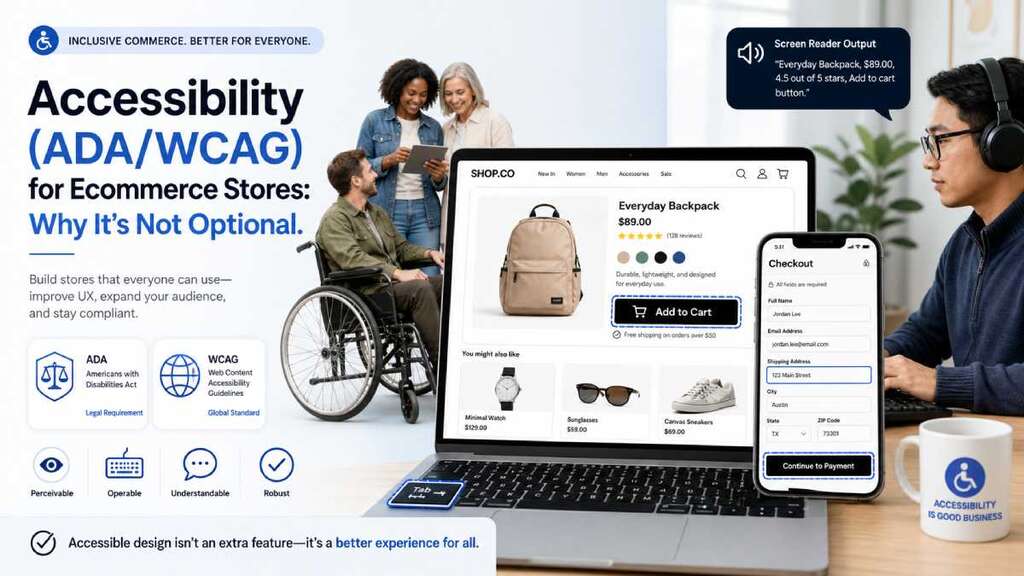
For ecommerce stores, accessibility is now a non‑optional requirement driven by accelerating ADA litigation and the reality that inaccessible UX directly erodes conversions and revenue. If you run an online store, “we’ll get to accessibility later” has quietly become one of the most expensive assumptions you can make.
The lawsuit wave you can’t ignore
ADA website accessibility lawsuits have grown every year since 2017 and crossed more than 5,000 digital cases in 2025 when federal and state courts are combined. Seyfarth Shaw’s ADA Title III tracker reports 3,117 federal website/app accessibility suits in 2025 alone—a 27% increase over 2024—and projections for 2026 are approaching roughly 6,176 digital accessibility lawsuits.
Zooming out, total ADA Title III federal lawsuits (covering both physical and digital access) hit 8,667 in 2025, roughly triple the 2013 baseline, with website cases now representing about 36% of all filings. Multiple trackers agree that since 2021, more than 4,000 digital accessibility lawsuits have been filed every year, confirming that this is a structural trend rather than a short‑term spike.
Why ecommerce is the epicenter
Ecommerce is now the single largest target category for ADA web lawsuits, accounting for roughly 69–79% of all filings depending on the dataset and year. UsableNet’s 2025 year‑end report found that nearly 70% of ADA web lawsuits targeted ecommerce, and among the top 500 ecommerce retailers, 35.8% had already received at least one accessibility lawsuit.
Critically, this is not just a “big box retailer” problem: various reports show that 67–68% of defendants have less than 25–50 million dollars in annual revenue, meaning small and mid‑market merchants are now the primary targets. Shopify merchants and other hosted platforms feature prominently in lawsuit data, largely because their ecosystems are dense with third‑party apps and custom scripts that introduce accessibility issues in carts, product filters, and checkout flows.
ADA, WCAG, and what “compliance” really means
In the U.S., ecommerce accessibility obligations primarily stem from ADA Title III, which requires “places of public accommodation” to be accessible—an interpretation courts have increasingly applied to websites and mobile apps that accept orders or bookings. While the ADA statute itself is technology‑neutral, WCAG 2.1 Level AA (and emerging 2.2) has become the de facto benchmark used by regulators, plaintiffs, and auditors to assess whether a site is accessible.
Internationally, similar obligations are emerging through frameworks like the European Accessibility Act (EAA) and Canada’s AODA, which also treat WCAG AA as the reference standard—so global ecommerce brands cannot assume this is only a U.S. concern. Functionally, “compliance” means building and maintaining your storefront so that people using screen readers, keyboard navigation, magnifiers, or alternate input methods can browse products, add to cart, and complete checkout without artificial barriers.
Quantifying the legal risk and cost
Industry analyses of ADA web accessibility cases show that typical single‑plaintiff ecommerce settlements fall somewhere in the 5,000–30,000 dollar range for demand letters and low‑complexity lawsuits, but full litigation exposure—including defense, remediation, and monitoring—often lands between 55,000 and 270,000 dollars per case. Breakdown data suggests that core settlement payments tend to be in the 30,000–75,000 dollar range for many ecommerce retailers, with additional legal fees often adding 10,000–50,000 dollars even when cases are resolved relatively quickly.
Aggregated numbers highlight how frequency amplifies impact: with around 5,000 digital accessibility suits in 2025 and an average settlement in the 25,000–30,000 dollar band, the industry is absorbing well over 100 million dollars annually in payouts before remediation and reputational costs are even counted. Many reports also stress that 40–46% of defendants are repeat targets, which means prior settlement does not automatically shield you from future claims if you continue to ship inaccessible experiences.
Widgets and quick fixes don’t protect you
One of the most sobering data points for ecommerce owners is how often sites are sued despite having accessibility widgets or overlays installed. EcomBack’s Q1 2026 report found that roughly 25–26% of ADA website lawsuits involved sites using accessibility widgets, and mid‑year and annual datasets for 2025 show similar percentages of overlay customers among defendants.
Several trackers note that courts and enforcement agencies increasingly view overlays as insufficient because they attempt to mask structural issues instead of fixing them in the underlying code, and lawsuit data shows that 20–38% of sued businesses had installed such tools at the time of litigation. The takeaway is clear: you cannot buy a one‑line script, toggle an icon, and assume you are insulated from ADA claims—genuine remediation at the template and component level is what matters.
Accessibility as core UX, not just compliance
Accessibility is often framed narrowly as a legal checkbox, but practically it is a UX discipline focused on making your store usable for more people, across more devices and contexts. Ecommerce benchmarks repeatedly find that over 90% of leading sites still have critical accessibility issues affecting navigation, images, forms, and keyboard support, and those same issues are friction points for every shopper, not just people with disabilities.
When you improve accessibility—clear labels, consistent headings, predictable navigation, adequate color contrast, and robust form validation—you also improve product discovery, checkout completion rates, and overall customer satisfaction across your entire audience. Studies and practitioner guides emphasize that accessible layouts and flows reduce abandonment by removing unexpected hurdles, whether someone is using a screen reader or simply shopping one‑handed on a phone in bright sunlight.
The patterns plaintiffs keep finding
Looking at lawsuit complaints and accessibility scans, the same WCAG failures appear over and over again across ecommerce sites. WebAIM’s “Million” report and litigation analyses identify low‑contrast text, missing or incorrect alt text, unlabeled form fields, empty links and buttons, missing document language, broken keyboard navigation, and inaccessible modal dialogs as the most common violations.
In ecommerce specifically, accessibility studies and legal analyses highlight chronic problems in product galleries, filters, and checkout flows: carousels without keyboard support, filters that don’t announce state changes to assistive tech, multi‑step checkouts with unlabeled inputs, and error messages that aren’t programmatically associated with the fields they reference. Because these components sit at the heart of the shopping journey, any break in accessibility directly translates to abandoned carts and lost revenue—long before a demand letter arrives.
The AI factor: why risk is accelerating
New reports and practitioner write‑ups point to a rise in pro se filings—lawsuits filed by plaintiffs without attorneys—which jumped to roughly 40% of federal web cases in 2025 according to some ADA Title III analyses. This trend is directly tied to the availability of AI‑assisted tools that can scan sites for WCAG violations and generate complaint drafts in minutes, dramatically lowering the barrier to filing.
At the same time, law firms specializing in accessibility litigation are using automated scanning pipelines to identify high‑value targets at scale, which helps explain why a relatively small number of firms are responsible for a large share of filings each year. For ecommerce operators, this combination of automation and established case law means that visible violations—missing alt text on product images, broken keyboard focus in checkout, low‑contrast pricing and CTA buttons—are now machine‑discoverable risk surface.
A practical roadmap for ecommerce stores
Given the data, “doing nothing” is an increasingly expensive default, but the path to meaningful accessibility is entirely manageable when treated as an ongoing product discipline rather than a one‑off project. Research‑backed guidance from accessibility firms and lawsuit trackers converge on a few pragmatic steps for ecommerce teams: run automated scans to identify machine‑detectable WCAG 2.1 AA issues, fix them in your templates and components instead of relying on widgets, monitor changes continuously, and document your remediation efforts.
Specifically for online stores, this means prioritizing core flows—home, category, product detail, cart, and checkout—ensuring they are fully operable by keyboard, screen reader‑friendly, and free from contrast and labeling issues, then extending that discipline to promotional modules, account areas, and any embedded third‑party apps. Many lawsuits arise from simple oversights like unlabelled “Add to Cart” buttons or inaccessible promo popups, so consistently baking WCAG requirements into design reviews, QA, and content governance creates both UX wins and a demonstrable compliance narrative.

Author of four Opencart book.
The recent are Opencart 4 developer book and Opencart 4 user manual