
The Metaverse Revolution: Artificial Intelligence Has Arrived

The combination of artificial intelligence (AI) and the Metaverse is going to revolutionize the way we interact with technology. AI enriches both virtual reality (VR) and augmented reality (AR) experiences by providing a level of realism and personalization that was previously unthinkable.  

What can artificial intelligence do in virtual spaces?

Generate virtual spaces in real time 

For starters, AI can be used to automatically and procedurally generate content in the VR environment. This allows creative designers to speed up their work and build more ambitious experiences in less time. In addition, it also allows virtual worlds to be created and adapted in real-time, according to the needs and actions of the users. AI and metaverse algorithms can dynamically generate landscapes, scenery, and elements, thus ensuring a unique and varied experience. For example, we could have a virtual space that we could customize in an almost unlimited way or roam the Metaverse with a pet generated from the characteristics that we want. 

Create more realistic and intelligent avatars 

For added realism, AI allows avatars and virtual characters within VR to behave more realistically and respond intelligently to user actions and gestures. AI algorithms can interpret and analyze user movements, leading to a more fluid and natural interaction in the virtual environment. This opens the door to specialized virtual advisors who could answer all our questions and help us at all times.  

Learn from data to improve virtual experiences 

Additionally, the AI ​​has the ability to analyze the data generated by users during their interactions in VR. This allows AI systems to tailor experiences in real-time to meet individual user preferences. By learning from past interactions, the AI ​​can deliver personalized content and adjust challenges or difficulty levels (in the case of entertainment experiences or sports training) to ensure a more rewarding experience. In fact, it can be used to provide accessibility to experiences by adapting to the needs of each individual, changing color scales for color-blind people, increasing the size of letters or buttons for the elderly, stabilizing hand movement for people with Parkinson’s, or describing images for visually impaired people. 

Translate in real time in multicultural virtual environments 

And what is surely going to revolutionize the Metaverse is the ability of AI to translate and communicate in multicultural VR environments. AI algorithms can recognize and translate speech and text in real-time, facilitating communication and collaboration between users of different languages ​​and cultures by connecting people’s lives in the Metaverse, removing barriers and making that concept possible. of the Metaverse as an accessible, inclusive, and global world that we all want.  

The risks of artificial intelligence and the Metaverse 

While the combination of artificial intelligence (AI) and virtual reality (VR) presents many exciting opportunities, it also carries potential risks that we must be aware of.  

Creativity and originality 

On the one hand, the automatic generation of content through AI in VR could lead to saturation of similar experiences and a lack of originality. If we put too much trust in algorithms, we could lose human creativity and diversity in creating virtual worlds.  

Privacy & Security 

In addition, the realism of AI-controlled avatars and virtual characters can raise ethical concerns, such as privacy, emotional manipulation, or even not knowing how to differentiate between a virtual avatar and a person.  

If AI can interpret and analyze our movements and gestures, to what extent will our privacy and free expression be respected in these virtual environments?  

In addition, real-time tailoring of experiences based on our personal data could lead to the manipulation of our preferences and limit our exposure to new ideas and perspectives. This collection of large amounts of data about users, such as movements, gestures, preferences, and behaviors, raises privacy and security concerns, as personal data could be misused or vulnerable to cyberattacks. It is essential to establish clear privacy policies and ensure that adequate measures are taken to protect user data. 

Discrimination and exclusion 

It is also important to consider the challenges related to translation and communication in multicultural environments. Although AI can facilitate communication between different languages, misunderstandings and loss of important cultural nuances can also occur. We are aware that communications may contain cultural, gender, or racial biases, which AI systems can perpetuate and amplify in the Metaverse. This raises ethical and social concerns in terms of discrimination and exclusion, so it is important to conduct an assessment and mitigation of biases in the AI ​​systems used in the Metaverse. 

It is critical to address these risks and develop appropriate safeguards to ensure that the combination of AI and the Metaverse is used ethically and responsibly for the benefit of all users.

How to make the CKeditor supports HTML, iFrame and scripts in Opencart editor?

We were trying to add the google map iframe HTML code in the CKeditor of Opencart but by default, the HTML encode output is disabled on Opencart 4+, so to enable we need to change the CKeditor configuration and make the CKeditor support the HTML and iframe code. The General HTML Support allows for adding markups like elements, attributes, classes, and styles to the source and prevents it from being filtered from the editor window and the output.

Enable the General HTML Support for CKeditor in Opencart 4

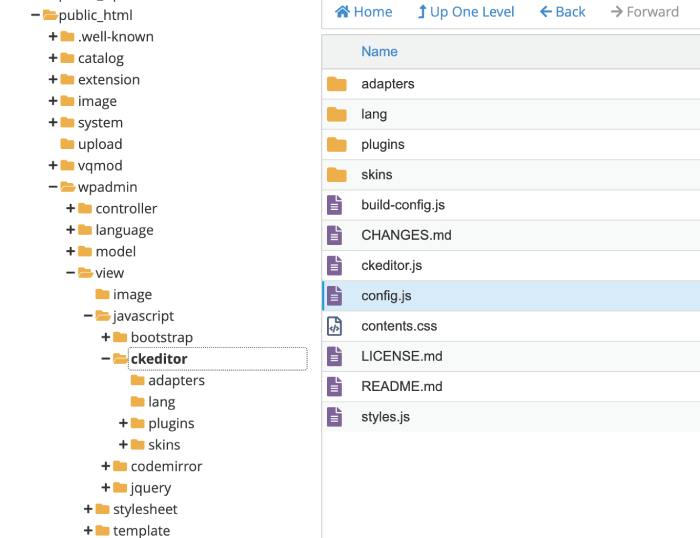
Go to admin >> view >> javascript >> ckeditor and open config.js

CKeditor Opencart

In the config.js file find config.htmlEncodeOutput = false, and change it to true.

config.htmlEncodeOutput = true;

And also make sure there is

config.allowedContent = true;

With this config change and clearing the website cache, now you can add the iframe and HTML code in the CKeditor.

If you still are not able to add the iframe or other HTML code then download the following code and unzip it and replace the ckeditor folder at admin >> view >> javascript >> ckeditor

Demo example of google map iframe

We added the iframe of google map in the HTML module and show it in the contact us page

In this way, you can configure the CKeditor to add the iframe, scripts and HTML markups like elements, attributes, classes, and styles. Please let us know if you have any other issues that you are facing then we can look at it, you can email us at webocreation.com@gmail.com. Hope you liked this tutorial, please subscribe to our YouTube Channel and read more about Opencart Documentation. You can also find us on Twitter and Facebook.

Web3 and the Future of Ecommerce: Bridging the Gap Between Buyers and Sellers

Web3 has arisen as a potent force in the constantly changing world of technology and business that has the potential to completely change how we buy and sell products and services online. Web3 is positioned to close the gap between buyers and sellers by providing a more transparent, safe, and effective ecommerce experience thanks to its decentralized structure and cutting-edge apps. We will discuss the idea of Web3 and how it might affect ecommerce in the future in this article.

The development of Web3 technology has expanded e-commerce’s potential and transformed how buyers and sellers communicate and conduct business online. Web3 utilizes blockchain technology and decentralized networks to build a more democratic and inclusive digital economy than its predecessor, Web2, which was dependent on centralized platforms and middlemen.

Recognizing Web3

The term “Web3,” usually referred to as “the decentralized web,” describes a group of technologies that allow peer-to-peer communication and data ownership without the need for centralized control. Web3’s primary method of establishing trust, transparency, and security in online transactions is through the use of blockchain technology.

The State of Ecommerce Right Now

Online marketplaces have grown in popularity over the past ten years as ecommerce has expanded significantly. The ecommerce environment of today is not without its difficulties, though. Centralized platforms frequently regulate information flow and charge transaction fees, increasing expenses for both buyers and sellers. Furthermore, fraudulent activity and data breaches have reduced people’s faith in online transactions.

Web3’s Advantages in Ecommerce

Web3 has the ability to improve on the drawbacks of conventional e-commerce platforms and open up a number of advantages for both shoppers and merchants.

Higher Transparency

Increased transparency in ecommerce is one of Web3’s main benefits. Every transaction made using blockchain technology is recorded on a public, open ledger that is accessible to all parties. As the transaction history can be easily confirmed, this transparency fosters trust between buyers and sellers.

Improved Security

In addition, Web3 provides better security than conventional e-commerce systems. Web3 makes guarantee that transactions are safe, immutable, and resistant to fraud by utilizing the cryptographic protocols of blockchain. Customers gain trust as a result of the greater security, which encourages them to shop online more frequently.

Peer-to-Peer Transactions that are Quick

By enabling direct peer-to-peer transactions, Web3 does away with the necessity for middlemen. This enables direct communication between buyers and sellers, resulting in quicker and more effective transactions. Web3 lowers expenses and enables sellers to get paid the full value of their goods or services by doing away with middlemen.

Web3 applications for online shopping

A new world of e-commerce opportunities is made possible by Web3. Here are a few of the most important Web3 uses in the online retail industry.

Centralized Alternative Markets

Blockchain technology is used by decentralized marketplaces to build peer-to-peer systems that enable direct communication between buyers and sellers. By doing away with middlemen, these marketplaces provide reduced fees, quicker transactions, and greater privacy.

Asset Tokenization

Physical or digital assets can be represented as blockchain tokens thanks to Web3’s ability to tokenize them. As a result, chances for fractional ownership become available, enabling buyers to make investments in high-value assets without having to spend a lot of money. Additionally, tokenization improves liquidity and makes ownership transfers simple.

Insightful Contracts

Smart contracts are agreements that automatically carry out their obligations because they are encoded in code. Smart contracts can be used in e-commerce with Web3, automating a number of steps in the purchasing and selling process. These agreements make sure that transactions only take place when specific requirements are satisfied, which minimizes the need for trust between the parties.

Reputation Management

Reputation systems powered by blockchain technology are now available thanks to Web3. Based on their past transactions, these systems enable buyers and sellers to build and maintain reputations. Reputation scores aid in decision-making and foster trust in the online market.

Challenges and Things to Think About

Although Web3 has a bright future for e-commerce, there are still a number of issues that need to be resolved.

Scalability

Scalability is still a major obstacle for blockchain technology, which is still in its infancy. In comparison to centralized platforms, current blockchain networks are susceptible to bottlenecks and slower transaction speeds. Scalability solutions must be created as Web3 develops to support widespread usage.

User Acceptance

Widespread user adoption is essential for Web3 to genuinely transform ecommerce. Users must be informed about the advantages and features of Web3 applications in order for adoption to occur. The divide between traditional ecommerce and the decentralized web can be closed with the use of user-friendly interfaces and seamless onboarding processes.

Regulatory Conformity

Regulatory compliance becomes a key factor as Web3 challenges established ecommerce practices. Governments and regulatory organizations must modify their frameworks to account for Web3’s decentralized nature while maintaining consumer security and protection.

Web3 and the Future of E-Commerce

The use of Web3 technology into e-commerce has the potential to significantly alter the market.

Enhanced Customer Confidence and Trust

Web3 can boost trust and confidence in online transactions by utilizing blockchain’s transparency and security capabilities. The availability of verified information will give buyers the confidence they need to make wise choices. A higher conversion rate and greater client loyalty may result from this enhanced trust.

Increasing Small Business Power

By lowering entrance barriers and getting rid of middlemen, Web3 can level the playing field for small enterprises. Small enterprises can sidestep conventional distribution channels and reach a global audience thanks to decentralized marketplaces. Increased competition and innovation may result from this democratization of ecommerce.

Traditional Platform Disintermediation

By eliminating middlemen and lowering transaction costs, Web3 has the potential to challenge established e-commerce platforms. Buyers and sellers are empowered by this disintermediation, enabling them to communicate openly and take advantage of the advantages of a peer-to-peer economy.

Conclusion

With its decentralized and trustless infrastructure for online transactions, Web3 marks a paradigm change in the field of e-commerce. Web3 has the ability to close the gap between customers and sellers by enhancing security, transparency, and peer-to-peer interactions, transforming the way we purchase and sell products and services online.

How Blockchain is Revolutionizing the Supply Chain

The supply chain is an essential part that every company must take care of if it wants to be truly competitive in its sector. Five key players participate in it: suppliers, producers, distributors, retailers, and finally customers. In the global industrial environment in which we live today, keeping track of each of these parts is complex, especially since each actor often intervenes from a different part of the world.

Getting each of these participants to collaborate is key to having a consistent and efficient supply chain system. If this is not achieved, there will be a negative impact both on the profitability of the companies and on the final sale price, which ends up harming customers.

Fortunately, there is a technology that promises to make supply chain management more efficient, flexible, and profitable. This is Blockchain, the technology behind Bitcoin, which is presented as a new way of understanding business thanks to its transparency, immutability, and decentralization.

Blockchain to face the challenges of the supply chain

Blockchain technology has become very popular in the last decade thanks to cryptocurrencies. However, it can be said that it is a technology that is still in its early stages. Even so, shortly, its use is expected in multiple sectors, the supply chain being one of the most promising due to its complex environment.

Blockchain, which in Spanish means chain of blocks, is a technology that allows the transfer of encrypted digital data in a complex way to guarantee the security of the information. A key characteristic of this system is that said information does not have intermediaries or owners but is distributed in different nodes (computers) that are independent of each other. In this way, data is recorded and validated without the need for trust between them.

The highlight is that the information registered in the Blockchain cannot be deleted once it has been entered. It is only possible to add new records that the majority of those involved must approve. Therefore, it is not possible to manipulate or alter data, unless the entire network agrees.

Supply chain problems

Thanks to the way Blockchain works, one of the big problems in the supply chain is eliminated: the lack of transparency, which leads to inconveniences associated with costs and customer relations, which in the end can negatively influence the brand name.

Blockchain provides a proper tracking mechanism for the supply chain. In this way, the tracking of the origin of the components becomes easier and the product information can be accessed through the help of elements such as RFID tags and integrated sensors. In short, with Blockchain you can trace the history of a product from its origin to its current location.

Being able to trace a product from start to finish in the supply chain also eliminates the problem of poor customer service. Remember that the process does not end when the product is distributed to retailers. After delivery, proper customer management must be carried out, since they are an essential part of the chain.

Companies must then satisfy customers’ needs and respond to their concerns so that their reputation is not affected. If the company does not do so, it will surely lose that client, and the worst thing is that it will not be just one, since many more will follow. Keep in mind that in the age of social media, complaints about poor service can spread quickly, which will undoubtedly mean the loss of many customers in the long run.

Advantages of using Blockchain in the supply chain

Blockchain promises to eliminate these problems in supply chains by increasing transparency, reducing costs, tracking specific items at each stage of their journey, and enabling better customer-facing management. And it is that with this technology each participant in the chain can visualize the progress of the merchandise, identify where it is and what its status is, among many other things.

● Transparency

Since records are transparent and immutable, Blockchain can be used to record data on the location and ownership of products and materials. And so, anyone in the Blockchain supply chain can monitor everything while the move is happening. Also, because the data records are unchangeable, there will be no question of who is responsible if something goes wrong.

● Cost reduction

Inefficiency within the supply chain can result in many economic losses, especially when it comes to industries that work with perishable products. By having greater transparency in management, companies can more efficiently and quickly identify the areas where losses occur. And with this information in hand, they can establish measures that allow cost savings.

Uses of Blockchain in the supply chain today

Blockchain technology can transform the supply chain of companies in many ways. For this reason, many companies are already adopting systems based on it. Since this technology makes it possible to know the place of origin of the product, companies such as De Beers, one of the largest diamond producers in the market, have begun to use it to avoid so-called ‘blood diamonds’. And it is that the Blockchain allows, among many other things, to detect copies and copyright infringement.

Numerous food companies are also betting on the use of Blockchain in the supply chain. One of them is Walmart, which has a food traceability project; for example, the traceability of the origin of pork comes from China. They are also planning to track food from farm to store in real-time.

Another big company that wants to take advantage of Blockchain is Unilever. The company is using this technology to manage the tea supply chain process. One of his projects involves tracking tea farmers in Malawi, the main supplier of tea leaves.

In the logistics sector, companies like FedEx and Maersk are also leading the way toward the use of Blockchain in the supply chain. Therefore, it is thought that although this technology is still in the maturing phase, the time to include it in the ‘supply chain’ has already arrived.

There is no doubt that Blockchain has introduced its potential to generate positive changes in the supply chain industry. That is why it can be expected that in the coming years, it will grow at a very fast pace. With this in mind, companies must explore the different ways to embrace the change that this technology has to offer, especially to help eliminate vulnerabilities and inefficiencies in today’s supply chain management.

Rust-based Decentralized Applications for Blockchain

DApps or Decentralized Applications: What are they?

Blockchain technology is already here and works to improve and secure many of the issues that concern our day to day. Among the improvements that the blockchain brings us, we find DApps or Decentralized Applications (Decentralized Applications), a type of application that does not depend on a central server but is based on a decentralized network of computers. This fact makes it possible to access the information in a more secure way.

In order to be part of the development of applications and tools based on the blockchain, at Three Points we advise you not to neglect your training and to make the most of programs such as the Master in Blockchain and Crypto. Thanks to this postgraduate course, you will be able to learn how to get the most out of this technology, which is increasingly present in our daily lives. Do not doubt it, currently, the market is demanding 26% more professionals trained in this field.

What are DApps?

Dapps or Decentralized Applications are a category of applications that work from a decentralized network of computers. The data generated by these applications are hosted on a computer network that works so that the information is safe and also has easy access.

The decentralized network is what is known as DLT, a set of non-centralized technologies, which are generally based on blockchain technology.

To try to understand it, what happens with DApps is that, instead of running on a central server, it runs on a network made up of a large number of computers or nodes.

The main characteristics of DApps are:

· Security: due to the use of blockchain, they work on very strong cryptography that allows greater security to the data that is used in them.       

· Decentralization: it does not require central servers, which means it does not depend on them and, therefore, has fewer failures.       

· Open source: having a source code available provides great transparency. Anyone can inspect the code or improve it.       

· Blockchain: they are based on the blockchain to encrypt the data that is handled.       

OpenAI ChatGPT uses in eCommerce business

DApps and Rust blockchain

Among the characteristics that these types of applications have, we must highlight the blockchain. The DApps have their origin in it and in its security possibilities, more and more tangible.

The DApps or Decentralized Applications interact on the blockchain in which your Smart contract is running. In other words, each interaction in the Decentralized Applications creates a new entry of information in the blockchain. Thanks to this interaction, the data is stored in a cryptographic way to add greater security to the operation.

We must be aware of the importance of blockchain technology for the security of the information that is handled through it. That is why this type of rust blockchain application is used so much, especially in companies. But not only that, beyond the business world, the innovation provided by the blockchain is transferred to other types of very different applications, such as blockchain games for Android.

What advantages do DApps in Rust have?

DApps have certain advantages over other applications :

· The security provided by the blockchain allows the most sensitive user information to be shielded against theft, manipulation, and cyberattacks by third parties.       

· If used for social media posting, it cannot be tracked by any central entity so that the data can be used for commercial purposes.       

· They allow contracts to be closed through Smart Contracts (smart contracts), which are executed automatically if certain conditions are met.       

· By having a distribution in nodes, there is no service drop. Should any part of the network go down, the rest will continue to function without a problem.

Metaverse makes a transformative impact on eCommerce

Benefits of building DApps with Rust :

The top 2 benefits of building web3 DApps with Rust instead of Solidity are: Rust’s fast speeds and memory-safe properties make development safer for engineers and apps more efficient for customers.

Memory safety is a property of some programming languages ​​that prevent programmers from making certain types of memory-related errors.
Rust  Blockchain achieves memory security using the principle of ownership and borrowing. Rust ensures memory safety by removing memory-related errors at compile time, making it memory efficient without the use of a garbage collector like other memory-safe languages.

How to handle a large number of products in a sitemap for Opencart?

One of our clients had products around 50k because of which the sitemap could not load and always throw 500 errors as Opencart tried to load all the products’ sitemap URLs on one page. So, our solution is to show the sitemap URLs in a chunk of 500 and use the sitemap index.

Solution:

Although a single sitemap limit is 50MB or 50k URLs, mostly the hosting providers or servers cannot handle showing all of those 50k URLs on one page so our solution is to create chunks to 500 URLs as one sitemap and list all sitemaps using sitemapindex and submit this one sitemap which includes the sitemapindex.

Here is an example of sitemapindex:

<?xml version="1.0" encoding="UTF-8"?>
<sitemapindex xmlns="http://www.sitemaps.org/schemas/sitemap/0.9">
    <sitemap>
        <loc>https://webocreation.com.com/index.php?route=extension/feed/google_sitemap&amp;start=0&amp;end=500</loc>
        <lastmod>2023-02-19T18:23:17+00:00</lastmod>
    </sitemap>
    <sitemap>
        <loc>https://webocreation.com.com/index.php?route=extension/feed/google_sitemap&amp;start=500&amp;end=500</loc>
        <lastmod>2023-02-19T18:23:17+00:00</lastmod>
    </sitemap>
    <sitemap>
        <loc>https://webocreation.com.com/index.php?route=extension/feed/google_sitemap&amp;start=1000&amp;end=500</loc>
        <lastmod>2023-02-19T18:23:17+00:00</lastmod>
    </sitemap>
    <sitemap>
        <loc>https://webocreation.com.com/index.php?route=extension/feed/google_sitemap&amp;start=1500&amp;end=500</loc>
        <lastmod>2023-02-19T18:23:17+00:00</lastmod>
    </sitemap>
    ...
    ...
    ...
</sitemapindex>

When you see one of the sitemap URLs, for example, this URL https://webocreation.com.com/index.php?route=extension/feed/google_sitemap&amp;start=0&amp;end=500 then you will see the sitemap code like below of 500 products:

<?xml version="1.0" encoding="UTF-8"?>
<urlset xmlns="http://www.sitemaps.org/schemas/sitemap/0.9"
    xmlns:image="http://www.google.com/schemas/sitemap-image/1.1">
    <url>
        <loc>https://webocreation.com.com/walnut</loc>
        <changefreq>daily</changefreq>
        <lastmod>2023-02-20T00:00:00+00:00</lastmod>
        <priority>1.0</priority>
        <image:image>
            <image:loc>https://webocreation.com.com/image/cache/catalog/data/GKOF20SVE-1000x1000.jpg</image:loc>
            <image:caption> Walnuts</image:caption>
            <image:title> Walnuts</image:title>
        </image:image>
    </url>
    <url>
        <loc>https://webocreation.com.com/insurances</loc>
        <changefreq>daily</changefreq>
        <lastmod>2023-02-20T00:00:00+00:00</lastmod>
        <priority>1.0</priority>
        <image:image>
            <image:loc>https://webocreation.com.com/image/cache/catalog/data/GPT2A45410-1000x1000.jpg</image:loc>
            <image:caption>Insurances</image:caption>
            <image:title>Insurances</image:title>
        </image:image>
    </url>
   ...
   ...
   ...
</urlset>

Code changed for the Google sitemap extension

Open file catalog/controller/extension/feed/google_sitemap.php, remove all code, and paste the following:

<?php
class ControllerExtensionFeedGoogleSitemap extends Controller {
	public function index() {
		if ($this->config->get('feed_google_sitemap_status')) {
			if(isset($_GET['manufacturers']) && $_GET['manufacturers']=='active'){
				$output = $this->getManufactureresSiteMaps();
			}elseif (isset($_GET['start'])) {
				$output = $this->getProductsSiteMaps($_GET['start'], $_GET['end']);
			}else{
				
				$output ='<?xml version="1.0" encoding="UTF-8"?><sitemapindex xmlns="http://www.sitemaps.org/schemas/sitemap/0.9">';

				$this->load->model('catalog/product');
				$totalProducts = $this->model_catalog_product->getTotalProducts();
				for($i=0; $i<$totalProducts; $i=$i+500 ){
					$output .= '<sitemap><loc>'.HTTPS_SERVER.'index.php?route=extension/feed/google_sitemap&amp;start=' . $i . '&amp;end=500</loc><lastmod>2023-02-19T18:23:17+00:00</lastmod></sitemap>';
				}
				$output .= '<sitemap><loc>'.HTTPS_SERVER.'index.php?route=extension/feed/google_sitemap&amp;manufacturers=active</loc><lastmod>2023-02-19T18:23:17+00:00</lastmod></sitemap>';
				$output.='</sitemapindex>';
			}

			$this->response->addHeader('Content-Type: application/xml');
			$this->response->setOutput($output);
		}
	}

	protected function getCategories($parent_id, $current_path = '') {
		$output = '';

		$results = $this->model_catalog_category->getCategories($parent_id);

		foreach ($results as $result) {
			if (!$current_path) {
				$new_path = $result['category_id'];
			} else {
				$new_path = $current_path . '_' . $result['category_id'];
			}

			$output .= '<url>';
			$output .= '  <loc>' . $this->url->link('product/category', 'path=' . $new_path) . '</loc>';
			$output .= '  <changefreq>daily</changefreq>';
			$output .= '  <priority>0.7</priority>';
			$output .= '</url>';

			// $this->load->model('catalog/product');

			// $products = $this->model_catalog_product->getProducts(array('filter_category_id' => $result['category_id']));

			// foreach ($products as $product) {
			// 	$output .= '<url>';
			// 	$output .= '  <loc>' . $this->url->link('product/product', 'path=' . $new_path . '&product_id=' . $product['product_id']) . '</loc>';
			// 	$output .= '  <changefreq>daily</changefreq>';
			// 	$output .= '  <priority>1.0</priority>';
			// 	$output .= '</url>';
			// }

			$output .= $this->getCategories($result['category_id'], $new_path);
		}

		return $output;
	}

	protected function getProductsSiteMaps ($start, $end) {
		$output = '<?xml version="1.0" encoding="UTF-8"?>';
		$output .= '<urlset xmlns="http://www.sitemaps.org/schemas/sitemap/0.9" xmlns:image="http://www.google.com/schemas/sitemap-image/1.1">';

		$this->load->model('catalog/product');
		$this->load->model('tool/image');

		$filter_data = array(
			'start' => $start,
			'limit' => 500,
		);
		$products = $this->model_catalog_product->getProducts($filter_data);
		foreach ($products as $product) {
			if ($product['image']) {
				$output .= '<url>';
				$output .= '  <loc>' . $this->url->link('product/product', 'product_id=' . $product['product_id']) . '</loc>';
				$output .= '  <changefreq>daily</changefreq>';
				$output .= '  <lastmod>' . date('Y-m-d\TH:i:sP', strtotime($product['date_modified'])) . '</lastmod>';
				$output .= '  <priority>1.0</priority>';
				$output .= '  <image:image>';
				$output .= '  <image:loc>' . $this->model_tool_image->resize($product['image'], $this->config->get('theme_' . $this->config->get('config_theme') . '_image_popup_width'), $this->config->get('theme_' . $this->config->get('config_theme') . '_image_popup_height')) . '</image:loc>';
				$output .= '  <image:caption>' . (str_replace('&', 'and', $product['name'])) . '</image:caption>';
				$output .= '  <image:title>' . (str_replace('&', 'and', $product['name'])) . '</image:title>';
				$output .= '  </image:image>';
				$output .= '</url>';
			}
		}
		$output .= '</urlset>';

		return $output;
	}

	protected function getManufactureresSiteMaps(){
		$output = '<?xml version="1.0" encoding="UTF-8"?>';
		$output .= '<urlset xmlns:xsi="http://www.w3.org/2001/XMLSchema-instance" xmlns:image="http://www.google.com/schemas/sitemap-image/1.1" xsi:schemaLocation="http://www.sitemaps.org/schemas/sitemap/0.9 http://www.sitemaps.org/schemas/sitemap/0.9/sitemap.xsd http://www.google.com/schemas/sitemap-image/1.1 http://www.google.com/schemas/sitemap-image/1.1/sitemap-image.xsd" xmlns="http://www.sitemaps.org/schemas/sitemap/0.9">';

		$this->load->model('catalog/category');

		$output .= $this->getCategories(0);

		$this->load->model('catalog/manufacturer');

		$manufacturers = $this->model_catalog_manufacturer->getManufacturers();

		foreach ($manufacturers as $manufacturer) {
			$output .= '<url>';
			$output .= '  <loc>' . $this->url->link('product/manufacturer/info', 'manufacturer_id=' . $manufacturer['manufacturer_id']) . '</loc>';
			$output .= '  <changefreq>daily</changefreq>';
			$output .= '  <priority>0.7</priority>';
			$output .= '</url>';

			//$products = $this->model_catalog_product->getProducts(array('filter_manufacturer_id' => $manufacturer['manufacturer_id']));

			// foreach ($products as $product) {
			// 	$output .= '<url>';
			// 	$output .= '  <loc>' . $this->url->link('product/product', 'manufacturer_id=' . $manufacturer['manufacturer_id'] . '&product_id=' . $product['product_id']) . '</loc>';
			// 	$output .= '  <changefreq>daily</changefreq>';
			// 	$output .= '  <priority>1.0</priority>';
			// 	$output .= '</url>';
			// }
		}

		$this->load->model('catalog/information');

		$informations = $this->model_catalog_information->getInformations();

		foreach ($informations as $information) {
			$output .= '<url>';
			$output .= '  <loc>' . $this->url->link('information/information', 'information_id=' . $information['information_id']) . '</loc>';
			$output .= '  <changefreq>daily</changefreq>';
			$output .= '  <priority>0.5</priority>';
			$output .= '</url>';
		}
		$output .= '</urlset>';
		return $output;
	}
}

This is the rough way to do it for now but no worries we will soon create an extension for it and provide you guys, for now, this is the quick way to achieve it.

In this way, you can submit the sitemap for a large number of products and submit it to google, bing, or other search engines. Please let us know if you have any kind of projects, you can email us at webocreation.com@gmail.com. Hope you liked this tutorial, please subscribe to our YouTube Channel and get more Opencart free extensions. You can also find us on Twitter and Facebook.

Tips and tricks to improve Pardot form select fields with JavaScript

After completing multiple projects in Pardot, here are some of the tips and tricks to improve the form select fields of Pardot with Javascript. There is no default value shown in the Pardot form select, so if you want to add some default value like for the country field: “Please select your Country” then you need to add some JavaScript. Here is the default form select field in Pardot.

No default select in Pardot form

Here is the JavaScript that you can add to the form

<script>
    window.addEventListener("load", function (event) {
        var countryoption = document.querySelector(".country select option");
        if (countryoption) {
            countryoption.innerHTML = "Please select your Country";
        }
    });
</script>

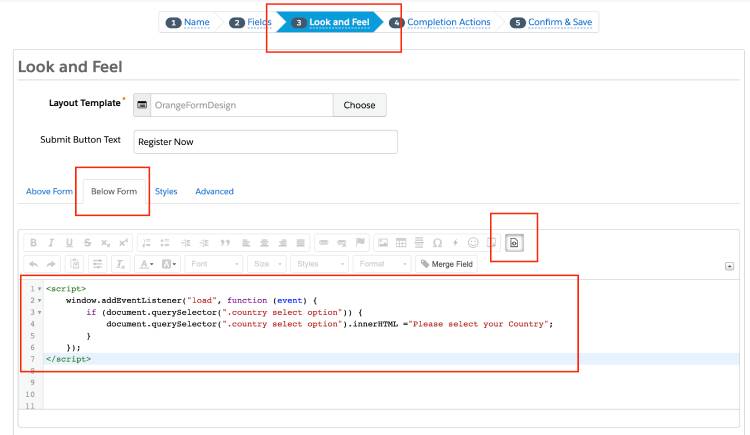
You can add the above JavaScript in the Pardot form, one way is you can add the JS by editing the form >> Look and Feel tab >> Below Form tab >> Click the Source icon and paste the Javascript.

Pardot form custom javascript

Now the form looks like the below:

Please select country default

Read more: Marketo form administration tool – add or update field for all forms at once

If you did not see the value then you may need to customize the following line of code:

document.querySelector(".country select option");

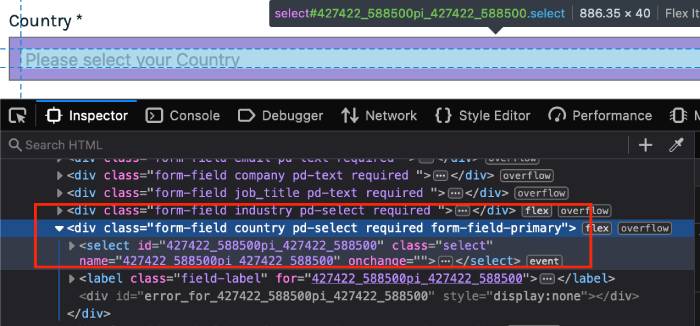
Change that country to your form field name. You can see it by inspecting it. In the browser, right-click near the form field >> then click inspect >> see what is the field name in the class

Following is one example:

form-field  country pd-select required    form-field-primary

With that, we can say the class is country so we use .country

find form field name

How to set a default value for a custom dropdown in a Pardot form?

You wanted a default value to be selected, for example, the USA country needs to be selected by default.

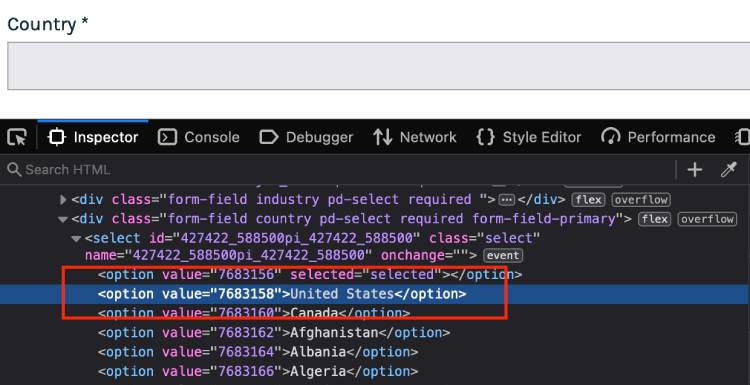
When we inspect we find that the value of the option is 7683158

option value of USA country pardot form

Now adding the following JavaScript in the below form will select the USA by default.

<script>
    window.addEventListener("load", function (event) {
        var countries = document.querySelector(".country select");
        for (var i = 0; i < countries.options.length; i++) {
            if (countries.options[i].value == ‘7683158’) {
                countries.options[i].selected = true;
            }
        }
    });
</script>

Here is the final result:

auto option selected

Read more: Pardot, Mailchimp, and website integrating Marketing system

Let’s make the select label a placeholder

CSS that makes the label lower can be like below:

<style>
#pardot-form .pd-select .field-label {
    position: relative;
    top: 35px;
    padding-bottom: 5px;
    padding-left: 10px;
}
</style>

Now select the field that looks like below:

select label placeholder

Now, with the following JavaScript, the select form label is pulled up when the option value is changed.

<script>
   window.addEventListener("load", function () {
       var inp = document.querySelector(".country select");
       inp.onchange = function (e) {
           if (this.value != '439913') {
               document.querySelector(".country.pd-select > label").style.cssText =
                   "top:-1.5em;font-size: 12px;position: relative; min-height: 55px";
               document.querySelector(".country.pd-select > select").style.cssText =
                   "padding-left: 15px !important;";
           } else {
               document.querySelector(".country.pd-select > label").style.cssText = "";
           }
       };
   });
</script>

Here is the result

Move Label in form field

Read more:  How to integrate Pardot on the website easily?

How to add custom form field validation in Pardot form?

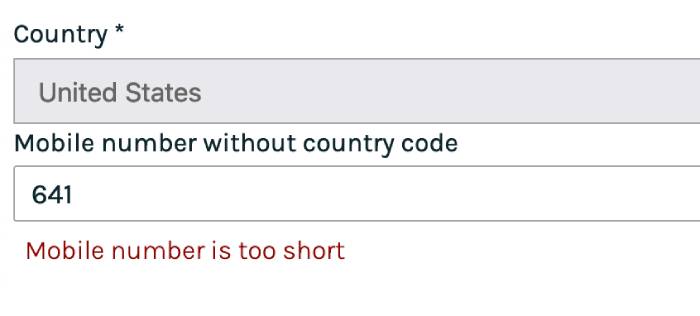
Let’s say you need to validate a phone form field and allow more than 7 digits, then something like the below JavaScript can do the trick.

<script>
    window.addEventListener("load", function () {
        var inp = document.querySelector(".phone input");
        var element = document.querySelector(".phone div");
        inp.onkeyup = function (e) {
            if (inp.value.length < 7) {
                element.innerHTML = "<p class='error'>Phone number is too short</p>";
                element.style.display = "block";
            }
        };
    });
</script>
phone validation pardot form

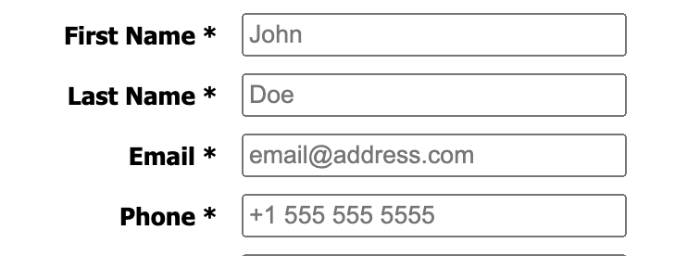
How to add the placeholder form field in Pardot form?

Pardot form placeholder

As Pardot doesn’t have a placeholder by default, so you can add the placeholder from JavaScript code like below, let’s say your field’s class name is first_name then the code is:

var firstname = document.querySelector('.first_name input');
 if(firstname){
    firstname.placeholder = 'John';
}

In this way, we helped multiple clients to make form layouts, landing page layouts, and email layouts and made them as per their brand guidelines. Please let us know if you have similar kinds of projects, you can email us at webocreation.com@gmail.com. Hope you liked this tutorial, please subscribe to our YouTube Channel and read more about Salesforce, Pardot, Marketo, and Hubspot. You can also find us on Twitter and Facebook.

Best practices to prevent e-Commerce Fraud

It’s no secret that e-commerce fraud is on the rise. From phishing scams to fraudulent chargebacks, online businesses often struggle with high levels of fraud and lost income due to theft and misuse of their services. But don’t worry – there are some steps you can take to help reduce the chances of becoming a victim. 

 This guide will explore the best practices for preventing eCommerce fraud and keeping your business running smoothly and securely. So let’s get started! 

25 website security measures for eCommerce developers

Put a limit on order quantities

Keeping your e-commerce business safe from fraud is all about prevention, so why not start at the checkout? Limiting order quantities can help you spot suspicious orders right away. For example, if someone’s trying to buy five of the same item in one go, that could be a potential warning sign.

Regarding specific rules, it’s wise to limit how many items an individual can purchase in one day or week and restrict orders for certain expensive items. This way, you can help ensure that legitimate customers are ordering what they need without giving criminals a chance to take advantage of your shop. Plus, it can help prevent over-ordering, leading to excessive returns and unhappy customers. 

Be strict about verification 

To protect your e-commerce store from fraudsters, you must have a strict verification process in place. This means ensuring that customers provide accurate information, such as a valid shipping address and phone number. You can also require customers to provide a current photo ID or credit card to verify their identity. Wondering why this is an essential practice in your business? 

Well, the truth of the matter is that fraudsters are always on the lookout for an opportunity to take advantage. They can quickly identify and manipulate vulnerable systems with ease. By having strict verification measures in place, you’ll be able to protect your eCommerce store from any fraudulent activity. On top of that, you also make eCommerce customers feel safe since strict verification ensures the legitimacy of your website. 

Setup Cloudflare easily for eCommerce websites

Keep an eye out for risky orders

While it’s not always possible to tell if an order is suspicious at first glance, taking extra time and doing a little extra digging can go a long way. In the case of e-commerce fraud, it’s always better to be safe than sorry. If you spot something that looks a little off, don’t hesitate to check it out immediately. 

Reach out to suspicious clients to settle your doubts and judge whether to continue with the transaction. This way, you’ll be able to protect your business from fraud and scams. Some common ‘red flags’ include customers outside your typical customer profile, multiple purchases from one IP address, and orders for expensive items without verification. 

Always check and update site security 

It’s a no-brainer: constantly checking and updating site security is the best way to protect your e-commerce business from fraud. This means ensuring that your website’s code is up-to-date and free of any vulnerabilities that hackers could exploit. This also includes renewing your SSL certificate to encrypt customer data or regularly monitoring for any signs of phishing scams and malicious activities.

In addition, look for any outdated or vulnerable versions of software and plugins and any new threats that may have been discovered since you last checked. Don’t forget to have an updated form of two-factor authentication for logging into customer accounts and adopting new measures to monitor IP addresses. All of this help stave off fraudsters who use loopholes to exploit weaknesses in your website system.

Post clear policies on your website 

When it comes to protecting your e-commerce website from fraud, it pays to be proactive. One of the most important steps you can take is to post clear policies on your site so that customers know exactly what they should expect when making a purchase. From shipping times to potential taxes or fees, ensure it is all clearly stated and easy to find. 

Aside from this, don’t forget to entail potential fraudulent policies on your website, including how you’ll deal with them. This way, customers who are trying to scam you will know that their actions won’t be tolerated and that they can expect swift action from you should anything suspicious occur. 

Rely on anti-fraud tools

If you’re handling an e-commerce business, it’s absolutely essential to have the right anti-fraud tools in place. Not only will they help keep your customer’s data safe and secure, but they can also prevent many headaches down the line. Remember, these tools are designed to recognize suspicious activity and alert you to any potential threats. 

They come in all shapes and sizes, ranging from traditional data analysis techniques like anomaly detection and machine learning algorithms to more advanced methods like facial recognition and biometrics. Some can even help you prevent cryptojacking, ensuring the safety of site visitors and customers alike. With them in place, you’re sure to have an extra layer of security against many types of fraud attempts. 

Create detailed order records

No matter how big or small your e-commerce business is, it’s important to have detailed order records. Of course, it’s beneficial since it allows you to trace orders without any hassle. However, it’s also a great practice if you want to save yourself from many fraudulent attempts. 

Doing so can help you quickly spot suspicious activity in requests, such as orders placed using stolen credit cards or duplicate ones from the same customer. Tip: ensure to include information such as the customer’s name, address, and order details in your records so that you can easily reference them if needed. You should also keep a record of any refunds or cancellations to support you in resolving any disputes that might arise. 

In conclusion

Following these practices can help ensure that your e-commerce business is secure and protected from fraud. You can also provide a safe shopping experience for your customers, which is crucial if you want to pave the road to success! 

The Potential of Cryptography in Cybersecurity: A New Era of Protection

We live in a world where threats lurk around every digital corner. To protect our data, networks, and communication from malicious outside forces, we need powerful tools to keep these elements secure and safe. Cryptography is an ancient practice, yet its potential for cybersecurity applications is only beginning to be tapped into. 

In this article, we will discuss the potential of cryptography in cybersecurity, its benefits and drawbacks, current examples of cryptographic tools used in this field, and future predictions for the usefulness of cryptography for cyber protection.

Brief History of Cryptography

Cryptography is defined as the use of mathematics, algorithms, and codes to protect the confidentiality and integrity of data. It is the science of securing communications by transforming readable data into an encrypted format. 

Since its inception, cryptography has been a crucial tool for protecting confidential information in digital communication. The first known evidence of cryptography dates back to 1900 BC when ancient Egyptians used hieroglyphics as a code to protect texts from prying eyes. 

Since then, cryptography has steadily evolved, becoming increasingly sophisticated and versatile. Today it’s estimated that over 50% of cyber security relies on modern encryption techniques, integral to almost every privacy-related industry. 

In many cases, our day-to-day lives depend on cryptography because it securely transfers medical records, stores financial data, secures crypto exchanges, and transmits sensitive government information – the list goes on! 

As a vital component of cyber security, we must continue developing new encryption techniques that keep us one step ahead of malicious actors.

Benefits of Cryptography for Cybersecurity

As the internet and digital age have advanced and created the need for faster, more reliable encryption methods, cryptography has become paramount in cyber security. 

Here are some of the ways cryptography can be used to improve cybersecurity:

Confidentiality

One of the primary benefits of cryptography is confidentiality. Cryptography techniques such as encryption ensure that data is hidden from unauthorized individuals. Only those with the decryption key can access the data, preventing sensitive information from being disclosed.

Integrity

Cryptography also ensures data integrity. Cryptographic techniques such as digital signatures ensure that data has not been tampered with or altered. This helps to prevent data from being modified or corrupted without detection.

Authentication

Cryptography is fundamental to secure communication, verifying the sender and receiver’s identity. Confirming that data is only sent between approved parties provides a reliable authorization system – essential for any confidential information exchange.

Secure Communication

Cryptography provides secure communication capabilities that help protect confidential information as it is sent over networks and the internet. This is of paramount importance to individuals, organizations, and systems alike to ensure the integrity of their data while keeping it safe from malicious actors.

Key Management

Cryptography also provides key management capabilities that enable the secure generation, storage, and distribution of cryptographic keys. This ensures that keys are only available to authorized individuals and cannot be accessed by unauthorized parties.

Access Control

By leveraging the power of cryptography, access control measures can be implemented to guarantee that only those authorized gain entry into sensitive data. After all, safeguarding such records as financial and personal details is crucial.

Non-repudiation

Cryptography provides non-repudiation capabilities, which means that once a sender has sent a message, they cannot deny having sent it. This is important in legal and financial transactions, where evidence of communication is required.

Potential Vulnerabilities in Cryptographic Systems and Possible Solutions

Brute Force Attacks

Brute force attacks are a type of attack that involves using multiple different keys to decrypt a ciphertext. While this process may take a significant amount of time and resources, it is still possible for attackers to use brute force if they have access to enough computing power.

This attack could be used in various ways, such as attempting to guess passwords or cracking encryption codes. Brute force attacks work by systematically trying every possible key combination until the correct one is found, making it an effective but expensive method of cracking codes. Brute force attacks are also known as ‘exhaustive search’ and are often used as a last resort when all other attempts at breaking codes fail.

Possible Solutions

One potential solution to address brute force attacks is to increase the length of the key used for encryption. Since attackers must try every possible combination of several characters to crack a ciphertext, increasing the key length can significantly increase the time and resources required for a successful attack. 

Additionally, attackers can use existing computing power more efficiently by using parallel processing techniques. Another potential solution is to use two-factor authentication with both passwords and biometric authentication before granting access. 

This will ensure that even if an attacker can guess or obtain a user’s password, they will still need additional authentication to gain access.

Side Channel Attacks

Side-channel attacks focus on exploiting weaknesses in cryptographic implementations or environments rather than attacking the algorithms themselves. These attacks could involve measuring noise levels to infer information about a system or observing how long it takes to decrypt a message, thereby identifying weak spots in the encryption process that can be exploited.

These attacks require sophisticated techniques because side-channel data often has a minimal variation between different executions of the same attack. 

Possible Solutions

One way to stop side-channel attacks is to use implementations and hardware that were made with security in mind from the start. Examples include tamper-resistant chipsets, explicitly designed for cryptographic applications, and hardware components, such as shielded cables or housings, that can reduce electromagnetic leakage and inhibit packet sniffing attacks.

Also, when making cryptographic algorithms, software designers should take extra steps to make them less vulnerable to side-channel attacks. These steps could include adding anti-tampering measures or obfuscation techniques, which make it harder for attackers to find weak spots in code implementation.

Poor Key Management Practices

Poor key management practices can be one of the significant vulnerabilities in cryptographic systems. This is because the security of a cryptographic system depends on how securely keys are managed and distributed. If an attacker can access the keys, they can decrypt encrypted data or communications without using brute force attacks or side-channel methods.

For example, if an organization doesn’t have proper access controls, an attacker could quickly gain unauthorized access to the group’s encryption keys. Also, if keys are distributed over insecure channels such as email or unencrypted USB drives, hostile actors could maliciously intercept and use them. Likewise, using outdated or weak algorithms for key exchange and storage can also give attackers a significant advantage over legitimate users.

Possible Solutions

Organizations must have strong key management practices to protect their encrypted data from potential attackers. Such practices include implementing secure protocols for key exchange and storage; using robust authentication measures; regularly auditing access rights; and enforcing strict policies for user authentication.

Examples of Cryptographic Tools Used in Cybersecurity

There are several cryptographic tools used in cybersecurity today. Here are some examples:

SSL/TLS

Secure Sockets Layer (SSL) and its successor, Transport Layer Security (TLS), are cryptographic protocols that secure internet communication. They are commonly used to secure website connections and ensure the confidentiality and integrity of data exchanged between a client and server.

AES

Advanced Encryption Standard (AES) is a symmetric-key encryption algorithm widely used to secure data in transit and at rest. It is used in many applications like email, instant messaging, and VPNs.

RSA

RSA is a public-key cryptography algorithm used for digital signatures and key exchange. It is commonly used in applications like secure email and secure online transactions.

Hash Functions

Hash functions generate a fixed-size output (hash) from a variable-size input. They are commonly used to verify data integrity and securely store passwords.

One-time Passwords

One-time passwords (OTPs) are a type of cryptographic tool that provides an additional layer of security to authentication. OTPs are generated for single use and expire quickly, making them more difficult to steal and reuse than traditional passwords.

Digital Certificates

Digital certificates are used to verify the identity of a website or individual. They are commonly used in HTTPS connections to ensure that the website being accessed is authentic and not a phishing site.

Final Thought

Overall, cryptography is a crucial component of a comprehensive cybersecurity strategy, and it can help keep sensitive data safe when used correctly. With the proper precautions in place and regular testing of cryptographic systems, organizations can benefit from the protection offered by cryptography while minimizing the risk of exploitation.

 UI and UX design: find out what is the difference between the two!

Any digital marketing strategy’s success is mostly dependent on the effectiveness of the website. The issue is that there is a great deal of misunderstanding regarding what design entails or how it should be applied in a UX development company‘s digital strategy. It is understandable that businesses of the caliber of Nike, Coca-Cola, Google, and Apple care so much about this element of their goods and services.

The good news is that everybody can benefit from design; it’s not only the big names in the business. Your business may (and ought to) follow suit.

But how do you use what you still don’t grasp? As a result, today we’ll go over two of the most crucial ideas you should understand: UI and UX design.

We will assist you in clearing up any confusion you may have had if you previously knew them and believed that both were the same. Ready? Let’s go!

What is UX design?

User Experience, or User Experience, is the root of the phrase UX. It generally refers to how a person feels when utilizing any digital goods or services that your business provides.

UX is also related to the user’s experience with your product.

Even if your organization isn’t entirely digital, this still applies to how they interact with your website, blog, online platform, or application.

What function does UX design serve in online marketing?

Consider the following scenario: a potential customer visits your website and asks how to contact one of your salesmen.

He looks around for a while before finding a link to the contact page, but the form is faulty and he needs to submit it three times to get a quote.

What sort of experience do you suppose this person had at this point? He’s probably already annoyed from the hunt, don’t you think? He probably encountered a problem with the form and may have become frustrated or irritated.

The fact is that most people wouldn’t even try to log in three times, as in our example, in a circumstance like this.

Whoever does, however, won’t be as likely to carry on the discussion after they hear from the seller, isn’t that the point?

In other words, a positive user experience may aid in increasing lead generation and increasing transaction closing. A negative experience, on the other hand, suggests the opposite.

What is UI design?

The word “UI” stands for “User Interface,” as its definition suggests. The purpose of the user interface (UI) is to direct the user through your programme as he utilizes it.

To make the explanation easier to understand, we’ll use the same example as before.

There are certain activities you want visitors to perform as soon as they get on your website.

So you can direct people through the navigation and encourage them to execute those activities organically if the UI design is done well.

Everything on the website (text, navigation menus, CTAs, graphics, etc.) must work together if the goal is for the user to ask for the seller’s contact information.

What part does user interface design play in a digital strategy?

Users will scarcely perform the proper activities if your website’s interface does not point them in the right direction. As a result, the business objectives for this sales channel will be unsuccessful.

Have you ever been to a website that was difficult to navigate or that made it challenging to access the information you were seeking for or wanted to use? So you have seen examples of UIs that were not well designed.

Additionally, a subpar user interface is expensive since users will very immediately return to their browsers and visit another website that provides a better user experience.

But hold on an improved encounter? Is it, not a UX role? Keep that in mind since we are about to inform you that the UI directly influences the UX because it is challenging to deliver a positive experience if your site’s navigation is poor.

But that does not imply that the two ideas are interchangeable. Let’s look at three glaring contrasts between them to help make it obvious.

There are three key distinctions between UI and UX design.

In order to comprehend what each accomplishes completely, it is necessary to take into account certain significant variations between UI and UX. Now, take 3 of the important ones.

1. UX does not exist; only a visual interface constitutes UI.

The visual interfaces of your website or application are the focus of UI, as the name suggests. A screen is necessary for a user interface. However, why can’t we say the same about UX?

Because a screen isn’t always to blame for how a person feels about their surfing experience.

If the designer is able to minimize certain steps in the usage process, which implies fewer displays to deal with, it is possible to make this experience even more enjoyable.

2. UX makes navigation meaningful while UI caters to the user

Even though we’ve previously covered this a little bit, it bears repeating that the roles of UI and UX design are essentially distinct from one another.

The purpose of the UX is to make surfing enjoyable, whereas the UI on the one hand instructs the user what to do when using the website or programme.

Even the most attractive website won’t satisfy visitors if it lacks the content they anticipate and the methods of consumption they like. The UI makes navigation simple to grasp and actions simple to carry out.

3. UI is about logic, but UX is about feeling

Which method of using a website or app is the simplest? It is a fairly logical procedure, and there are solid practices for it.

What does this have to do with UI and UX? In the West, individuals typically read from top to bottom and left to right, excluding the different systems available.

Well, despite the fact that both are targeted at distinct audiences, in order to make the user have a favorable response (both with UI and UX), you need to consider who your audience is, what context they use your application in, and what you are trying to find.

4. There are four advantages of combining UI and UX design.

You already understand how important UI and UX design services are to the accomplishment of your digital strategy. It seems to make sense that you would want to know which of the two should be used.

The response, though, is both. There is no justification for picking just one or for believing that they are in any way rivals. As we’ve just discussed, UI and UX work best together.

Each one can help your business when used separately, but the following advantages are only possible when the two are combined:

1. Generation of high value for the public

It is feasible to provide considerably more value for your audience with both a well-designed interface and an in-depth understanding of how your buyer persona acts than if you simply had one of the components in your approach.

Always keep in mind that providing value to your audience is never enough. In the end, if the UI and UX work is done properly, even if not all visitors are ready to take instant action, they are likely to return.

2. High chances of retaining and enchanting users

The amount of time people spend on a website is one of the primary success measures for many websites and services. When the involvement is crucial to the project’s success, this indication is employed.

If this is the case, nothing is more beneficial than the marriage of a good user experience with a decent interface.

is a result of recommendations.

This duo is in charge of keeping users interested and charming them, which increases traffic and user engagement. 

3. Strengthening the brand

Brands that are concerned with the whole user experience on their digital platforms build better user relationships.

Everything in the internet world is shared, including people’s satisfaction and dissatisfaction with their preferred companies.

People will thus remark on your brand in some way. Whether it is good or bad news for you depends on how well the UI and UX perform.

4. Higher conversion rates

Conversions are the most significant factor in a digital strategy in the end.

The commitment to the design of the interfaces and the whole experience is what ensures the return on this investment, which is why every organization invests in digital marketing.

The best part is that, once you start getting results, you can keep maximizing your efforts and regularly achieving higher objectives.

To complete

Knowing the differences between UI and UX design, you can see that they are closely related but not the same. Remember that the key to enhancing your digital strategy is to combine the two. In the end, you’ll probably see more conversions if your audience had a great experience. Did you like learning about the world of UI and UX design? Then benefit from our UX writing material and learn a lot about it.