How to let the Opencart APIs work for all IP addresses?

Opencart checks the IP address to allow the API calls, but sometimes you need to let all IP addresses do the API calls, for example, while testing the API. To allow all IP addresses to comment following the line of code at catalog/controller/api/account/login.php

//$json[‘error’] = sprintf($this->language->get(‘error_ip’), $this->request->server[‘REMOTE_ADDR’]);

if ($api_info) {
	// Check if IP is allowed
	$ip_data = [];

	$results = $this->model_account_api->getIps($api_info['api_id']);

	foreach ($results as $result) {
		$ip_data[] = trim($result['ip']);
	}

	if (!in_array($this->request->server['REMOTE_ADDR'], $ip_data)) {
		//$json['error'] = sprintf($this->language->get('error_ip'), $this->request->server['REMOTE_ADDR']);
	}
} else {
	$json['error'] = $this->language->get('error_key');
}

To learn more about Opencart API following posts help more:

University project proposal example: ‘LYRICS-FINDER’ for the music industry

0

This blog post is about a University project proposal example which gives details about Lyrics finder for the music industry. It shows how to create the cover page of the project proposal and table of contents introduction, the background of the study, literature review, scope, methodology, analysis, and design diagrams, implementation, estimation, limitations and conclusion, and references. In the end, we will show you the project defense example as well.

Table of contents of project proposal

A cover page of the project proposal

A PROJECT PROPOSAL ON ‘LYRICS-FINDER’
Submitted by:
Name
Submitted to:
College Name
Faculty
University

In the partial fulfillment of the requirement for the degree of
Bachelor awarded by University

CHAPTER I: INTRODUCTION

1.1 Background of the study

Music doesn’t have any language. Everybody loves the songs. Some people get confused while listening to the songs about the lyrics, and then songs get behind what it is describing. Like the songs of System of Downs, Raps, AC/DC, etc. People used to watch the lyrics manually. If there is anything that can just automatically display the lyrics while listening to the songs, happiness to the music lovers.

  • 1.2 Title of the CIS project: “Lyrics-Finder”
  • 1.3 Introduction about the Lyrics-Finder

“Sing along the music, substituting singer voice with your own”

Lyrics-finder displays synchronized lyrics to view in time with the music being played. On its native apps, it bears the ability to scan all the songs in a user’s music library and find lyrics for them all, as well as to be used as a native music player. Lyrics- finder gives you instant access to millions of songs from old favorites to the latest hits. Just hit play to stream anything you like.

CHAPTER II: LITERATURE REVIEW

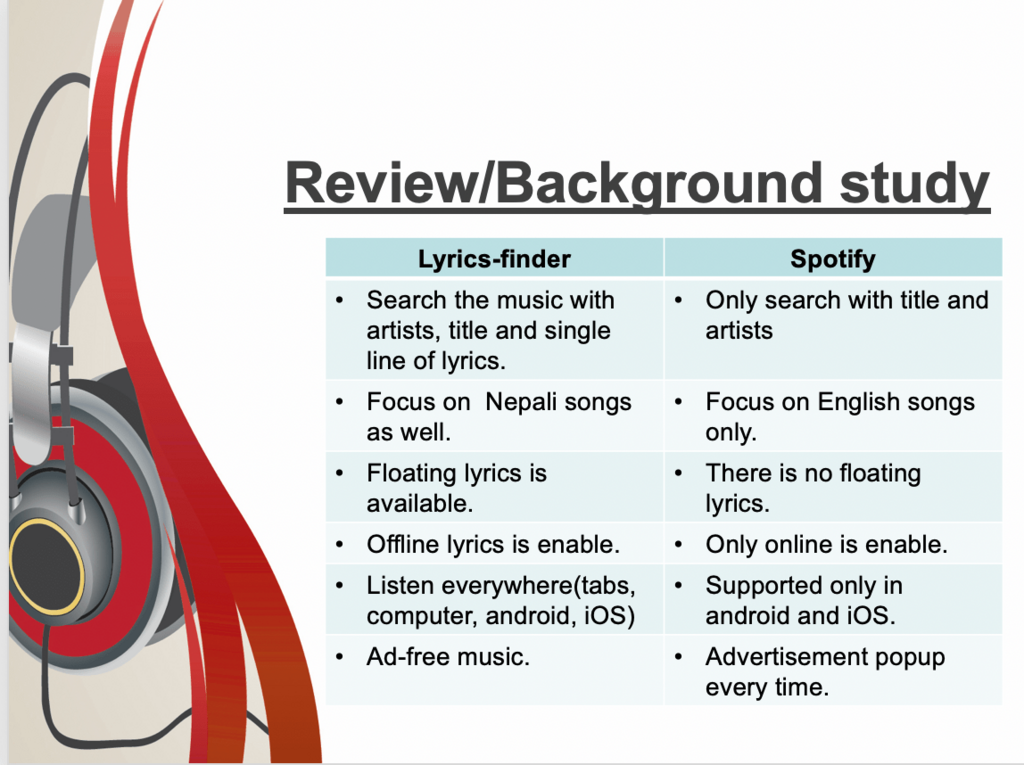
The song is a beautiful creation. It is a short poem or other sets of words set to music or meant to be sung. Lyrics-finder will help you to sing with a song. There is an app made for android and iOS with the same features of a sing with a song called Spotify. Although there is already availability of such innovative idea, lyrics- finder will add some very precious, timely and very compatible features as it will focus on Nepali songs. Spotify is unavailable in Asia. Lyrics-finder has a good place in there. The difference between Lyrics-finder and Spotify are

Lyrics-finder(New Product) Spotify(Existing Product) 
1Search for your favorite song by title, artists and even just using a single line of the lyrics. Only search with title and artists 
2Focus on Nepali songs as well. Focus on English songs only. 
3Real-time notification to display the Floating Lyrics widget and get the current track’s lyrics. There are no floating lyrics. 
4Offline lyrics are available. So, the user can enjoy listening and reading facility. 

Supports only online. 

Play, pause, skip track from your lock screen. Identify and get the lyrics to any songs that are playing around you with one tap. The app lets you find and match lyrics to your favorite music tracks. This is a kind of music player thus mp3, mp4, m4a, mp2, .flv can be read easily.

CHAPTER III: SCOPE

Lyrics-finder is a music player, music catcher and lyrics finder. All in one. Putting aside apps for downloading MP3, we can mainly find three types of music apps on the Android market: players, catchers (identifiers) and lyrics finders. Well, Lyrics-finder merged all of them to offer a new concept of the music app. The features of the Lyrics-finder are

  • Identify and get the lyrics to any songs that are playing around you with one tap.
  • The app lets you find and match lyrics to your favorite music tracks.
  • Offline lyrics are available. So, the user can enjoy listening and reading facility.
  • Play, pause, skip track from your lock screen.
  • Listen everywhere (tabs, computer, mobile).
  • Premium sounds better.

CHAPTER IV: METHODOLOGY

The Software development life cycle of Lyrics-finder is:

Requirements Analysis

Various requirements of the project are the database of the lyrics as the app is concern about finding and presenting the lyrics to the users. Node.js is installed to make an app with ionic and Cordova.

Application design

The design consists of the diagram, a list of the activities to be performed and Layout of the application. Design is the first part to be performed before moving to the coding part. Flow-chart representation help to does this task. Google

Coding

To build this innovative app I will be using Angular JS JavaScript and HTML5 ionic framework as most UI will be made in html5 and JavaScript. As we are not focused on only phone operating system we are focusing on multiple phones. If we use android programming it will be used only for android. If we use JavaScript and html5 then we can use it in Android, iPhone, and windows as well.

Testing and implementation

The app is tested on the Android, iOS and windows version. The application is tested and the feedback is taken from the users and maintenance is performed.

CHAPTER V: ANALYSIS AND DESIGN DIAGRAMS

It is actually great: starting from its neat interface which sets high-quality standards. What’s more, it has been designed focusing on usability. In other words, users won’t need to rack their brains to find the feature they’re looking for: home is divided by four icons which are its four basic features: “My music” (player for your local music), MusicID (which is the catcher), Favorites (for both songs and lyrics you like most) and Settings (from where you can set your social networks accounts to share songs from the app). It’s important to note that when you tap on a song (doesn’t matter if a local song or search results), you get into a swappable menu from where you can see “now playing”, “lyrics”, “other lyrics”. Finally, a search bar at the bottom allows you to seek music: doesn’t matter if you input song, artist, the album it will find it as well as its lyrics. From the search result, you can even buy the album from the store you choose. An app that came quietly but that will give something to talk about due to its cool design, user-friendly interface and it’s all-in-one music app concept.

In the above UML diagram, it is clear that what are the activities can be done by the user of Lyrics-finder. Here, the users first get register to our app. The song can be played as the app itself is a music player. Play song, previous song, next song, rewind songs, forward song. Creation of playlist is another feature of this app. So, the user can save the song to a playlist. Furthermore, the user can get a built form of a playlist. Login features can give access to the external environment. Sharing, Recommendation, profile setting, etc.

CHAPTER VI: IMPLEMENTATION

Tools and technology used

  • To build this innovative app I will be using Angular JS JavaScript and HTML5 ionic framework as most UI will be made in html5 and JavaScript. As we are not focused on only phone operating system we are focusing on multiple phones. If we use android programming it will be used only for android. If we use JavaScript and html5 then we can use it in Android, iPhone, and windows as well.
  • Android Studio will be used to give an outlook of an app to Android phones.
  • Google Chrome Canary developer view will be used. Chrome canary always has the latest DevTools.
  • Code-pen helps to use HTML, CSS, and JAVASCRIPT simultaneously.
  • Sublime text editor and node.js are used as node.js provide a platform for ionic and Cordova. Ionic
  • MySql for the database management system.

CHAPTER VII: ESTIMATION

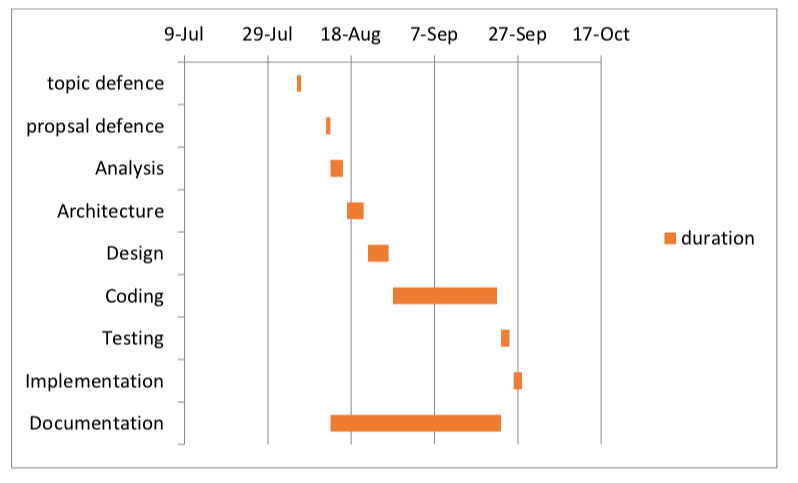
The estimated time is presented below

Estimation Diagram

CHAPTER VIII: LIMITATIONS AND CONCLUSION

8.1 Limitations

During my analysis of an application, there are various limitations. Limitations are

  • Time is limited.
  • Tools and technology are limited.
  • Knowledge is limited.

8.2 Conclusion

Lyrics-finder will help users; have access to a world of music. Lyrics-finder is an innovative idea in the field of music. Song- translations help people to learn a new language by displaying the translation of the lyrics, in time with the music.

CHAPTER IX: REFERENCES

  1. Musixmach: https://sliithciapp.wordpress.com/
  2. Google search: https://www.google.com.np/search?q=sdlc+waterfall+model&espv=2&rlz =1C1CHFX_enNP702NP702&biw=1366&bih=623&source=lnms&tbm=i sch&sa=X&ved=0ahUKEwiFhfuzw7fOAhUEL48KHa1WCMUQ_AUIBi gB#imgrc=lkbUQq_M6RcF3M%3A
  3. Spotify webite: http://pansentient.com/2011/04/spotify-technology-some- stats-and-how-spotify-works/

Project Defense example

•Introduction •Use, Benefits and importance •Lecture Review •Scope •Methodology •Analysis and design •Tools and technology Conclusion

Introduction

  • Lyrics-finder displays synchronized lyrics to view in time with the music being played.
  • On its native apps, it bears the ability to scan all the songs in a user’s music library and find lyrics for them all, as well as to be used as a native music player.

Use, Benefits and Importance

  • The song is a beautiful creation. It is a  short poem or another set of words set to music or meant to be sung. Lyrics-finder will help you to sing with a song.
  • Whenever people can sing a song it brings happiness, Lyrics-finder does that job easily.
  • Lyrics-finder will help users, have access to a world of music.
  • Create your own playlist of the favorite songs
  • Reading is always good. Lyrics-finder will help people to know the song, artist, increase vocabulary, improve communication skills, fetch song info and cover art.

Scope

  • Identify and get the lyrics to any songs that are playing around you with one tap.
  • App lets you find and match lyrics to your favorite music tracks.
  • Offline lyrics are available. So, the user can enjoy listening and reading facility.
  • Play, pause, skip track from your lock screen.

Tools and Technology

  • To build this innovative app I will be using Angular JS JavaScript and HTML5 ionic framework as most UI will be made in html5 and JavaScript. As we are not focused on only phone operating system we are focusing on multiple phones. If we use android programming it will be used only for android. If we use JavaScript and html5 then we can use it in Android, iPhone, and windows as well.
  • Android Studio will be used to give an outlook of an app to Android phones.
  • Google Chrome Canary developer view will be used. Chrome canary always has the latest DevTools.
  • Code-pen helps to use HTML, CSS, and JAVASCRIPT simultaneously.
  • Sublime text editor and node.js are used as node.js provide a platform for ionic and Cordova. Ionic
  • MySql for the database management system.

Conclusion

  • Lyrics-finder is an innovative idea, itself.
  • Song- translations help people to learn a new language by displaying the translation of the lyrics, in time with the music.
  • Lyrics-finder help users to get information about song and artists.

How to create Opencart 4 modules or extensions?

With the launch of Opencart 4, there are changes in extensions or module management and code structure so we are creating Opencart 4 extension tutorial to create Opencart 4 modules or extensions and try to understand the flow and ways to develop Opencart 4 extensions. We will create a new module called “showallproducts” and others will be similar to it. Check Opencart 4 demo.

Files and folder structure of the Opencart module

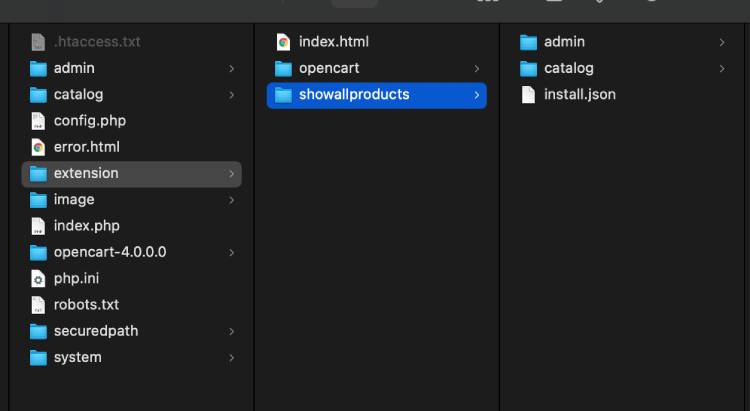
The modules are in the extension folder in Opencart 4, now it is available in the root folder. When you see in the extension folder, by default there is an opencart folder and index.html, in the opencart folder, you will see all default extensions provided by default.

Files and folder structure opencart extensions
  • The file name should be between 1 letter and up to 128 letters.
  • The filename should end with “.ocmod.zip”
  • The uploaded file should not exceed the max file size: of 32 megabytes
  • Opencart extension installer checks if the file already exists, if it exists then it will throw an error.
  • It validates if the file can be opened and if there is an install.json that can be read. So, every extension should have install.json

How to create an install.json file in the Opencart extension?

Create a folder, in our example, it is “showallproducts” and inside it create a file name called install.json. It supports the following keys: name, version, author, and link. 

As per our module, the following is an example:

{
	"name": "Show all Products OC 4",
	"version": "0.1",
	"author": "Rupak Nepali",
	"link": "https://webocreation.com"
}

Once install.json is inside the folder, you can zip it and name it that ends with .ocmod.zip, then uploads it from the Opencart extension installer.

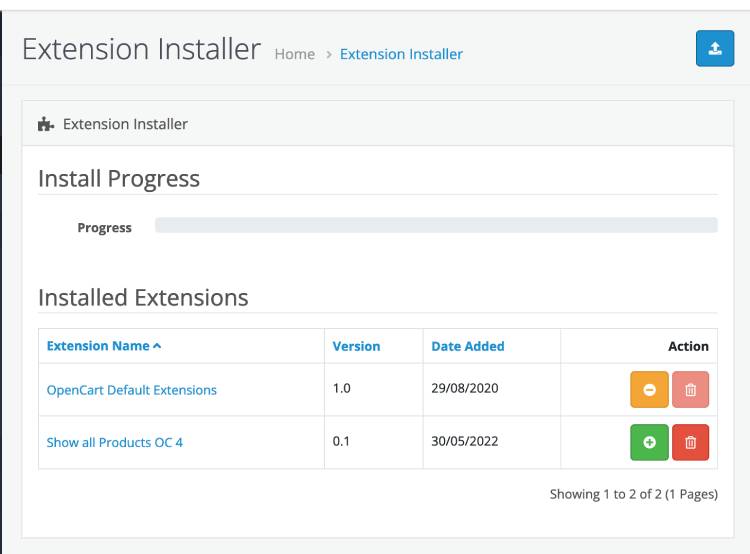
For our example we named it show_all_products.ocmod.zip and uploaded in Admin >> Extensions >> Installer and click the upload blue button and we get details like the below:

Opencart module extension installer

While uploading, if you don’t get anything then you need to go to the storage folder and inside it see the marketplace folder and remove the existing zip file.

With this, you are ready to start coding and adding files for your module. Now, in our next opencart tutorial we will create all the files needed for the showallproducts module and start adding code to install it and create an admin form and show the link in the header when activated.

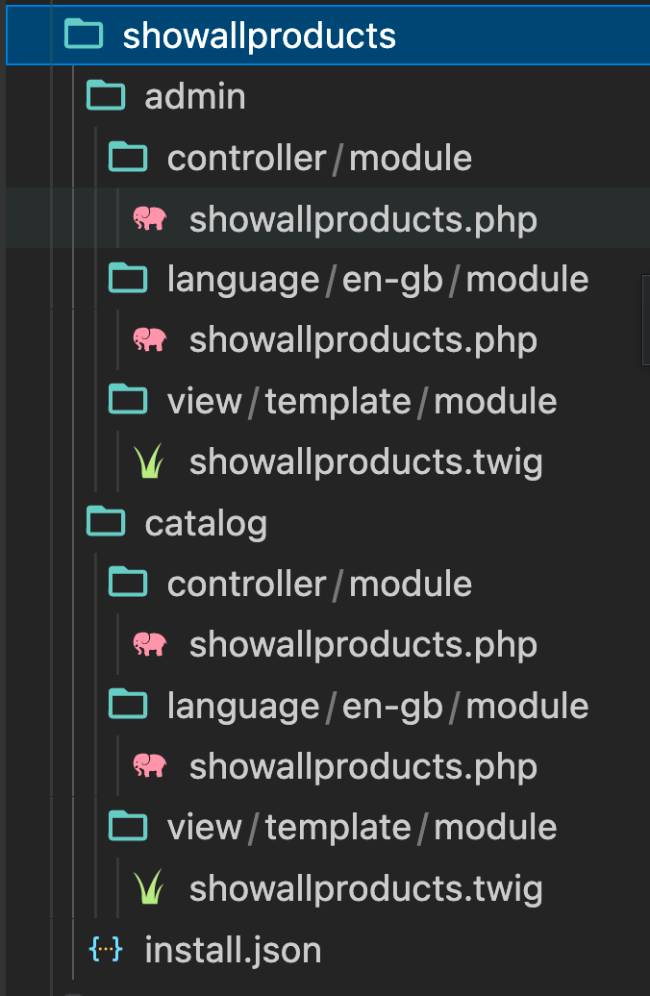
It will contain files and folders like the below:

Files and folder Opencart module

Looks like we need to create a unique filename as well so for example as we are creating these files so our extension will be like webocreation_showallproducts.php and similar naming conventions.

In this Opencart 4 tutorial, we set up install.json for the opencart module and upload it, and we are ready to install it and create a way to add the functionalities. Please don’t forget to post your questions or comments so that we can add extra topics. You can follow us at our Twitter account @rupaknpl, and subscribe to our YouTube channel for an opencart tutorial. Click to see all Opencart 4 tutorials.

10 eCommerce Automation Ideas to implement on the Website in 2024

eCommerce automation simply means switching manual tasks into automated ones through software. With the advancement of technologies, shopping can be done in Just Walk Out Technology, the checkout-free shopping experience is introduced. Just Walk Out Technology detects products taken from or returned in the cart automatically and when you leave the store it charges you automatically on the card that you sign up for. So, to keep up with enhancement and competitors, we need to automate the workflow of your eCommerce as much as possible. Tasks like billing, email checking, notifications, and other similar tasks are easily carried out through automation.

Automating your online store may not cause any harm to your employers but saves their precious time. It boosts customer interaction, creativity corners, and big-picture thinking. All these things have really important roles in the line of your business.

Here are some of the best lists of eCommerce automation ideas that will prove themselves fruitful for your eCommerce.

Online Try-Ons with 3D visualization, VR and AR

With the introduction of cutting-edge innovative technologies like computer vision, VR, AR, sensor fusion, and deep learning, now it is possible to implement the online virtual Try-Ons so the customers can experience the 3D look and try it online and accurately sizing. AR technology will help with 3D visualization so the customers can try as many clothes as they want and keep on trying until they are fully satisfied. Having these kinds of technologies implemented, there will be an increase in conversions, reduced returns, personalization, safe, and security.

AR VR 3D Tryon

Read about: How e-Commerce will be affected by Web 3.0 and blockchain?

Recommender system with machine learning algorithms

The recommender system is part of machine learning and all big companies like eBay, Amazon, Walmart, google shopping, etc everyone use some sort of recommender system. As you see “Recommended Products”, “Sponsored Products” and many other sections of the page show different products for everyone, so it is recommending similar products as per your search, order history, geographic, demographic, etc. It keeps on learning what are your preferences, ideas and predict what products you like and recommend similarly, with which the conversions can increase. The recommendation can be content-based, collaborative filtering, item-based, user-based, scoring each item, ranking, and re-ranking, analysis of criteria or constraints with machine learning and provide relevant things that are expected as a recommendation, so in this evolving using recommender system in eCommerce website and we highly recommend to use it as it can help on increasing the conversions.

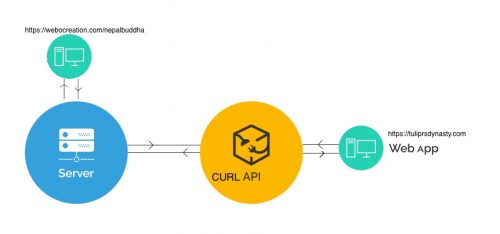
Extensive use of API and Web Services

APIs are easy to use by third parties, such as providing helpful documentation, monitoring API performance, and even monetizing API usage. With APIs, you can connect data, apps, devices—all the “things” you need to speed innovation with APIs and microservices. A web service for automating shopping over the Internet from a portable mobile device accessed by a user. First, shopping automation is considered a hardware system like an embedded device product. They are connected to the network through protocols. At the same time, portable mobile devices also use the WAP protocol to connect to the network. So, to automate development and innovate easily and maximize the investment, extensive use of API and web services are important.

Read More: Pull products from another website through API and syndicate it

Opencart API

Image and video interactivity and quality 

Image interactivity technology enables the creation and manipulation of product images on websites, affects experiential value and instrumental value. So having quality and interactive images and video can help a lot. Like a 360° view of the products, like for example if selling cars, exterior 360°view and interior 360° view and multiple quality images may help get the assurance of the customers. Factors dependent upon Web site interactivity have been embraced by online marketers to entice the consumer to visit the site, purchase online, and be satisfied enough to get a repeat visitor/customer

Addresses Automation – use google map API to automate the Shipping Address and Payment Address

The Place Address Autocomplete form gets selected addresses from the Google Places database and uses them to fill out the address form automatically. Automatic address form filler is important and useful when you are using a shipping address for an online order, a credit card billing address, a ridesharing booking form, etc. You can easily integrate the google map API to your checkout form with something like the below:

https://developers.google.com/maps/documentation/javascript/examples/places-autocomplete-addressform

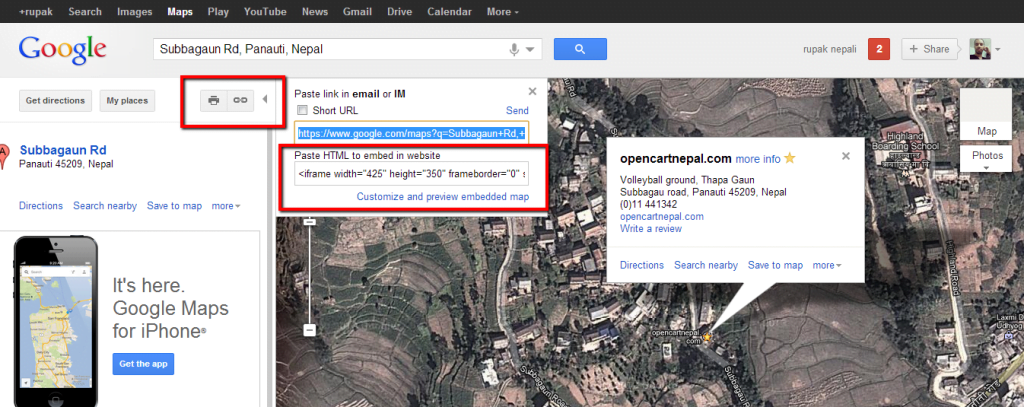
Google map at the opencart store
how to show the shop on the google map

Cognitive behavioral analysis of the Customer

You can boost your eCommerce up to 95 percent only by paying attention to your customers by just 5 percent. Google will display the results in different ways, depending on what is most useful for the type of information you are looking for with analysis of components of cognitive, behavioral, interpersonal, browser cookies, browser history, etc. Once you search in one platform for example google.com then it will show the ads and similar products or content on Youtube, Google maps, etc. So, cognitive-behavioral analysis of the customers is very important to understand your customers and improve as per it. Like

  • Collect feedback after every sale

Honest reviews matter in the line of your eCommerce business. They can make or break your online store. To have honest and good reviews, you need to gather your customers’ reviews on every sale. You can encourage reviews by sending follow-up emails to your customers. Simply, you can provide the link where your customers can share their reviews.

  • Trace negative feedbacks

If you ever receive any bad reviews on your sales products, make sure that you are responding to them. Find out the case and cause behind it. Never let anyone joke about your market products as it has a catastrophic effect on your eCommerce.

Dropshipping is beneficial

Many of the eCommerce businesses automate order fulfillment so businesses do not need to think about logistics like shipping, payment, etc and this is possible by dropshipping. Dropshipping means simply adding products to your store and shipping them directly to the customers. Dropshipping lowers the risk of harming your eCommerce business as there is no inventory problem. You should be cautious in selecting the market products for your eCommerce store for dropshipping. But automating your eCommerce businesses just to handle websites can help you lower the risk and higher the profit.

Automate your inventory for low-stock items, Printing and sending shipping labels

It is so frustrating for the customers if they find any item out of stock. So, to handle such a hazardous situation you can automate your inventory list. Setting up a notification system, you can notify on time when you are nearly going out of stock. And thus you can lessen your customers’ frustration. Likewise, you can automate printing and sending shipping labels and also send the tracking numbers in just one click.

Email Automation: Sending reminders to your customers for re-orders

If your eCommerce business is related to products like health stuff, food, make-up stuff, then you should be sending reminders to your customers every week. They will need the items once they are out of it. Note the time of the product you sell to them and fix automated mailing on a specific date as a reminder. You can use the most outstanding eCommerce automation tools to sync the accounts of your daily eCommerce customers. So it may be easy for you to send your newsletter and emails to your customers. One example is like:

  • Send abandoned cart emails to your customers

Almost 80 percent of the cart emails are abandoned automatically. Abandoned cart emails help you get back all your old customers. You can integrate your eCommerce software with any native mailing provider.

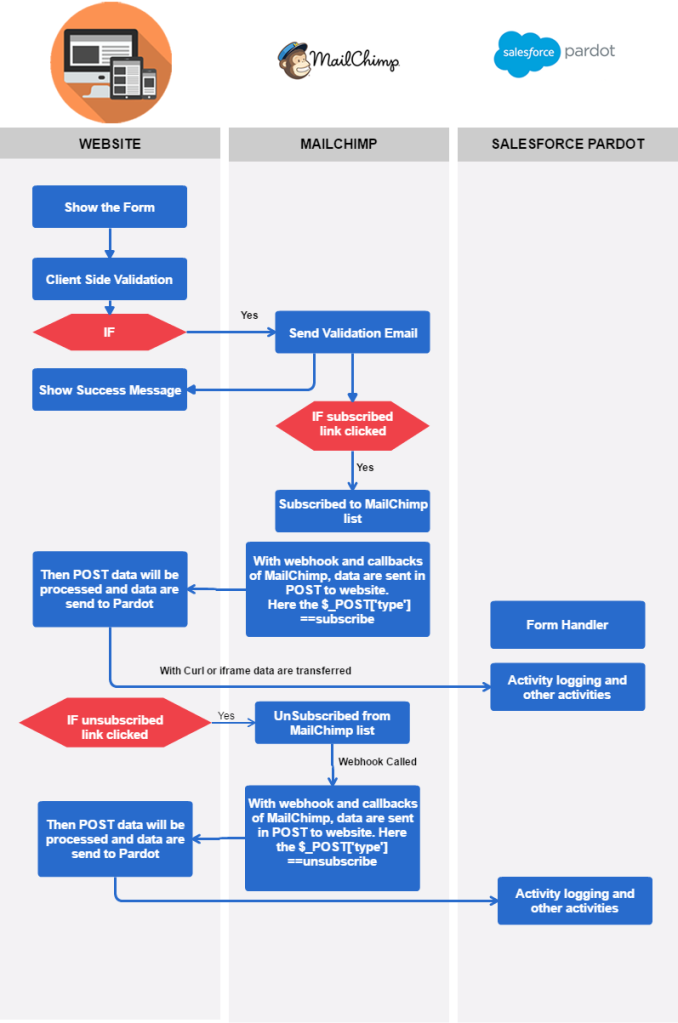
Another simple workflow example of how to create subscribers from the website to Mailchimp and then log the activity to the Pardot marketing automation tool.

Mailchimp Pardot flow step

Read about: How to integrate Pardot on the website easily?

Social Media on Autopilot, Schedule social media posts for your eCommerce

To promote your eCommerce, you need to know about marketing tactics on social media but you don’t need to consume your energy on it, you can automate the posting of products, content automatically on social media platforms. These tools automatically post your schedule plans on Facebook, Twitter, and other social media platforms. You can boost your eCommerce with just a single click in today’s world. That is the reason we should opt for automation regarding our eCommerce projects.

In this way, you can implement multiple automation in your eCommerce website. Please let us know if need support to create any automation we have created automation for reporting, stock monitoring, batch processing, API analytics, and many more, as well as please post your questions or comments, or any other automation that you guys are using. In our upcoming posts, we will write about tools that we use for automation as well. You can follow us at our Twitter account @rupaknpl Facebook page @Webocreation. Subscribe to our YouTube channel for Opencart tutorials, and click to see other eCommerce tips and tricks.

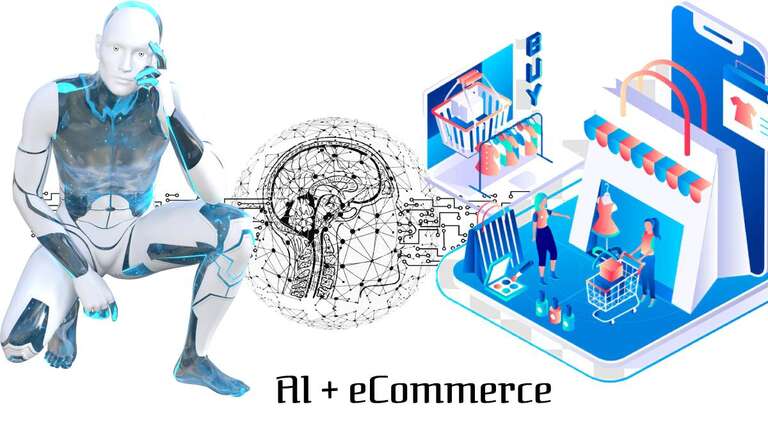
12+ Artificial Intelligence ideas that you can use for your eCommerce website

You already know that artificial intelligence can boost your eCommerce website sales. At the same time, you should understand that lacking proper use of artificial intelligence can be a giant threat to websites. The use of artificial intelligence (AI) has become essential in today’s world. Billions of market competitors compete in eCommerce on a daily basis. This is the reason you should know tips that can provide you with better opportunities in boosting your e-commerce up. Following are 12 proven AI tips that are regularly used by successful eCommerce websites:

Enhance full-proof Cybersecurity for your website

Cyber Security eCommerce

Always make no compromise with the security of your eCommerce. Hacking has been one of the heinous crimes in today’s growing world of online business. To lower the risk of hacking, you should select the most authentic spyware. Spywares are the most successful tools to counter any systematic harm to your eCommerce website.

Read More: 25 eCommerce websites security measures

Retargeting customers with AI

retargeting customer

It is not unheard of that AI plays a key role in retargeting your customers. What that means is that you analyze your customer’s purchase history, likes, dislikes, and behavior. Based on this analysis, you can “retarget” your customers with relevant products.

For example, if a customer has a history of purchasing men’s fashion products like wristwatches, men’s wallets, sunglasses, etc, you can show them relevant products. These products can be caps, T-shirts, and bags just to name a few.

Let your Artificial Intelligence tools dictate that, and see how your customers sustain a series of purchasing histories with you.

Read more: eCommerce conversion tracking with Google Analytics 4 and GTM

Automation of your website with AI

Artificial Intelligence has the best use in finding algorithms. It provides market retailers with all the information about what exactly they demand.

Automation keeps traffic to your eCommerce site. The task of producing customers can be done more effectively by AI. A recent survey from eMarketer shows that 65% of eCommerce businesses outperform their competitors that have their websites automated. The survey suggests that these eCommerce sites drive more traffic and repeat sales.

That is why it is inevitable to have your website automated. Consequently, this will bring you, loyal customers, in the long run.

Show Related Products to Customers Via Recommendations

Recommendations for the customers can be done through app developers. If you are unaware of the high-tech apps, then developers will help you out.

Basically, recommendations let your customers know about your brands. It collects all the data from the browsing history of customers.

Add ChatBots to your website

ChatBots allow and help your customers in the following ways:

  1. Letting your customer know what they want
  2. Answering the queries of your
  3.  Customers
  4. Act as a bridge between you and your customers 24/7

That is why it is pertinent for you to add chatbots to your website. Without chatbots, you are missing out on a massive opportunity for conversions and sales.

Read more: 40 cool projects for students in 2022

Add voice search & voice assistant to your eCommerce website

Voice Search

Artificial Intelligence has developed so vastly. There are voice assistants to buy things online. It is time-saving and customer-friendly.

In this regard, Google’s Alexa and Apple’s Siri are the best AI voice assistants. You can easily add voice search functionalities supported by modern browsers by changing simple HTML code. You can: How to add voice search for input form?

Quora creative stats show that 60% of searches will take place through voice. OC&C research also shows that smart speaker searches will increase by 55% in 2022. So, make adequate use of voices searches and get the most out of them.

Forecast your sales

Forecasting your sales means letting your customers know about your daily, weekly, or monthly sales. This will benefit you in the following ways:

  1. It will create a better bond with your customers
  2. Builds trust in your customers
  3. Increase sale reliability rate.

That is why it is mandatory for you to have an estimated projection of your weekly, monthly, and yearly sales. And none can project your expected sales than Artificial Intelligence Software. HubSpot, Trello, Pipe Drive, and Gong.io are some of the best AI tools for sales projections.

Filter Fake Reviews

Reviews eCommerce

Fake reviews cause huge damage to your e-commerce. They also damage the reputation market brand.

 That is why you should be using artificial intelligence to clean up the harm. There are multiple software and AI tools for this purpose. So, make use of it as much as you.

Set up Google reCaptcha or Basic Captcha

AI-based Smart Searches

artificial search

Your brand should have a smart search engine. It conveys the following positive gesture to your customers:

  1. Gives a professional look to your eCommerce website
  2. Makes your eCommerce website interesting
  3. Makes your eCommerce website smarter
  4. Gives sufficient proof of your website to be the best one.

That is why it is necessary for your website to have smart searches.

Personalizing your eCommerce website

According to recent research conducted by Consultancy, 74% of eCommerce brands increase their sales through personalization.

You should personalize your website activity through the following ways:

  1. Keep updating fresh market products
  2. Engage yourself with customers all the time
  3. Update your market content
  4. Decrease transaction time.

These ways will help you personalize your website and will keep your customers engaged. As a result, you will notice an immense conversion rate and increase in your Year over Year (YoY) revenue.

Learn more: 5 phases in products selling life cycle of eCommerce in 2022 for startup business

Create Visual Search for your eCommerce website

It is very annoying for customers when they do not find the exact items on your e-commerce website. To avoid this, you should use NLP (natural language process).

Actually, NLP lets your customers search through pictures to match their market product. Thus, customers love shopping with you online.

Adding a visual search option to your e-commerce can boost up repeat sales and thus you can also get regular customers easily.

Add sale game options to your website

magic wheel

In order to attract potential sales and buyers should be the goal of your e-commerce website. Potential buyers are those buyers which are seriously interested in purchasing things from you.

Games like face recognition can help you in understanding the interest of your customers. Gaming also engages your customer to stay longer with your market brand.

Ways to increase eCommerce sales

Some additional AI ideas for your website

Better Customer Experience Via a 24/7 Customer Service

Real-Time Data Analysis

Active Engagement With Your Audience Via AI-based Automation

Self Designing & Building Functional Website Via AI Tools Like Take Maker

Artificial Intelligence Design (AID)

Better Solutions for Website Developers & Gamers Through AI

Proper Alignment of Sales & Marketing Team

Summing up

eCommerce websites need very careful precautions. If you want to get your eCommerce web boosted, you should be knowing basic tips. Simultaneously, you must have a hands-on understanding of Artificial Intelligence, since it plays a pivotal role in deciding the future of your eCommerce business.

That is why we have shared some of the most effective and useful artificial intelligence ideas that you can use for your eCommerce website. We are hopeful that these Artificial Intelligence ideas will help you in increasing the conversion rate and the Year over Year (YoY) revenue. Let us know if you have any other ways ideas of AI that you have used in eCommerce websites or have any questions or suggestions, please subscribe to our YouTube Channel and read more about eCommerce, Web 3.0, blockchain, NFT, and the metaverse. You can also find us on Twitter and Facebook.

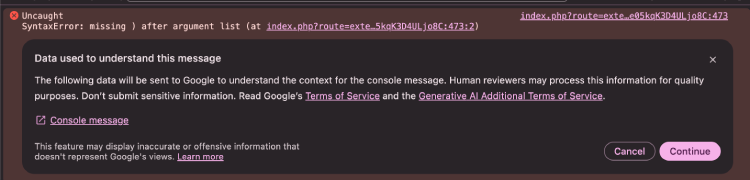
Warning: imagecreatefrompng(): gd-png: libpng warning: iCCP: known incorrect sRGB profile in /system/library/image.php on line 45

Once we upgrade the PHP to the 8+ version we keep seeing the error like Warning: imagecreatefrompng(): gd-png: libpng warning: iCCP: known incorrect sRGB profile in /system/library/image.php on line 45.

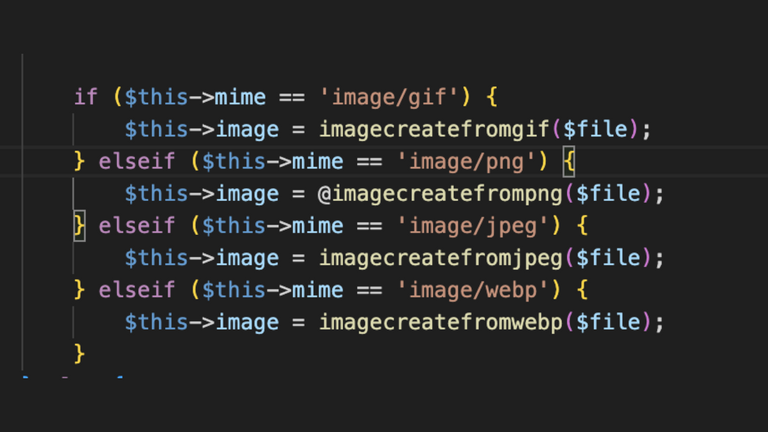
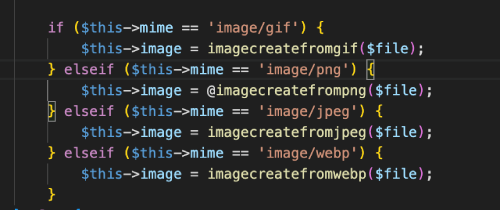
The fix that we implemented is by suppressing using @. Open system/library/image.php and find imagecreatefrompng($file); and add @ before it.

$this->image = @imagecreatefrompng($file);
imagecreatefrompng

Augmented Reality vs. Virtual Reality: Which Technology Will Dominate Software Development?

These days, being in a virtual environment is not unusual. Today, several people are using several gadgets to access virtual worlds. Games, apps, retail apps, instructional resources, and other stuff are all on the list! Augmented reality and virtual reality are the 2 major technologies ruling the internet today. 

Both technologies have numerous, widely-used applications that have been proven. For instance, players adore augmented reality games. However, virtual reality offers a lot of advantages in the field of education. One application of virtual reality that has been extended is metaverses.

This article will help you understand the importance, the difference, and the future of AR and VR. You will also read about the main differences between the two technologies. The site also contains some fascinating facts about AR and VR.

Augmented Reality Or AR: An Overview

Augmented reality is a more interactive representation of the actual world. It includes digital sights, music, and other sensory elements. Augmented reality encompasses three different elements: exact 3D identification of virtual and real-world objects, real-time interactions between digital and physical worlds, and both.

Overlaying digital content on top of real-world work situations using augmented reality provides an improved method for designing, selecting, and delivering consumable instructions. When a company understands augmented reality (AR), everyone can work together efficiently from a distance. 

VR Or Virtual Reality: An Overview

Virtual reality enables the simulation of human experiences. This technology helps users perceive and comprehend complex subjects. The experience is immersive and captivating. As evidenced by the Metaverse, it can even be utilized to link entire worlds together.

Experiences in virtual reality (VR) are widely employed in many different industries. These include business, healthcare, and entertainment. VR is starting to positively influence society in many ways. To appreciate its importance, we need to understand why VR is so successful. While earlier iterations of the VR headset required it to be connected to a device, most recent models support cordless or stand-alone operation. 

Impact on Software Development

  • Design and Prototyping

Web design services’ prototyping and design phases are changing as a result of AR and VR technologies. The designer may see and work with their works in a more natural and engaging way by building virtual worlds or projecting digital prototypes onto real-world surroundings. This quickens the design process and makes it possible for early user testing and input, which results in finished products that are better.

  • Instruction and Modeling

Many different sectors use AR and VR for training and simulation. These sectors include aviation, healthcare, and manufacturing. Software developers use these technologies to create realistic training environments. These environments simulate real-world situations accurately. They can safely rehearse operations without any real-world risks. This immersive training method lowers training expenses, increases learning results, and lessens the hazards connected with in-person instruction.

  • User Experience and User Interface

AR and VR present new opportunities for creating user experiences and interfaces that are simple to use and captivating. In order to provide a more natural and immersive interaction paradigm, developers might design immersive interfaces that react to user gestures and movements. The way consumers engage with software programs could be revolutionized by AR and VR interfaces, whether it’s through virtual menu navigation or 3D object manipulation in space.

  • Joint Development

Web application development requires teamwork, and AR and VR technologies are making distant collaboration easier than ever. Regardless of where they are physically located, developers may work together on projects in real time, exchange ideas, and review code by using virtual meeting rooms. This distributed development methodology encourages innovation, expedites decision-making, and facilitates effective teamwork across regional borders.

  • Improved Information Analysis and Visualization

Developers may see complex data sets and analytics in new ways with the help of AR and VR. AR and VR offer strong tools for data visualization and analysis, whether it’s for investigating volumetric data in healthcare, displaying 3D models of architectural designs, or evaluating spatial data in urban planning. Deeper insights and better decision-making can be obtained by developers by submerging people in settings rich with data.

The Future of AR in Software Development

The top augmented reality (AR) trends for 2024 are varied and cutting edge, indicating big developments in technology and their widespread applications. They are employed in numerous industries because they give users a new quality by bridging the physical and digital worlds.

Discover some of the major trends of Augmented Reality in Software Development:

1. Solutions for Generative AI and Multisensory Technology

The development of digital environments, artwork, and lifelike characters is anticipated to improve with the integration of generative Artificial Intelligence (AI) with AR. In order to produce more immersive experiences, multi-sensory technology is also being emphasized. Examples of this include haptic gloves and gadgets that arouse senses like smell.

2. Developments in Augmented Reality Hardware

Notable advancements in motion capture and people occlusion have been made by Apple, and LiDAR scanning has great promise for producing precise floor layouts and (AR) augmented reality measurement instruments. With more sophisticated hardware and software, Apple’s ARKit and Google’s ARCore are still vying with one another to enhance augmented reality experiences.

3. Cross-Platform AR and WebAR

Not requiring any further software downloads, WebAR provides necessary but approachable augmented reality experiences. Contrarily, cross-platform augmented reality strikes a compromise between accessibility and performance, working with a wider variety of devices but having certain drawbacks as compared to native apps.

The Future of VR in Software Development

The following are some key forecasts for VR in 2024:  

1. VR Headsets Will Get Lighter And Smaller  

Users of VR headsets can immerse themselves in the virtual world and feel its presence, immersing themselves completely. Virtual reality headsets are getting lighter and smaller than they used to be.   

VR headsets now come equipped with widely used technologies like eye tracking and hand detection. Users no longer need controllers to enjoy the virtual world thanks to hand detection technology. In addition, eye tracking technology lets the user concentrate solely on the portion of the image they choose to pay closer attention to.   

2. The User Experience Will Be Improved With XR Accessories.  

XR accessories are now being developed to improve user experience. One excellent illustration of this would be robotic footwear. The Ekto One Boot was launched by the tech business “Ekto VR,” which allowed users to move and walk around their playspace. The roller skates on these boots maintain motion by adjusting to the direction of the wearer.  As a result, users can explore the virtual world by utilizing the device’s boot skills to move naturally.   

3. Virtual reality avatars  

Although virtual reality (VR) technology was previously fascinating, the addition of VR avatars to virtual concerts and events creates immersive virtual experiences. Envision avatars attending virtual meetings, acting human and imitating human expressions, and answering queries quickly.  These virtual delegates possess all the abilities of a typical human being. 

4. Virtual reality for remote help 

Since virtual reality creates an environment where users and support agents can easily cooperate and solve difficulties, remote assistance has become more engaging. VR integration across sectors is a Blessing.  However, it offers a number of advantages when it comes to IT support and upkeep. Even if the IT specialist is not physically present in the company, he may nevertheless use virtual reality technology to diagnose and fix equipment malfunctions. 

Comparative Analysis: AR vs. VR in Software Development

Despite the fact that both technologies aim to immerse the user in an artificial, surreal environment, they are the opposite of one another. When interacting with virtual things, AR users stay in the real environment, whereas VR separates and transports the user to another realm. In summary, the latter provides greater freedom and delivers virtual features as an overlay to the real world, whilst the former is more immersive and offers a digital recreation of a real-life setup. Let’s go through Augmented Reality vs Virtual Reality.

Objective

Virtual reality (VR) aims to construct a digital world entirely through computer simulation, bypassing the need for physical setup. AR, on the other hand, overlays real items with virtual elements like graphics and images.

Delivery Mode

With a head-mounted display or a handheld controller, users may navigate and engage with the virtual environment. Conversely, users can access augmented reality (AR) by downloading and using a mobile application. The moment your device is over an object, it transforms into a 3D image that would not otherwise be seen.

Experience 

VR needs a lot of devices, such headsets and headphones, which may not be sufficiently comfortable. However, it is extremely engaging and captivating because the user of a VR headset is unaware of what is happening in the actual world.

On the other hand, AR is extremely comfortable because it is often lightweight and doesn’t require you to wear bulky gear. However, AR might only provide a little view, suggesting that it’s not as immersive as VR.

Conclusion

Software development is changing as a result of AR and VR, which provide new tools and approaches for creating digital solutions. Developers may produce software experiences that are more impactful, logical, and engaging by utilizing the potential of these immersive technologies. Software development will undoubtedly have an interesting and engaging future as we continue to explore the possibilities of AR and VR.

The Most Important Tools and Technologies for Web 3.0 Development

Web 3.0 is the next step in the development of the Internet. In contrast to Web 1.0, which consisted primarily of static web pages, and Web 2.0, which brought greater dynamics and technological improvements to the World Wide Web, Web 3.0 is based on decentralized networks built on blockchain.

Web 3.0 developers are in high demand because there are still few experts in this field. So, if you are an experienced Web 2.0 engineer looking to enter this new field, you may be wondering where to start. What fundamental tools, concepts, and technologies need to be mastered?

In this article, you will get acquainted with Web 3.0, learn about its important features and differences from Web 2.0, as well as what technical solutions you need to be able to operate to enter this area of ​​​​development.

Web 3.0

Before moving on to the technologies used in Web 3.0 applications, we will look at this concept and its main value.

Web 3.0 has five key features:

  • decentralization
  • blockchain
  • safety
  • scalability
  • Confidentiality

In the decentralized world of Web 3.0, blockchain technology and other protocols are fundamentally changing the way data is stored, distributed, and used while providing a native transaction layer. Popular use cases for this paradigm include decentralization of financial flows (DeFi and cryptocurrencies), voting through a decentralized organization known as a DAO, and non-functional tokens (NFTs) serving as proof of ownership.

It may sound cynical, but the main motivation for the development of the Web 3.0 concept is due to the gradual loss of mutual trust between users, companies, and governments.

In a decentralized financial system, users store their savings in private wallets and make transactions without any connection to a centralized structure or relying on fiat government currency.

If we talk about a voting application, its creation based on blockchain can ensure complete transparency of the information provided by voters and the ability to verify it by anyone. This is what defines the concept of Web 3.0 as “removing the element of trust,” since this technology is transparent and cryptographically secure, which means there is no need for blind faith in government and commercial structures.

In turn, NFTs can be used to prove ownership of any digital asset such as music and works of art. At the same time, with the help of such tokens, it is also possible to more directly support the creator of this or that content.

All of these examples involve some basic activities for which there is no longer a need to rely on central government agencies or intermediate authorities.

It is important to note here that Web 3.0 is not a replacement for Web 2.0, just as Web 2.0 did not replace Web 1.0. There is still a place on the Internet for the static websites that characterized the early days of Web 1.0. Even with the growing popularity and prevalence of Web 3.0, there will still be a place for Web 2.0 on the Internet.

Decentralized applications (Dapps)

Now you have a basic understanding of what Web 3.0 is and why decentralization is important. But what exactly do Web 3.0 applications look like?

Well, they look just like Web 2.0 apps. Decentralized applications, also called “dApps” and “dApps,” consist of a front-end (UI) that interacts with a “smart contract” (a small program) deployed on the blockchain. This front end can also interact with the user’s wallet when conducting transactions or writing data to the blockchain.

The key difference from Web 2.0 applications is that the smart contract and blockchain replace the typical server and database owned by a single person or company that maintains it.

Technologies at the heart of working with Web 3.0

How is a decentralized application created? The good news is that you can start here by building on your existing programming skills. We already understood that the dApp is front-end, which means you will need to know HTML, CSS, and JavaScript. Unless you are planning to write applications in vanilla JS, then you will probably also need to master frameworks such as Angular, React, and Vue. All this, of course, is great for front-end developers who are familiar with these things. But that’s not all.

Below we will look at some of the languages, tools, and frameworks that you will need to learn specifically for Web 3.0.

Solidity is a language used to write smart contracts that run on the Ethereum blockchain. It resembles a mixture of C++, Python, and JavaScript. If you have already mastered several programming languages, then you know that each new one comes easier. Since most smart contracts involve some financial exchange, it will be very important to follow certain standards and best security practices.

On the website, the developers describe it as “a development environment, testing framework, and blockchain asset processing pipeline using the Ethereum Virtual Machine (EVM).” Similar to how React helps you write JS applications, Truffle helps you with smart contracts.

You don’t have to use it, but the framework will help a lot by abstracting away some of the complex implementation details. For those who use VS Code, the Truffle extension for VS Code will make life even easier.

Ganache is a personal blockchain for local smart contract development and testing. It allows programmers to create a local instance of the Ethereum blockchain with just a few simple commands. Similar to how you develop a Web 2.0 application on localhost or in a test environment rather than in production, Ganache allows you to do the same when designing for Web 3.0.

Web3.js is a JS library used to interact with Ethereum. It is used in the front-end application to perform actions such as connecting to the user’s wallet, providing access to the smart contract, and calling functions on this smart contract. Smart contracts can be accessed through the command line or the UI, and web3.js allows you to do this through the UI.

MetaMask is a Web 3.0 wallet that can be used through its browser extension or mobile app. Wallets were already mentioned above, but no specific description was given. A blockchain wallet provides an interface for accessing your digital financial assets. You protect its contents with a private key that is known only to you. For users, MetaMask provides a secure way to connect to and interact with blockchain application development from wallets. For developers, wallets are needed to deploy smart contracts and work with them. Typically this requires adding private keys to your code, but Truffle Dashboard allows you to connect your MetaMask wallet to your project without exposing the keys.

Infura is an infrastructure provider for connecting to Ethereum and other blockchains, as well as decentralized storage networks such as IPFS. Without going into details, any interaction with the blockchain requires access to the node via JSON-RPC or Websocket. Infura provides the infrastructure for this, eliminating the need for you to create your own node on your machine. This service can also act as a safety net in case you do decide to run your own node. In addition, Infura provides a suite of development tools and other capabilities for creating applications. This is an additional abstraction on top of some of the technologies already discussed that will make Web 3.0 development even easier.

Can’t wait to dive deeper into learning the tools described? Now that you’re familiar with the general features of each, you’re ready to start writing your first Web 3.0 application. There are many lessons on this topic on the Internet, and they all rely on most of these technologies in one way or another. To help beginners, the ConsenSys team offers dozens of “ Truffle Boxes,” which are templates you can use to start your first project. If you are fluent in English and are looking for an organized way to join the ranks of Web 3.0 developers, then I recommend the ConsenSys Academy website.

Conclusion

Web 3.0 is the next stage in the development of the Internet, which supports the latest generation of software. Blockchain is the most transparent technology, which has already become mainstream not only among ordinary consumers but also among serious social and business structures.

Understanding and mastering this development technology will give you a clear advantage in entering this labor market.

Those of you who already have knowledge and experience working with Web 2.0 will feel more confident at the initial stage. Take the time to master the technologies listed, and you will be ready faster than you ever imagined.

Blockchain smart contracts: uses, examples and benefits

Blockchain is the technology that has solved the problem of generating reliable transactions through its distributed database. 

The application of AI systems in businesses could revolutionize how people relate by promoting open data policies among them.

Smart contracts, for their part, are not digitized commercial contracts, they are the flow diagrams of lifelong operational processes, programmed, automated, and executed without human intervention. In this way, they are responsible for managing the link between two or several parties in a secure, efficient, and scalable way. They work through executable code on the blockchain to facilitate, effectuate, and enforce an agreement. 

This technology will bring great benefits with the power to turn traditional agreements and relationships into effective, secure, and digital automation. 

But what exactly is a smart contract? 

A smart contract is a computer program that digitally facilitates the verification, control, and execution of a predetermined agreement of a blockchain development company platform when these agreements are concluded and all transactions are processed without intermediaries. 

Like traditional contracts, smart contracts define rules and sanctions around an agreement and automatically enforce these parameters. 

It must be said that, although the blockchain has emerged closely linked to the world of bitcoin and cryptocurrencies, in my opinion, the power of the use of smart contracts is seen more in the environment of industrial and logistical processes, especially in management. of supply chains.

Benefits of smart contracts in business environments 

The business applications for smart contracts are endless. This is a method for increasing transparency and enhancing security while eliminating error and reducing red tape. Here you can find some specific general benefits of using smart contracts as part of the process of generating agreements using blockchain technology: 

  • Autonomy: Being a technology of a decentralized nature, smart contracts do not need any external party or human intervention in the process.
  • Trust and Transparency: The nature of smart contracts is that they are self-executing and a source of unbreakable trust. In this aspect, trust is based on a source of data and infrastructure that guarantees the confidentiality, integrity, and availability of data throughout the life cycle of the contract. Transactional and contractual data are stored, which are reliable and transparent for all participants. This can be a distributed ledger, a blockchain, or a traditional on-premises or cloud database.
  • Security: Through blockchain technology, unalterable ledgers are created that provide reliable and definitive proof of transactions. These books ensure that transactions are set in stone and that they are unalterable. Thanks to distributed node blockchain technology, smart contracts duplicate all transactions so that all parties have a record. The probability that all those involved will suffer data storage failures is non-existent.
  • Effectiveness and profitability: Thanks to the fact that intermediaries are not needed, the execution of bureaucratic procedures and procedures can be effective, fast, and precise. Smart contracts are paperless and swift, unlike their conventional counterparts in which they mostly occur. Human beings are subject to errors but the aforementioned automated agreements are not. In order to convert AI-like text to human-like text you have to as well lower perplexity while maintaining higher burstiness even while keeping the element HTML at the same level. The best thing is that while errors are avoided, management costs are significantly reduced. 

Examples of smart contract applications

  • Smart Contracts for product development

An interesting use of smart contract development is the ease of keeping records during the stages of product development. When two parties sign the contract, activate it, and track it throughout the project, any other relevant information is recorded in the contract. 

For example, if the parties agree to payments at certain milestones, when the agreed phase is reached the contract releases the transfer. Without a doubt, an alternative for companies of all sizes, whether selling products or professional services. 

Another interesting aspect is the ability to keep information secure and prove its origin. This has an impact on intellectual property issues. When a company has invested large amounts of resources in the development of an idea or project, it needs to be protected. This type of security can be completed through a Smart Contracts solution complemented by identity verification technologies.

  • Smart contracts for financial management 

This technology holds multiple ways to transform traditional financial services. One of these is the incorporation of critical accounting tools and the elimination of the possibility of manipulation of accounting records. 

They can also facilitate the participation of stakeholders in decision-making transparently and horizontally. Additionally, they assist in trade commission processes, where funds are transferred once settlement amounts are calculated or sales computation is performed.

  • Ease of peer-to-peer transactions

Smart contracts can be used for a wide range of peer-to-peer transactions. This reasoning is what led to the creation of the Ethereum Project and other similar companies. Anyone with interest and the internet can find use for platforms like these which they can develop and reach agreements on smart contracts whereas these contracts are always functioning until several conditions agreed are met. Typically, these are money transfers, but this is not always the case.

Until now, smart contracts have been used for everything from launching ICOs—a type of cryptocurrency financing—to selling products on the Internet. Businesses are using smart contracts to insure against unmet expectations, such as missing deadlines or failing to deliver.

  • Business Process Automation

By integrating workflows and mechanisms through a data model, smart contract applications can automate processes and increase data exchanges between different systems and participants.

  • Build a resilient supply chain

Supply chain solutions can use smart contracts to streamline the flow of goods by automatically triggering the next steps when conditions are met, such as shipping, delivery, and data on conditions during handling. 

Traditionally, supply chains are very inefficient due to paper-based systems and bureaucratic processes, where forms go through multiple channels to obtain approvals. All this paperwork is necessary due to a problem of lack of trust between the parties involved in the supply chain. Supply chain management is made up of multiple links generally distributed throughout the world. As each link does not trust the other, a large amount of paperwork and delays are generated, making the global chain very inefficient in time and costs.

Blockchain technology can nullify such drawbacks by delivering an accessible and secure digital version to the parties involved in the chain in real-time. Smart contracts and blockchain technology can be used for merchandise authentication, inventory management, chain traceability, automation of payments and tasks, etc. In short, they allow us to create an efficient, paperless, transparent, and traceable supply chain in real-time. In this sense, the joint application of IoT, AI, and blockchain opens up an immense world of opportunities for the innovative and efficient management of supply chains.

Smart abstracts and, in general, the solutions proposed by blockchain technology can mark a before and after for business development and serve as flow drivers in process management. They open the opportunity to address a unique way of solving problems, developing businesses with transparency, and generating savings in time, money, and effort. 

The decentralization, self-execution capability, and verifiability features of smart contracts allow parameters to be executed on a peer-to-peer network, where each node has the same hierarchical level, so no one possesses special authority. This generates horizontal relationships focused on trust and an agreement where mutual benefit is visualized during each step of the process. 

How can low code reduce the cost of software maintenance?

Software development and maintenance is where multiple companies spend a lot of resources to fulfill their objectives. Discover how low-code platforms can reduce this expense and optimize your resources.

Low-code is a tool that allows you to create applications and software in a simplified way through a visual platform, where the user can simply drag and drop components to create their interfaces which does not require a lot of specialized knowledge: programming or design.

This new modality of application generation will be largely responsible for changing the paradigm of development teams, where it is expected that 80% of professionals in areas assigned to custom enterprise software development will be able to create products for this segment by 2024.

It is now clear that these types of platforms will be major protagonists in the generation of new solutions which, in turn, pose new challenges. For example, what should you do and how much does it take to maintain low-code software?

The answer to this question will be explained in detail in the following lines. However, we have to start with the basics to decipher cover-by-cover this very interesting concept.

Brief low-code concept

Low-code development is a programming methodology that uses a visual and drag-and-drop platform to create software applications quickly and easily, with a minimum of manual coding.

The idea is to allow developers to create applications more quickly and with less effort, which in turn can increase productivity and reduce the time it takes to market applications. Furthermore, low-code development can also allow people without programming experience to create basic applications.

Benefits of low-code platforms for software development

As it’s easy to imagine, low-code development platforms provide a multitude of competitive advantages to companies, brands, and people who want to start having a presence within the world of applications and software.

However, we can mention the main ones:

Reduction of time for development

This is because a large amount of work is ready beforehand, which allows developers to focus on personalization and system integration.

Less need for technical knowledge

This type of tool allows users to create applications without the need for deep technical knowledge, which makes it easier for businesses and other non-developers to actively participate in the application development process.

Productivity

Low-code platforms allow developers to create applications faster, which in turn increases productivity and reduces development costs.

Agility

Low-code development allows developers to quickly respond to business needs and make rapid changes to existing applications.

Without a doubt, it is a factor that enables companies to adapt more quickly to changes in the market and the demands of their customers.

Scalability

In turn, they allow companies to develop scalable applications that can handle large amounts of users and data, which means that applications can grow and evolve alongside the business.

Flexibility and customization

Low-code platforms allow developers to customize and adapt applications to satisfy specific business needs. This means that applications can be highly customized and adjusted to work together with other existing systems.

Lower development cost

Lastly and of utmost importance, low-code platforms allow companies to reduce software development costs and, in some cases, eliminate the need to hire highly skilled developers.

A solution that makes it easier for companies to obtain high-quality applications at a much lower cost.

On this point, we will continue to develop this post, as many managers and IT managers, despite knowing the benefits that low-code development can bring to their business, may want to better understand the costs associated with software maintenance and how to do it correctly.

If you want to learn it, keep reading!

How much does software maintenance cost?

As expected, software maintenance is an area that depends on several variables and results in different techniques, tools, and applications for each case.

However, in general terms, it is estimated that the cost of software maintenance can range between 20% and 50% of the total cost of developing the software.

Furthermore, the cost of maintenance can be recurring over time, as updates, error corrections, improvements, and adaptations must be carried out as requirements and software development services change.

Factors that affect maintenance costs

Several factors can affect the costs of maintaining software. Some of them are explained:

  • Complexity may depend on several factors, such as the size of the code, the number of functionalities, and the level of integration with other systems, among others.
  • A larger team could require more resources and coordination, which would increase costs.
  • If the code is of low quality, it is likely that more time and effort will be required to make changes and corrections.
  • If the technology is out of date or has compatibility problems with other tools, it may be more expensive to maintain the software.
  • If third-party software is used, the level of support offered by the provider may affect maintenance costs. If the provider does not offer good support, internal developers may need to dedicate more time to solving problems.
  • If the software requires frequent changes and updates, maintenance can be more expensive.
  • Automation of maintenance processes can reduce costs. If automation tools are used for routine maintenance tasks, costs are likely to be lower.

These are just some factors that can influence the costs of maintaining software, and their impact can vary depending on the specific case.

How much does it cost to maintain low-code software?

The cost of maintaining low-code software may vary according to the same factors that affect other types of development.

However, in general, the maintenance cost is expected to be significantly lower than that of traditional applications, as the use of low-code platforms allows for greater automation and less dependence on personalized programming.

Furthermore, low-code software maintenance can often be carried out in a continuous development life cycle, which means that changes and improvements can be implemented quickly and more efficiently.

How does low-code lower maintenance costs?

Now, looking in more detail at the factors that make it possible for software maintenance costs to drop significantly for low-code development, it is necessary to mention aspects such as:

Less need for preventative maintenance

The use of low-code platforms implies the reduction of custom code, which reduces the complexity of the software and minimizes the need for preventative maintenance.

Ease of making changes

The visual naturalness of low-code platforms allows developers to make changes more easily. Furthermore, changes propagate automatically through the application, which reduces the risk of errors.

Code documentation

Most low-code platforms automatically generate code documentation, which makes it easier for developers to follow and understand the software and reduces the time they dedicate to documentation.

Independence of developers

Low-code platforms allow less experienced developers to create applications with ease. This means that experienced developers are not necessary at all stages of the maintenance process, which reduces costs.

Simplified test execution

The visual and modular nature of low-code platforms means that the tests are simpler and less resource-intensive. Developers can execute regression tests in an easier and faster way, which reduces the time dedicated to manual tests and reduces associated costs.

Learn to control software maintenance costs

As it couldn’t be otherwise, next, we’ll give you some valuable advice to reduce maintenance costs in your business through low-code:

  •  This way, changes, and updates can be carried out quickly without requiring great effort and costs.
  •  Documentation can be used to carry out preventive maintenance and avoid errors and misunderstandings that could lead to more costly problems in the future.
  •  Ensure that users and maintenance personnel are trained in using the low-code platform and in software maintenance.
  •  Low-code platforms have integrated tools to simplify the testing process and reduce associated costs.
  •  Use a version control system to ensure that changes in the software are implemented in a controlled and traceable manner.