Google’s Rules for AI-Generated Content in 2026: What Search Central Actually Says About Scaled Content, Accuracy and Disclosure
Google's own 2026 guidance on AI-generated content, without the myths: what is allowed, what counts as scaled content abuse, accuracy, disclosure, stores, and a workflow that stays safe.
 Rupak NepaliPublished Nov 22, 2026
“Does Google penalize AI content?” is the wrong question, and it has been since 2023. Google doesn’t care which tool wrote a page. It cares whether the page helps the person who lands on it, and whether it was published mainly to game rankings. What changed in 2026 is how clearly Google spells out the line, and how many places the rules now apply: classic results, AI Overviews and AI Mode alike.
This guide sticks to what Google itself says, in Search Central’s documentation and its 2026 documentation updates, and turns it into a workflow for using AI without risking your site. Plenty of SEO blogs describe 2026 updates and penalties that Google’s own pages don’t mention; where Google is silent, so are we.
What Google changed in 2026
From Search Central’s documentation updates log:
- October 1, 2026: the guidance on using generative AI content was updated “with information from the Search Quality Raters guidelines”.
- May 15, 2026: Google clarified that its spam policies “apply to all of Google Search, including generative AI responses”, and added a guide on optimizing for generative AI features.
- April 14 and 23, 2026: Google may now use spam report submissions to take manual action.
- June 15, 2026: a note that
llms.txtfiles “aren’t needed for Google Search”.
No new spam policy about AI was introduced. The rules below are the existing ones, made more explicit.
What’s allowed
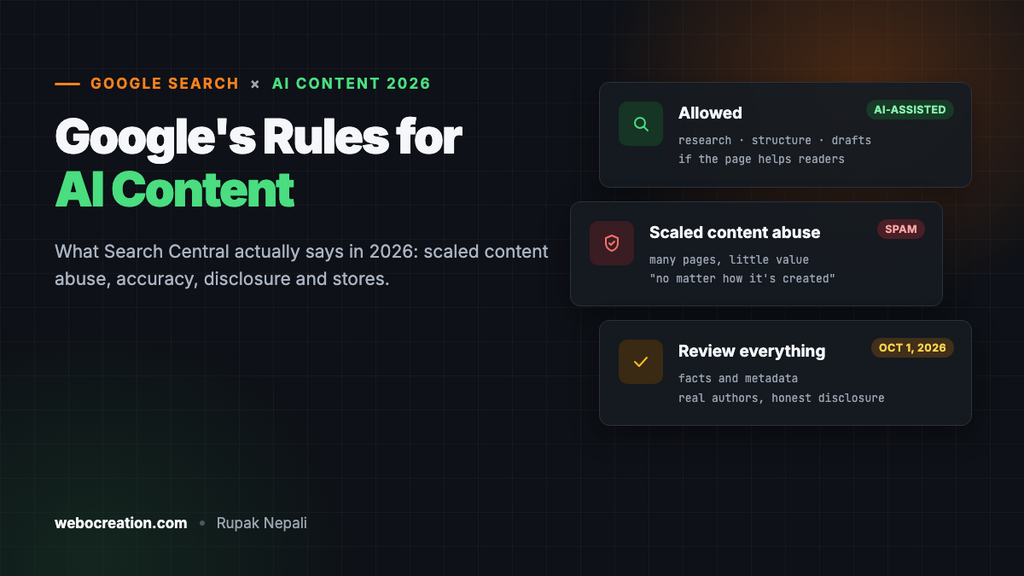
Google’s guidance on generative AI content says gen AI “can be particularly useful when researching a topic, and to add structure to original content.” Using AI to draft, outline, summarize your own notes, translate, or tidy up writing is fine, as long as the result meets Search Essentials and the spam policies like any other page.
What’s not: scaled content abuse
The spam policies define scaled content abuse as “when many pages are generated for the primary purpose of manipulating search rankings and not helping users”, typically “large amounts of unoriginal content that provides little to no value to users, no matter how it’s created.” The examples:
- “Using generative AI tools or other similar tools to generate many pages without adding value for users”
- Scraping feeds, search results or other content to generate many pages, including through synonymizing, translating or other automated transformations, “where little value is provided to users”
- “Stitching or combining content from different web pages without adding value”
- “Creating multiple sites with the intent of hiding the scaled nature of the content”
- Pages that make little or no sense to a reader but contain search keywords
Note what’s not in that list: using AI. A hand-written content farm breaks the same rule, and an AI-assisted page with real value doesn’t. The test is volume without value, for rankings rather than readers.
The October update points to two sections of the Search Quality Rater Guidelines: 4.6.5 (scaled content abuse) and 4.6.6 (main content created with little effort or originality). Google is careful to add that the rater guidelines “are not a guide to ranking first in Google” and that raters’ ratings “don’t directly influence ranking”. They describe what Google’s systems aim to reward and demote, not a checklist.
Accuracy is your job, including the metadata
Google’s guidance puts it simply: generative models “don’t retrieve facts, but predict a likely sequence of words”, so “it is critical to manually factcheck and review all AI-generated content for accuracy and trustworthiness before publishing.” It adds that this review “also applies to metadata”: titles, meta descriptions, structured data and image alt text.
That last point catches people out. Bulk-generated meta descriptions, alt text and product schema are exactly where nobody looks, and where a confidently wrong price, size or claim slips through. Review them like body copy.
Say how the content was made
Google’s helpful content page asks you to think about the “Who, How, and Why” of your content. On “How”, it says that can include “automated, AI-generated, and AI-assisted content”, and that “AI or automation disclosures are useful for content where someone might think ‘How was this created?'” The gen AI guidance suggests “providing more background information on how automation was used”.
Disclosure isn’t required everywhere. A product description drafted with AI and checked by your team doesn’t need a label. A review roundup, a medical explainer or anything that claims first-hand experience is different: readers reasonably want to know whether a person actually tested the thing.
On “Who”: “Fabricating creator profiles (such as by using AI-generated headshots, made-up names, or false credentials…) is a form of deception.” Invented author personas are out. Put real names on content and make sure those people actually reviewed it. More on this in E-E-A-T, authors and brand signals.
On “Why”: “If you use automation, including AI-generation, to produce content for the primary purpose of manipulating search rankings, that’s a violation of our spam policies.”
For online stores
The gen AI guidance points merchants to Google Merchant Center’s policies for AI-generated content, which are stricter than Search’s:
- AI-generated images “must contain metadata using the IPTC
DigitalSourceTypeTrainedAlgorithmicMediametadata.” Most image generators add this; image editors and optimizers can strip it, so check after compression or conversion to WebP. - AI-generated product data, such as titles and descriptions, “must be specified separately and labeled as AI-generated” in your Merchant Center feed.
For Search, the scaled content rule is the one to watch. Generating descriptions for thousands of products that say the same thing in slightly different words is the textbook case of volume without value. Use AI to turn real product data (specifications, materials, dimensions, compatibility, your own photos and test notes) into readable text, and spend your human time on the products that sell. Tools like our AI description generator and AI alt text extensions for OpenCart are built for that kind of assisted, reviewed workflow, not for publishing unread output.
The rules apply to AI Overviews and AI Mode too
Since May 2026, Google’s spam policies explicitly cover “attempting to manipulate generative AI responses in Google Search”. Pages stuffed with text written to be quoted by AI answers, or hidden instructions aimed at models, fall under the same policies as keyword stuffing. If you want to appear in AI answers, Google’s advice is the same as for search: original, accurate, well-structured content. See generative engine optimization and answer engine optimization.
A workflow that stays on the right side
- Start from something only you have. Test results, your own photos, customer questions, sales data, an expert’s notes. AI is good at structuring this; it can’t invent it.
- Draft with AI, edit as a person. Cut the filler, check every fact and number, add what the model doesn’t know.
- Review metadata too: title, description, alt text, structured data.
- Put a real name on it, of someone who reviewed it and can stand behind it.
- Disclose where it matters: when readers would ask “did a person actually do this?”
- Publish what’s worth publishing, not everything you can generate. Ten pages that answer real questions beat a thousand that rephrase each other.
- Prune. Merge or remove thin pages that never get traffic, especially old auto-generated ones.
At webocreation.com/ we use AI to help write and edit, and every extension we publish is installed and tested on a real OpenCart store first; the screenshots and numbers in our posts come from those tests. That first-hand part is what no model can produce for you.
Quick answers
- Will Google penalize my site for using AI? Not for using AI. It acts against scaled, low-value content and ranking manipulation, however it’s made.
- Must I label AI content? Google doesn’t require it in Search, but says disclosures are useful where readers would wonder. Merchant Center does require labels for AI-generated product data and IPTC metadata for AI images.
- Can I mass-produce pages if each is different? If each page adds real value for its reader, yes, that’s normal programmatic SEO (store locators, product pages from real data). If they’re variations of the same text to rank for more keywords, no.
- Can competitors report me? Yes. Since April 2026 Google may use spam reports to take manual action.
- Do I need llms.txt? Not for Google Search, Google says.
Sources
- Google Search’s guidance on using generative AI content on your website
- Spam policies for Google web search
- Creating helpful, reliable, people-first content
- Search Central documentation updates

Rupak Nepali is a web developer, manage Webocreation website and the author of six books:
Getting Started with OpenCart Module Development (Packt, 2013),
OpenCart Theme and Module Development (Packt, 2015),
OpenCart 4: Dev Guide for Themes & Extensions (2024),
OpenCart 4: User Manual (2025),
Cloudflare for the Enterprise Website (2026) and
The Technical Web Guide for Marketers (2026).
Rupak has built OpenCart stores and extensions since 2010, has published more than 600 tutorials on Webocreation, and shares free OpenCart extensions on GitHub.
Find Rupak on
GitHub | Amazon | LinkedIn | X | YouTube.