Search Everywhere: Answer Engine Optimization (AEO): Win Snippets, PAA and AI Overviews
Win featured snippets, People Also Ask, voice answers and AI Overview citations with proven answer-writing patterns and a worked optimisation example.
 Rupak NepaliPublished Nov 14, 2026
This post is Chapter 21 of Search Everywhere: The Practical Guide to SEO, AEO and GEO, the free online edition. Chapter and appendix references link to the matching post.
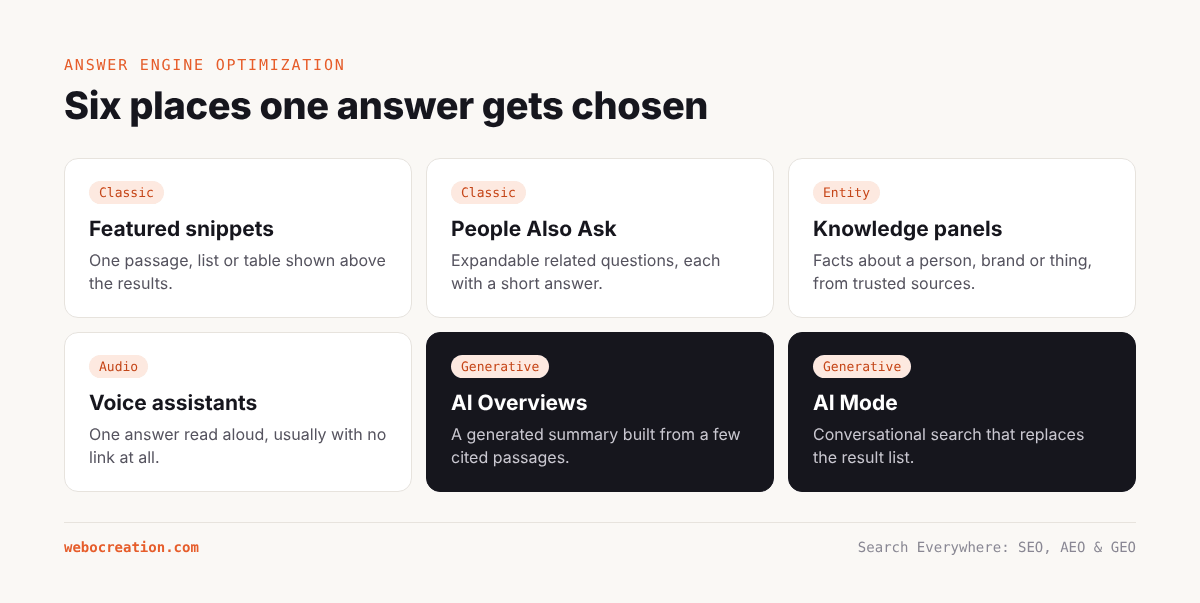
Answer engine optimization is the practice of making your content the answer a system chooses to show, read aloud or summarise. Its original targets were featured snippets, People Also Ask boxes, knowledge panels and voice assistants. Today its most important target is the set of sources behind Google’s AI Overviews and the short answers in AI Mode.
This chapter covers each answer surface, how it selects content, and the writing and formatting patterns that win.
The answer surfaces
Featured snippets
A featured snippet is a highlighted answer extracted from one web page and shown near the top of the results, with a link to the source. Formats:
- Paragraph: a definition or short explanation, typically 40 to 60 words.
- List: numbered steps or bulleted items.
- Table: comparison data.
- Video: a YouTube clip, often with a timestamp to the relevant moment.
Google selects featured snippets from pages that already rank on page 1 (usually top five) for the query. The page must contain a passage that answers the query directly and is easy to extract.
On queries where an AI Overview appears, featured snippets are shown less often, but they remain common on many queries, and the same passage qualities that win snippets also feed AI Overviews.
People Also Ask (PAA)
PAA boxes show related questions that expand to show a short answer from a web page. Each expansion loads more questions. PAA appears on a large share of informational queries and is a rich source of question research (Chapter 3). Winning a PAA answer works like winning a featured snippet: a clear, direct answer under a heading that matches the question.
Knowledge panels
Knowledge panels show facts about entities (people, organisations, places, books) from Google’s Knowledge Graph. You cannot directly edit them, but you can influence them through consistent entity information (Chapter 11) and, once verified as the subject or representative, suggest changes via the “Claim this knowledge panel” process.
Voice assistants
Voice assistants (Google Assistant and Gemini on phones and speakers, Siri, Alexa) read a single answer aloud. They often draw on featured snippets, knowledge panels and local business data. Voice answers favour concise, conversational responses of around 30 words that make sense when heard without visual context.
AI Overviews
AI Overviews are generated summaries at the top of Google results, built from multiple sources with links shown as cards or inline citations. Google has said that AI Overviews use the same core ranking systems and that there are no special requirements beyond being indexed and eligible for a snippet. In practice, the cited sources tend to be:
- Pages that rank well for the query or for related fan-out queries.
- Pages with passages that directly address a specific aspect of the question.
- Pages from sources Google considers reliable for the topic.
Being cited is not limited to the top-ranking page; pages ranking lower, or ranking for a sub-query, are often cited for a specific detail.
AI Mode
AI Mode is Google’s conversational search experience, using query fan-out to research a question through many sub-searches and then writing a longer answer with citations. It supports follow-up questions. The same principles apply as for AI Overviews, but the broader fan-out means comprehensive coverage of a topic, including edge cases and comparisons, has more chances to be used.
How answer selection works, in practice
Across all these surfaces, selection depends on three conditions:
- Eligibility: the page is indexed, ranks for the query or a related one, and allows snippets (no
nosnippet, andmax-snippetnot too restrictive). - Extractability: there is a passage that answers the question cleanly, in a format that matches the surface.
- Trust: the source is reliable enough for the topic.
You control all three, but extractability is where AEO adds the most beyond normal SEO.
Writing patterns that win answers
Pattern 1: Question heading + direct answer
Use the question as a heading (or a close variant), then answer it completely in the first sentence or two.
## What is OCMOD in OpenCart?

OCMOD is OpenCart's built-in modification system that lets extensions change
core files without overwriting them. It applies XML instructions that search
for code in a file and insert, replace or remove lines, and stores the
modified copies in a separate cache folder.

OCMOD was introduced in OpenCart 2.0 as a lighter replacement for vQmod...
The first paragraph is around 45 words: ideal for a paragraph snippet or an AI Overview passage.
Pattern 2: The “is/does/can” answer
For yes/no questions, start with the verdict, then the conditions.
## Does Cloudflare Turnstile work with OpenCart 4?

Yes. Cloudflare Turnstile works with OpenCart 4.0 and later through a captcha
extension that plugs into OpenCart's built-in captcha setting, so it can protect
the registration, contact, review and return forms. It needs a free Cloudflare
account for the site key and secret key, but the site does not need to use
Cloudflare's CDN.
Pattern 3: Steps
For how-to questions, use a numbered list with one action per step, each starting with a verb. Put a one-sentence summary before the list.
## How do I install an extension in OpenCart 4?

To install an extension in OpenCart 4, upload the .ocmod.zip file in the
Extension Installer, install it, then enable it in the extensions list.

1. Go to **Extensions › Installer** in the admin.
2. Click **Upload** and choose the `.ocmod.zip` file.
3. Click the green **Install** button next to the uploaded extension.
4. Go to **Extensions › Extensions** and choose the extension type.
5. Click **Install** (+) next to the extension, then **Edit**.
6. Configure the settings, set **Status** to Enabled, and save.
Google often shows the first several steps as a list snippet with “More items…”, which drives clicks.
Pattern 4: Comparison table
For “X vs Y” queries, give a one-sentence verdict, then a table.
## Turnstile vs reCAPTCHA: which is better for an online store?

For most online stores, Turnstile is the better choice: it is free, rarely
shows a challenge, and does not use visitor data for advertising. reCAPTCHA
remains an option if you already rely on Google's ecosystem.

| | Cloudflare Turnstile | Google reCAPTCHA v2 | Google reCAPTCHA v3 |
|---|---|---|---|
| Puzzles shown to users | Rarely | Often (image grid) | Never (score only) |
| Price | Free | Free up to a usage limit | Free up to a usage limit |
| Privacy | No ad tracking | Google data collection | Google data collection |
| Setup in OpenCart 4 | Extension | Built in | Extension |
Pattern 5: Definitions with context
For “what is” queries, follow the formula: term + category + distinguishing feature + purpose.
“Core Web Vitals are a set of three Google metrics (LCP, INP and CLS) that measure loading speed, responsiveness and visual stability, used as signals in Google’s page experience assessment.”
Pattern 6: Numbers with units, sources and dates
For factual questions, include the number, its unit, the source and the date in one sentence:
“Google’s threshold for a good Largest Contentful Paint is 2.5 seconds or less at the 75th percentile of page loads, according to web.dev’s Core Web Vitals documentation.”
Pattern 7: The FAQ block
At the end of a long article, a short FAQ section answers related questions concisely. Each answer should be two to four sentences. Even though FAQ rich results are now limited to a few authoritative sites, these blocks still feed PAA answers, AI Overviews and AI assistants.
Structure and formatting signals
- Use real HTML lists and tables, not styled
<div>s or images of tables. - Keep headings in a logical hierarchy.
- Put the answer high on the page. Content near the top and under clear headings is easier to identify as the main answer.
- Use
idattributes on headings so that Google can create “jump to” links, and so that AI systems can link to a specific section. Google sometimes uses text fragment links (#:~:text=) to highlight the exact passage it quoted. - Avoid hiding answers behind tabs that load on click or behind “read more” scripts.
Finding answer opportunities
- Your existing snippets. In Semrush Organic Research, filter by SERP feature “Featured snippet” and “Your domain is in” to see snippets you own, and “Your domain is not in” for snippets you could win on keywords where you already rank top 10.
- AI Overview presence. Semrush Position Tracking and other tools show which tracked keywords trigger AI Overviews and whether you are cited. Manually check a sample of important queries in an incognito window.
- PAA questions. For each target topic, record the PAA questions and check whether your page answers each one clearly.
- Search Console question queries. The regex filter from Chapter 15 shows questions you already get impressions for.
Illustrative example: snippet and AI Overview opportunities for webocreation.com/
Query Your position SERP features Current snippet/AIO owner Action how to upgrade opencart 3 to 4 6 AIO, PAA, Video Official forum + agency blog Add a 6-step summary list at the top of the upgrade guide opencart ocmod vs vqmod 4 Featured snippet (paragraph) Older tutorial site Add a definition paragraph and comparison table opencart turnstile 2 none – Add a 40-word “What it does” paragraph to help win a snippet if one appears what is llms.txt 24 AIO, PAA Large SEO publishers Hard to win; target the long-tail “llms.txt for WordPress” instead opencart admin blank page 9 PAA Stack Overflow Create a troubleshooting article with the most common cause first
Optimising an existing article: a worked example
Take webocreation.com/’s tutorial “Replace reCAPTCHA With Cloudflare Turnstile in OpenCart 4”. Its H2s are: Why stores are moving away from reCAPTCHA; How Turnstile works; How OpenCart 4 captchas work; Install the extension; What the code does; Test it before you go live; Troubleshooting; Clean up the fake accounts you already have; Summary.
This is already a strong structure. AEO improvements:
- Add a summary box at the top (currently the summary is only at the end): what the extension does, compatible versions, forms protected, cost, download link.
- Rephrase two headings as questions people ask: “How does Cloudflare Turnstile work?” and “Is Turnstile better than reCAPTCHA?”. Open each with a direct one- or two-sentence answer.
- Add a comparison table of Turnstile vs reCAPTCHA v2 vs v3 under the comparison heading.
- Make the install section a clean numbered list with one action per step.
- Turn troubleshooting issues into H3 questions (“Why does the Turnstile widget not appear?”, “Why does the form fail after an AJAX error?”) with the fix in the first sentence.
- Add a short FAQ: “Is Turnstile free?”, “Does Turnstile need the Cloudflare CDN?”, “Which OpenCart versions are supported?”, “Does Turnstile affect page speed?”.
- Add heading
ids for deep linking. - Shorten the title tag to about 60 characters and keep the long version as the H1.
None of these changes make the article worse for human readers. Most make it better.
Voice search specifics
- Answers read aloud need to make sense without visuals. Avoid “see the table below”.
- Use natural, conversational phrasing that mirrors how people speak questions.
- Local businesses should have complete Google Business Profile, Bing Places and Apple Business Connect profiles, since voice assistants rely on them for “near me” questions.
- Fast, mobile-friendly pages are favoured.
Measuring AEO
- Featured snippets owned: Semrush or Ahrefs, tracked monthly.
- AI Overview citations: Position Tracking’s AI Overview feature, or manual checks of a fixed query set.
- PAA presence: tools that track PAA (Semrush SERP features, AlsoAsked).
- Search Console CTR changes on pages where you optimised answers. Winning a snippet usually lifts CTR; being summarised in an AI Overview without a click may reduce CTR while increasing impressions.
Key takeaways
- Answer surfaces include featured snippets, People Also Ask, knowledge panels, voice assistants, AI Overviews and AI Mode.
- Selection depends on eligibility (ranking and snippet permission), extractability and trust.
- Use question headings with direct answers, verdict-first yes/no answers, numbered steps, comparison tables, precise definitions and FAQ blocks.
- Put answers high, in real HTML structures, and never behind click-loaded content.
- On the case study, the Turnstile tutorial needs a top summary, question headings, a comparison table, question-style troubleshooting and an FAQ.
Previous: Server Log Analysis for Search and AI Crawlers
Next: Generative Engine Optimization (GEO): Get Cited by ChatGPT, Perplexity and Gemini
All chapters: Search Everywhere: The Practical Guide to SEO, AEO and GEO

Rupak Nepali is a web developer, manage Webocreation website and the author of six books:
Getting Started with OpenCart Module Development (Packt, 2013),
OpenCart Theme and Module Development (Packt, 2015),
OpenCart 4: Dev Guide for Themes & Extensions (2024),
OpenCart 4: User Manual (2025),
Cloudflare for the Enterprise Website (2026) and
The Technical Web Guide for Marketers (2026).
Rupak has built OpenCart stores and extensions since 2010, has published more than 600 tutorials on Webocreation, and shares free OpenCart extensions on GitHub.
Find Rupak on
GitHub | Amazon | LinkedIn | X | YouTube.