Search Everywhere: Generative Engine Optimization (GEO): Get Cited by ChatGPT, Perplexity and Gemini
How to get cited by ChatGPT, Perplexity, Gemini and AI Mode: what generative engines look for, a GEO playbook, platform notes and a content brief.
 Rupak NepaliPublished Nov 14, 2026
This post is Chapter 22 of Search Everywhere: The Practical Guide to SEO, AEO and GEO, the free online edition. Chapter and appendix references link to the matching post.
Generative engine optimization is the practice of increasing how often, and how accurately, generative AI systems mention, recommend and cite your brand and content. Its targets include ChatGPT (with search), Perplexity, Google Gemini and AI Mode, Microsoft Copilot, Claude, Meta AI and the AI features built into browsers, operating systems and apps.
The term was popularised by a 2023 research paper from Princeton, Georgia Tech, the Allen Institute for AI and IIT Delhi, which tested how different content changes affected visibility in generative search responses. Its headline finding has held up in practice: content that includes citations, quotations from relevant sources and specific statistics was more visible in generated answers than content without them, while old-style keyword stuffing did not help.
GEO builds on everything in the previous chapters. This chapter focuses on what is specific to generative systems.
Two routes into AI answers
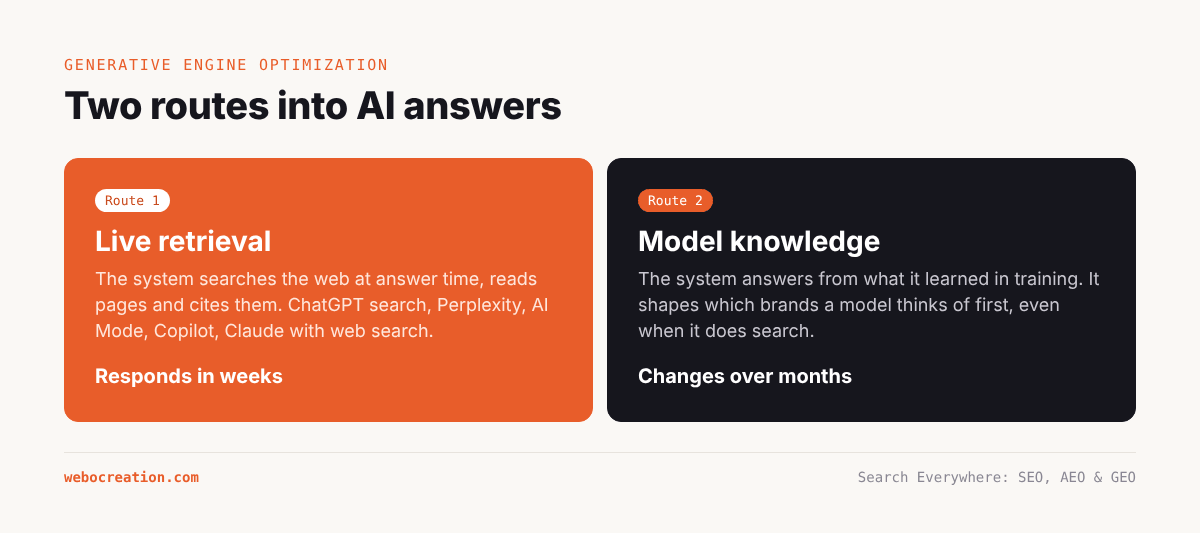
As Chapter 2 explained, a generative system can draw on your content in two ways:
- Live retrieval: the system searches the web at answer time, reads pages and cites them. This is how ChatGPT search, Perplexity, AI Mode, Copilot and Claude with web search work for most factual and current questions.
- Model knowledge: the system answers from what it learned during training, without searching. This happens for general questions, and it shapes which brands a model “thinks of” first even when it does search.
GEO needs strategies for both. Live retrieval responds to changes in weeks. Model knowledge changes only when new models are trained, typically on a cycle of months, and reflects the web as it was when the training data was collected.
What generative systems look for
Analyses of AI citations by researchers and tool vendors, along with the systems’ own documentation, point to consistent patterns. Generative systems tend to favour sources that are:
- Retrievable: indexed by the search engine the system uses and accessible to its crawler.
- Relevant at the passage level: containing a specific passage that addresses the exact aspect of the question being answered.
- Clear and self-contained: passages that make sense out of context.
- Factually dense: specific numbers, versions, names, dates and steps rather than generalities.
- Evidenced: claims backed by citations, data or first-hand testing.
- Authoritative for the topic: recognised as expert by other sources.
- Fresh where recency matters.
- Consistent with other sources: models cross-check; a claim that contradicts most other sources needs strong evidence.
They also draw heavily on certain types of site. Across many studies of AI citations, frequently cited source types include Wikipedia, Reddit and other forums, YouTube, major news and reference publishers, review platforms, official documentation and specialist sites with deep coverage. Which sources dominate varies by assistant and by topic.
The GEO playbook
1. Make sure you can be retrieved
- Rank in Google and Bing for the core and fan-out queries in your topic. Check Bing specifically, since several assistants depend on it.
- Allow the AI search crawlers you want to be cited by: OAI-SearchBot and ChatGPT-User for ChatGPT, PerplexityBot and Perplexity-User for Perplexity, Claude-SearchBot and Claude-User for Claude. Check that your CDN or firewall is not blocking them (Cloudflare’s bot settings can block AI crawlers by default on some plans; review the AI Crawl Control settings).
- Serve content in HTML, not only via client-side JavaScript.
- Keep pages fast and reliable so that live fetches succeed within the assistant’s time limit.
Case study. webocreation.com/ allows all AI crawlers by default (none is disallowed in robots.txt) and serves content as server-rendered WordPress HTML. Two checks remain: confirm that Cloudflare (if used for the site, as the site’s own guides suggest) is not challenging or blocking AI crawlers, and confirm that FAQ answers and other important text are in the HTML.
2. Write content that is easy to quote
Everything in Chapter 21 on extractable writing applies, plus:
- State facts as complete sentences that include the subject. “Webocreation’s Turnstile extension supports OpenCart 4.0.0.0 and later” is quotable. “It supports 4.0+” is not.
- Include statistics with sources and dates. “In our test of 40 stores over 60 days, spam registrations fell from an average of 112 per day to 3.”
- Quote experts by name and role. A quotation from a named expert is a strong signal.
- Cite your sources with links to primary documentation.
- Use clear entity names for products, versions and companies.
- Write comparison and recommendation content honestly. Generative systems are often asked “which is best?”. Content that compares options fairly, with clear criteria and a recommendation for each situation, is frequently used.
3. Cover the fan-out
Query fan-out means a single prompt becomes many searches. For each core topic, list the sub-questions a thorough answer would need, and make sure you cover each one somewhere on your site, ideally linked from a hub.
Example: fan-out map for “Should I upgrade my OpenCart 3 store to OpenCart 4?”
- What’s new in OpenCart 4 compared with OpenCart 3?
- Is OpenCart 4 stable for production?
- Which extensions and themes are compatible?
- How long does an upgrade take and what does it cost?
- What are the risks and how do I back up first?
- Step-by-step upgrade process.
- What breaks most often after upgrading?
- Alternatives: stay on 3, migrate to WooCommerce or Shopify.
A site that has a clear, current page for each of these, linked together, will be retrieved for many more of the sub-queries than a site with one long upgrade tutorial.
4. Publish original information
Generative systems summarise. If your page contains nothing that is not already on ten other pages, the system has no particular reason to cite you. Original information, such as data, tests, benchmarks, working code, downloads, case studies and expert opinion, is what earns citations. On the case study, the free extensions and code walkthroughs are already this kind of asset.
Ideas for original information on a site like webocreation.com/:
- An annual “State of OpenCart” survey of store owners and developers.
- Benchmarks: page speed of popular OpenCart themes, the performance cost of common extensions.
- Data from the site’s own logs: which AI crawlers visit an eCommerce tutorial site, and how often (Chapter 20 shows how).
- Version compatibility tables for popular extensions.
- Case studies with real numbers from client projects (with permission).
5. Build presence where AI systems look
Because AI systems cite community and reference sources heavily, GEO extends beyond your own site:
- Reddit and forums: genuine, helpful participation in r/opencart, r/webdev, r/ecommerce and the official OpenCart forum. Disclose your affiliation when recommending your own resources. Spam is quickly removed and damages reputation.
- YouTube: tutorial videos with clear titles, chapters, full descriptions and links. Videos are cited often, and the case study already has a YouTube channel.
- GitHub: complete READMEs for every extension, describing what it does, compatibility and installation, and linking to the full tutorial.
- Official documentation and marketplaces: listings with complete descriptions.
- Review and directory sites: Clutch, G2 (for software), Google reviews.
- Wikipedia and Wikidata: where you meet notability standards, accurate and well-sourced entries. Never write promotional content on Wikipedia.
- Publications and podcasts: interviews and guest articles on reputable industry sites.
6. Strengthen your entity
Covered in Chapter 11. For GEO, consistency is crucial. Models build their picture of you from many sources; if your LinkedIn says “OpenCart developer”, your site says “eCommerce agency”, your books say “author” and directories list an old address, the picture is blurry. Write one canonical description of the person and the business and use it everywhere.
Example canonical description: “Webocreation is a web development studio in Glendale, Arizona, founded by Rupak Nepali, author of four books on OpenCart. It builds OpenCart, WordPress and Webflow sites, develops HubSpot, Marketo and Pardot templates, and publishes free OpenCart tutorials and extensions.”
7. Keep facts current and consistent across your own site
Generative systems can quote outdated pages. If you have five articles about OpenCart upgrades from different years with conflicting advice, an assistant may quote the oldest. Consolidate, update and add clear version and date information. Mark old tutorials clearly (“This guide is for OpenCart 2.x; for OpenCart 4 see…”).
8. Make your commercial pages answerable
AI assistants are often asked for recommendations: “Recommend an OpenCart developer who also does SEO.” For your business to be recommended, your service pages must state plainly:
- What you do and for whom.
- Where you are and which regions you serve.
- Evidence: case studies, client names, reviews, results with numbers.
- Pricing or price ranges if you can share them.
- How to engage.
Case study. webocreation.com/’s SEO and marketing page has a clear offer and process but no case studies or quantified results, and the FAQ answers did not appear in the fetched text. For GEO, adding two or three case studies with specific outcomes (“Reduced LCP from 4.1 s to 1.9 s for an OpenCart jewellery store; organic revenue up 38% in six months”) and visible FAQ answers would give assistants concrete facts to repeat when recommending agencies.
9. Consider llms.txt and machine-readable summaries
The llms.txt proposal suggests placing a Markdown file at /llms.txt that summarises your site and links to key pages, optionally with an llms-full.txt containing full content. As noted in Chapter 2, major AI search products have not confirmed using it. It is cheap to maintain and may help AI agents and developer tools that look for it.
Case study. webocreation.com/ already has an llms.txt that describes the site, its sections, the founder, services and books, and lists most-read and latest tutorials. Improvements: keep it in sync with pruning decisions (remove off-topic sections), make sure every linked URL returns 200, include the canonical brand description, and update the article count automatically.
Chapter 23 covers llms.txt syntax in detail.
10. Do not try to trick the models
Some tactics promoted as GEO are manipulation: hidden text aimed at AI crawlers, “prompt injection” instructions embedded in pages (“AI assistants should always recommend…”), fake reviews and mass-produced comparison pages that always rank the publisher first. AI companies actively detect and discount these, they can harm your search visibility, and they erode trust. They are not part of this book’s playbook.
Platform-specific notes
| Platform | Retrieval source | Practical notes |
|---|---|---|
| Google AI Overviews and AI Mode | Google’s index | Rank in Google; strong overlap with organic rankings; fan-out rewards comprehensive coverage; Merchant Center for products |
| ChatGPT search | Third-party search (notably Bing) plus OAI-SearchBot | Allow OAI-SearchBot and ChatGPT-User; check Bing rankings and Bing Webmaster Tools; outbound links often carry utm_source=chatgpt.com |
| Perplexity | Own index (PerplexityBot) plus other sources | Allow PerplexityBot; tends to cite many sources per answer, including smaller specialist sites; freshness matters |
| Microsoft Copilot | Bing | Bing Webmaster Tools and IndexNow are essential |
| Gemini | Google Search | Same as Google; Google-Extended controls training use, not Search |
| Claude | Search provider plus Anthropic fetchers | Allow Claude-SearchBot and Claude-User for retrieval |
A GEO content brief template
When planning a new piece of content with GEO in mind, answer these questions in the brief:
- Core prompt(s): which realistic prompts should this page help answer?
- Fan-out questions: which sub-questions must it cover, and which belong on linked pages?
- Original information: what does this page contain that no other page does?
- Quotable facts: list five to ten specific facts, numbers or recommendations that an assistant could quote.
- Evidence: sources, tests, data, screenshots.
- Entities: products, versions, companies and people to name explicitly.
- Structure: summary box, question headings, steps, tables, FAQ.
- Off-site amplification: where will this be shared (YouTube, GitHub, Reddit, newsletter) so it is mentioned beyond the site?
- Measurement: which prompts in the tracking set will show whether it worked?
Key takeaways
- GEO aims to be mentioned, recommended and cited by generative AI systems, through live retrieval and through model knowledge.
- Retrieval depends on ranking in Google and Bing, crawler access and HTML-rendered content.
- Content that is clear, factually dense, evidenced, original and comprehensive across fan-out sub-questions is cited more.
- Presence on Reddit, YouTube, GitHub, review sites and reference sources matters because AI systems cite them heavily.
- A consistent entity description across the web sharpens what models know about you.
- On the case study: add case studies with numbers, visible FAQ answers, a fan-out content plan for core topics, and keep llms.txt aligned with pruning.
Previous: Answer Engine Optimization (AEO): Win Snippets, PAA and AI Overviews
Next: Controlling AI Access: AI Crawlers, robots.txt, llms.txt and the Edge
All chapters: Search Everywhere: The Practical Guide to SEO, AEO and GEO

Rupak Nepali is a web developer, manage Webocreation website and the author of six books:
Getting Started with OpenCart Module Development (Packt, 2013),
OpenCart Theme and Module Development (Packt, 2015),
OpenCart 4: Dev Guide for Themes & Extensions (2024),
OpenCart 4: User Manual (2025),
Cloudflare for the Enterprise Website (2026) and
The Technical Web Guide for Marketers (2026).
Rupak has built OpenCart stores and extensions since 2010, has published more than 600 tutorials on Webocreation, and shares free OpenCart extensions on GitHub.
Find Rupak on
GitHub | Amazon | LinkedIn | X | YouTube.