Search Everywhere: SEO, AEO and GEO Explained: How Search Works in 2026
SEO, AEO and GEO explained in plain terms: what each layer of search optimizes for, how they overlap, and how to measure success in 2026.
 Rupak NepaliPublished Nov 14, 2026
This post is Chapter 1 of Search Everywhere: The Practical Guide to SEO, AEO and GEO, the free online edition. Chapter and appendix references link to the matching post.
Imagine three people who all want to know how to stop spam registrations on an OpenCart store.
The first types “opencart spam registrations” into Google. They see an AI Overview summarising three fixes, a People Also Ask box, a forum thread, a YouTube video and a list of ten blue links. They scroll past the summary, click a tutorial, and download a free extension.
The second asks a voice assistant in their car, “How do I stop fake accounts on OpenCart?” They hear one answer, read aloud from one source, and never see a link at all.
The third opens ChatGPT and writes, “My OpenCart 4 store is getting hundreds of fake registrations a day and reCAPTCHA annoys customers. What should I do?” They get a tailored answer that recommends Cloudflare Turnstile, explains why, gives steps, and cites two sources at the bottom.
All three journeys can end on the same page, such as webocreation.com/’s tutorial on replacing reCAPTCHA with Cloudflare Turnstile in OpenCart 4. But the route to that page, the signals that put it in front of each person, and the way success is measured are different in each case. That is the whole subject of this book in three paragraphs.
Three disciplines, one foundation
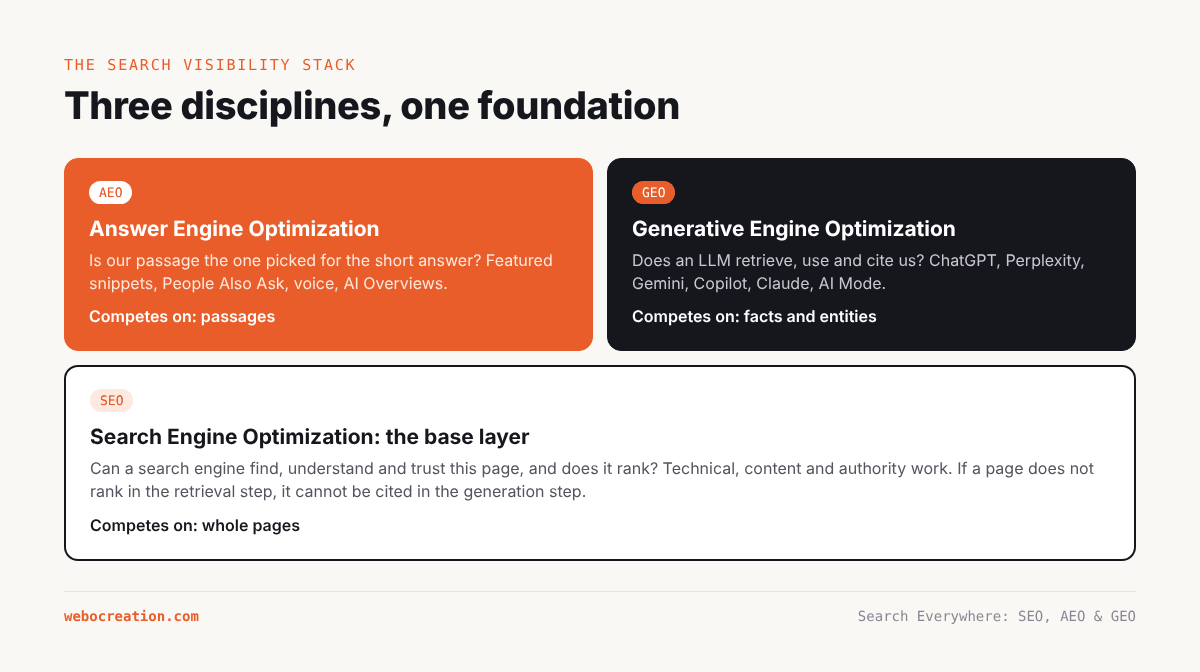
It helps to think of search visibility as a stack.
SEO is the base layer. It answers the question: can a search engine find, understand and trust this page, and does it rank for the queries it should? It includes technical work (crawling, indexing, speed, structured data), content work (relevance, depth, intent match), and authority work (links, mentions, brand, expertise).
AEO sits on top. It answers the question: when a system wants to show one short answer, is ours the one it picks? AEO grew up around featured snippets, People Also Ask boxes, knowledge panels and voice assistants, all of which choose a single passage to display or read aloud. AI Overviews extended the idea: the overview itself is generated, but it is built from a small number of passages that the system judged to be the best answers.
GEO sits alongside AEO at the top. It answers the question: when a large language model writes an answer, does it retrieve our content, use it, and cite us? GEO covers ChatGPT search, Perplexity, Gemini, Microsoft Copilot, Claude with web search, and Google’s AI Mode. It also covers the slower, harder-to-measure question of whether a model “knows” your brand from its training data.
The reason the three belong in one book is that the overlap is enormous. Almost every AI answer engine that cites sources works by running a search, or several searches, behind the scenes, taking the top results, reading them, and writing an answer from the passages it found. If your page does not rank in the retrieval step, it cannot be cited in the generation step. Good SEO is therefore the entry ticket for AEO and GEO, not a separate activity.
What changes as you move up the stack is the unit of competition:
| Layer | What competes | What wins | Typical success metric |
|---|---|---|---|
| SEO | Whole pages | Relevance, authority, page experience | Rankings, clicks, organic sessions |
| AEO | Passages and answers | The clearest, most direct, best-structured answer from a trusted page | Snippet ownership, PAA presence, voice answers, AI Overview citations |
| GEO | Facts, claims and entities | Content that is easy to retrieve, quote and attribute, from a source the model trusts | Citations, brand mentions, share of voice in AI answers, AI referral traffic |
How search behaviour changed
A few shifts explain why AEO and GEO became necessary.
Zero-click results grew. For many informational queries the answer appears on the results page itself. A definition, a conversion, a date, a short how-to. The searcher gets what they need and leaves. For publishers, ranking first no longer guarantees a click.
AI summaries moved to the top of the page. Google’s AI Overviews, introduced widely in 2024 and expanded since, put a generated summary above the organic results for a large share of informational queries. AI Mode, a separate conversational search experience, went further and replaced the result list with an answer for users who choose it. Both cite sources with links, but the number of links shown is small and the competition for them is intense.
Conversational assistants became a search channel. Hundreds of millions of people now use ChatGPT, Gemini, Copilot, Perplexity and Claude weekly. Many of those conversations are searches by another name: product comparisons, troubleshooting, research. When these assistants browse the web, they cite pages. When they do not, they answer from what they learned during training, which favours brands and facts that appear consistently across many sources.
Queries got longer and more specific. People write to an AI assistant the way they would brief a colleague. “Best OpenCart extension” becomes “I run an OpenCart 4.0.2 store selling handmade jewelry, my host is shared, which captcha extension won’t slow down checkout?” This long, contextual phrasing rewards content that covers specific situations, versions and trade-offs.
Trust became the scarce resource. Generative systems can produce fluent text about anything, so the value they add is selecting reliable sources. Signals that tell a system “this source is accurate and accountable” (named authors with verifiable expertise, consistent facts across the web, citations to primary sources, an organisation with a real address) matter more than ever.
What has not changed
It would be easy to read the last section and conclude that “SEO is dead”. Every few years someone does. It is not true, for three practical reasons.
First, traditional organic results still drive the majority of search referral traffic for most sites. AI referrals are growing fast from a small base, but for a typical content site in 2026 they are still a single-digit percentage of organic sessions.
Second, as already noted, the AI systems themselves depend on search indexes. Google’s AI features are built on Google’s index. ChatGPT search and Copilot draw heavily on Bing’s index and their own crawlers. Perplexity runs its own index plus third-party search. If you are invisible in search, you are invisible to most of them.
Third, the qualities that AI systems reward are the same qualities Google has said it wants for years: helpful, original, people-first content from people with real experience. The difference is that sloppy shortcuts are punished faster.
The webocreation.com/ case study
Here is a first look at the site we will audit throughout the book.
Case study: webocreation.com/ at a glance (November 2026)
- Platform: WordPress (version exposed in a generator meta tag), a custom theme called “webocreation”, Yoast SEO generating the XML sitemaps, Google Tag Manager for tags.
- Content: about 776 articles according to the site’s own
llms.txt, 52 pages of blog archive. Core topics are OpenCart development and tutorials, plus HubSpot, Marketo, Pardot, Webflow, WordPress, Cloudflare and AI for eCommerce.- Commercial pages: service pages for OpenCart, WordPress, Drupal, Webflow, Next.js, HubSpot, Marketo, Pardot, SEO and marketing, security and speed, ads, branding and hosting.
- Expertise signals: a founder, Rupak Nepali, who has written four OpenCart books (two with Packt in 2013, two OpenCart 4 guides on Amazon in 2024 and 2025) and has blogged since 2010.
- AI readiness: an
llms.txtfile exists. The robots.txt sets a crawl delay for ClaudeBot but has no rules for other AI crawlers. Service pages talk about “AIO/GEO”.- Legacy content: posts from earlier eras that do not fit the current focus, including a Nepali-language serial, health-sector study notes, internship report fragments and NFT and metaverse guest posts. The author sitemap lists 63 author archives, most of them guest contributors.
That combination is ideal for teaching. The site has real expertise and a clear core topic (OpenCart), which is the most important ingredient for both SEO and GEO. It also has the dilution, leftovers and missing signals that hold most sites back.
What “success” means in each layer
Before diving into technique, agree with yourself (or your client) on what you are trying to achieve. A common failure is to optimise for AI visibility and then judge the work by organic clicks, or the other way round.
For SEO, the familiar metrics still apply:
- Impressions, clicks, click-through rate and average position in Search Console.
- Organic sessions, engaged sessions and conversions in GA4.
- Rankings for a tracked set of keywords in a tool such as Semrush.
- Index coverage: how many of your important pages are indexed.
For AEO, add:
- The number of featured snippets you own (Semrush and similar tools report this).
- Presence in People Also Ask boxes for your target questions.
- How often your pages are cited in AI Overviews for your target queries.
For GEO, add:
- Citation rate: for a fixed set of prompts, how often each AI assistant cites your domain.
- Mention rate: how often your brand is named, with or without a link.
- Share of voice: your citations and mentions compared with competitors for the same prompts.
- AI referral traffic: sessions in GA4 from chatgpt.com, perplexity.ai, gemini.google.com, copilot.microsoft.com, claude.ai and similar sources.
- AI crawler activity in your server logs.
Chapter 24 shows how to build a measurement system for all of these. For now, keep the principle in mind: measure each layer on its own terms, and report them together.
A simple model for the rest of the book
Every chapter that follows connects to one of five questions a search or answer system asks about your content. Keep these in mind and the techniques will make sense even when tools change.
- Can I reach it? Crawling, robots.txt, server responses, rendering, AI crawler access. (Chapters 4, 20 and 23.)
- Can I understand it? Structure, headings, internal links, schema, entities, clear language. (Chapters 5, 7 and 10.)
- Is it the best match? Intent, depth, freshness, originality, answer quality. (Chapters 3, 10 and 21.)
- Can I trust it? Authors, expertise, links, mentions, consistency, reputation. (Chapters 11 and 12.)
- Can I use it? Is there a quotable passage, a clear fact, a step list, a table, a definition, that I can lift into an answer and attribute? (Chapters 21 and 22.)
The first four are classic SEO. The fifth is what AEO and GEO add. Content that scores well on all five tends to win everywhere.
Key takeaways
- SEO, AEO and GEO are layers of one job. SEO earns the right to be considered; AEO and GEO compete for the answer.
- AI answer engines mostly retrieve from search indexes, so ranking is still the entry ticket.
- The unit of competition shrinks as you move up: pages for SEO, passages for AEO, facts and entities for GEO.
- Trust signals (real authors, consistent facts, primary sources) carry more weight in AI answers than they did in classic search.
- Measure each layer with its own metrics, and report them side by side.
Next: How Search Engines and AI Answer Engines Work
All chapters: Search Everywhere: The Practical Guide to SEO, AEO and GEO

Rupak Nepali is a web developer, manage Webocreation website and the author of six books:
Getting Started with OpenCart Module Development (Packt, 2013),
OpenCart Theme and Module Development (Packt, 2015),
OpenCart 4: Dev Guide for Themes & Extensions (2024),
OpenCart 4: User Manual (2025),
Cloudflare for the Enterprise Website (2026) and
The Technical Web Guide for Marketers (2026).
Rupak has built OpenCart stores and extensions since 2010, has published more than 600 tutorials on Webocreation, and shares free OpenCart extensions on GitHub.
Find Rupak on
GitHub | Amazon | LinkedIn | X | YouTube.