
How to show multiple flat rates shipping as per total? OpenCart 4 extension for free

OpenCart doesn’t support a shipping method that allows for multiple flat rates as per total by default, for that we create an Opencart extension and provided it for free where you can set multiple flat rates shipping prices as per the sub-total price of the cart.

Installation of Opencart extension multiple flat rates

  • Download the multiple flat rates shipping extension
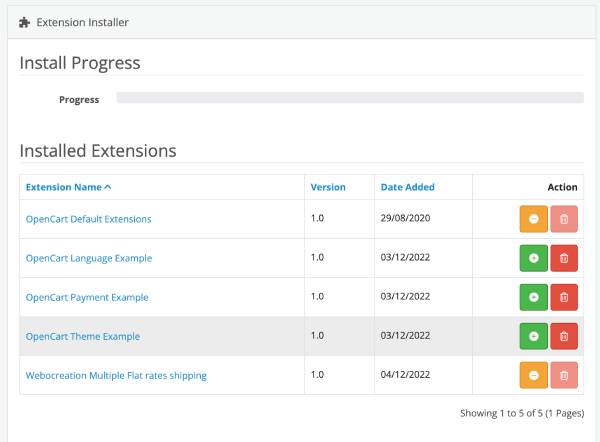
  • Go to admin >> Extensions >> Installer >> Upload the downloaded zip file named “multipleflatrates.ocmod.zip
  • Click the Green install button at the side of “Webocreation Multiple Flat rates shipping”
    Install multiple flat rate shipping
  • Now, go to Extensions >> Extensions >> Filter out for Shipping >> Click the install green button for “Multiple Flat Rates Based Shipping”
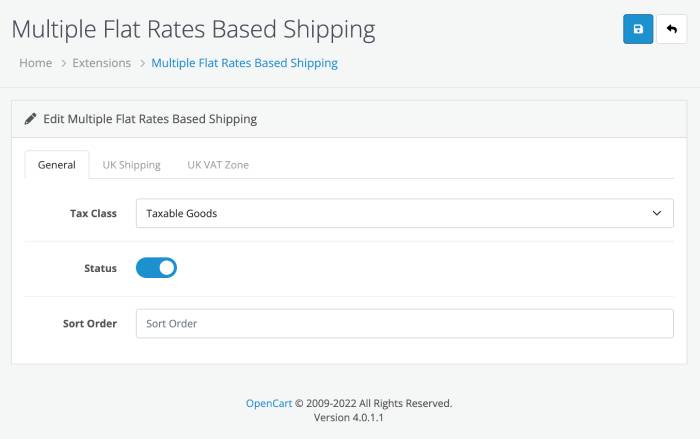
  • Edit the “Multiple Flat Rates Based Shipping”
  • Activate the status, select the tax class and enter the sort order.
    Multiple flat rate base shipping settings
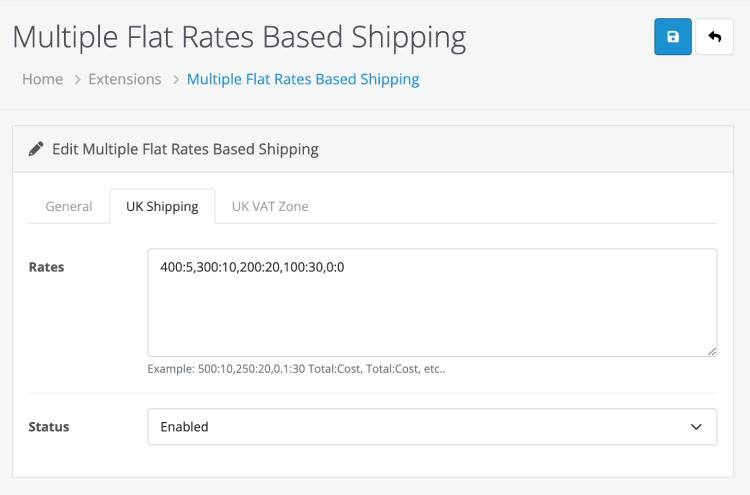
  • Click the geo zone tab and enter the rates and status. We entered the rates as “400:5,300:10,200:20,100:30,0:0”
    Multiple flat rates based shipping
  • Enter similar rates value for other geo zones as well and click save.
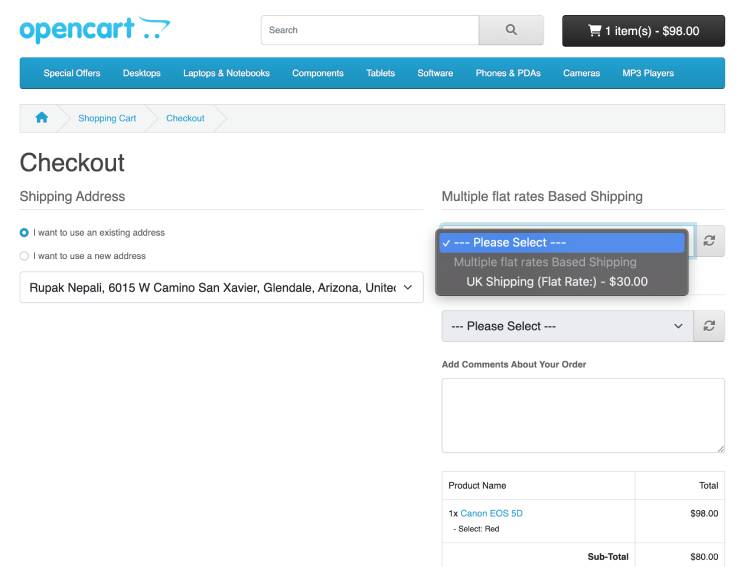
  • With these settings, you will see the shipping method below when the order is between $0 to $100, because of which the shipping cost is $30, as per the settings above.
    Shipping methods selection

How to set the shipping rates as per total in Opencart?

In the above example we set the rates like “400:5,300:10,200:20,100:30,0:0“, it means, the shipping cost is $30 when the sub-total of the cart is between 0 to 100, and 20 shipping cose when sub-total is between 100 to 200 and like wise.

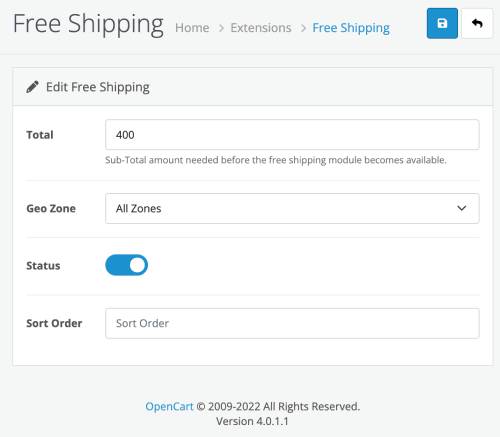
If you want to offer free shipping after some amount let say after 400, then you can install and activate the free shipping module and enter the total amount as 400.

Read more: Set free shipping, flat rate shipping, shipping as per item, or pick from a store in Opencart

free shipping extension

Release Notes

1.0.0:
Compatible with Opencart 4
Stability: Stable
Description:
Initial Release

Support:

If you have any questions about this extension, you can comment below or contact us at info@webocreation.com.

Conclusion:

In this way, your Opencart store now has multiple flat-rate shipping options for your customer. Please let us know if you have any questions or comments so that we can add extra topics. You can follow us at our Twitter account @rupaknpl, subscribe to our YouTube channel for opencart tutorials, and click to see more Opencart free extensions.

Opencart Cache details – remove while developing theme or module developer tips

Cache always make developer scream out in some case developers write the code correctly but they forget to clear the cache and they test the logic and data which they found it not working, as cache provides stale data and sense, they scream out loud, and after some hours of testing and logical changes, they remember to clear the cache 🙂 and they again scream out. The same case happens when I started to develop an OpenCart extension for OpenCart and I keep on testing the module but it did not show the changes as it is showing from the Cache folder which is in the storage/ folder that you keep outside of the public_html folder in your server. In OpenCart Version 2.*  it used to be in system/storage.

How to delete cache in OpenCart?

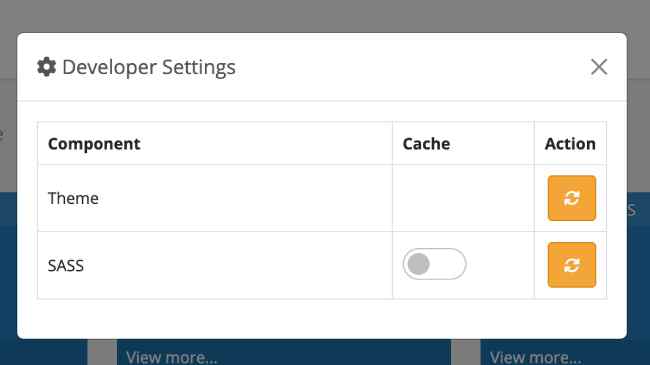
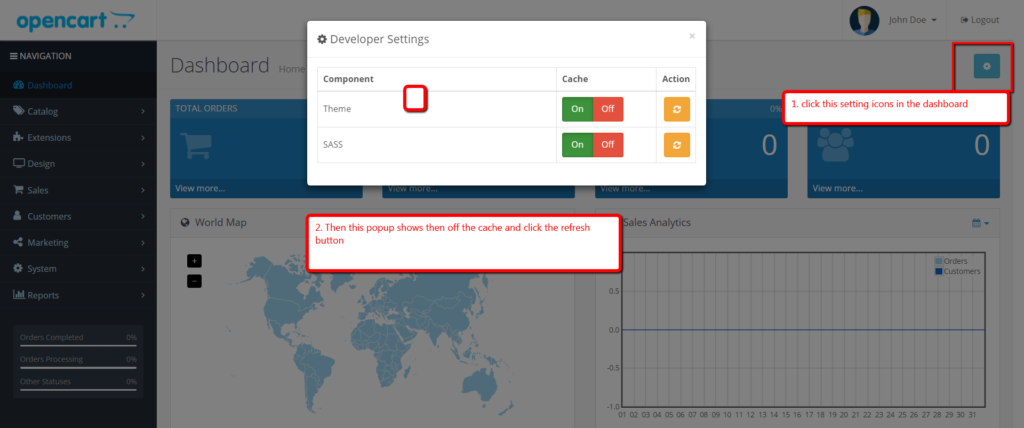
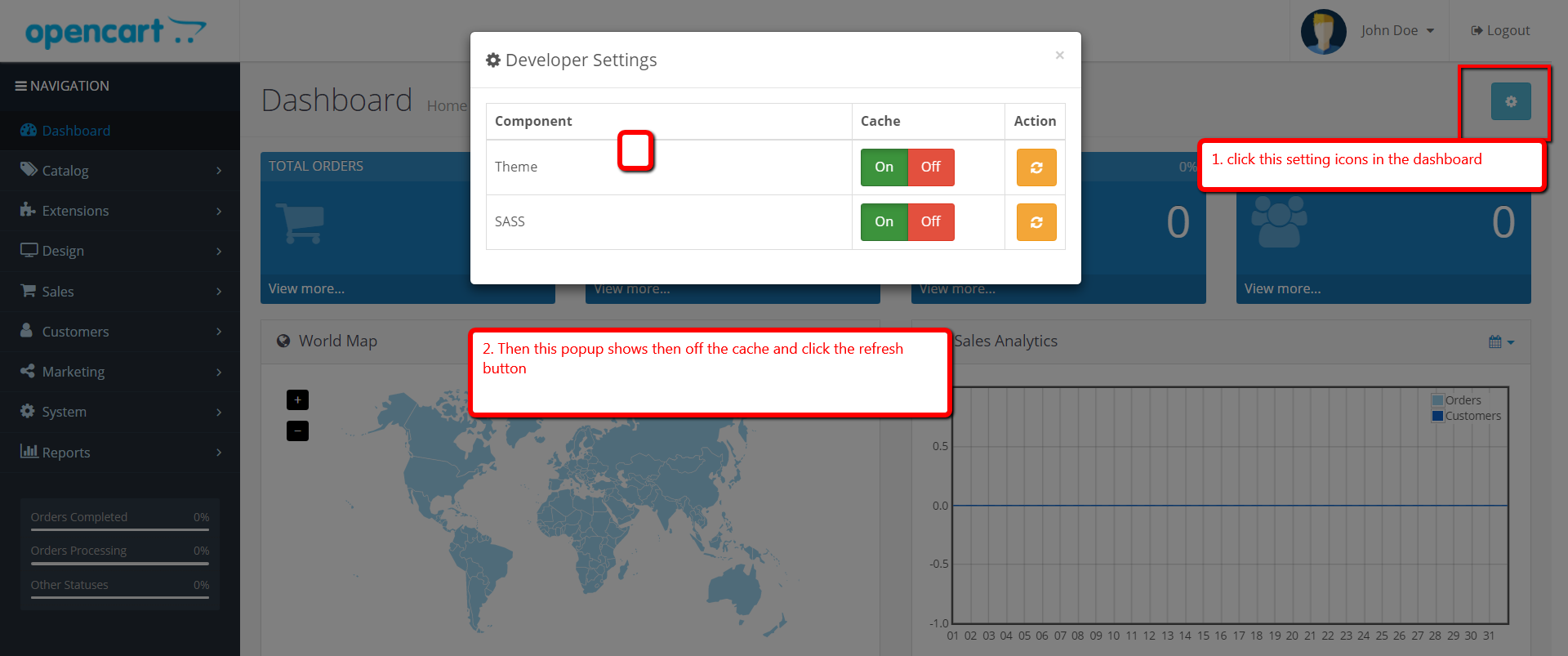
Login to the admin dashboard where you will see a gear icon for the Developer setting, and click it off the cache option available. For Opencart 4, you will see like below, where you can clear the cache and off it.

Opencart cache

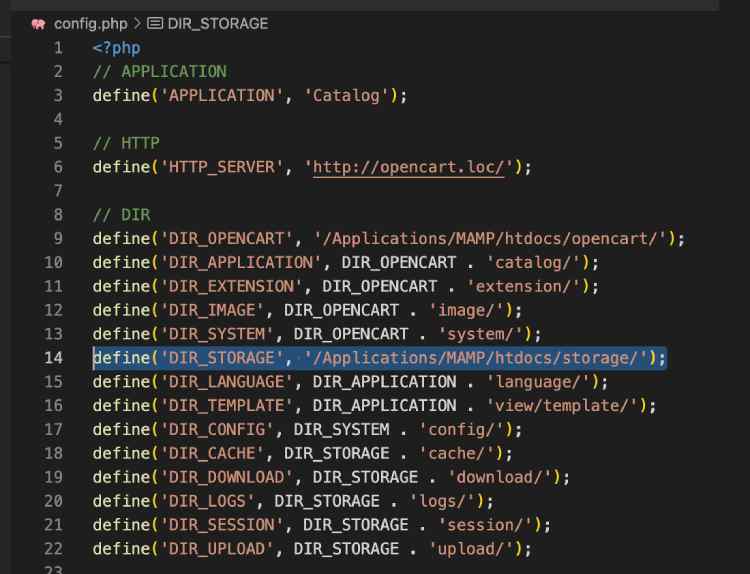
Another place you can remove the cache is in the storage/ folder. You can find the storage folder location at config.php, look for the DIR_STORAGE constant where you can find the path of the storage folder.

DIR_STORAGE folder location

Go to that folder and inside find the cache/ folder and remove all other files except index.html. Likewise, go to upload/ folder and remove all except index.html, in this way you can remove the cache in Opencart for OCMOD.

How to remove the Vqmod cache?

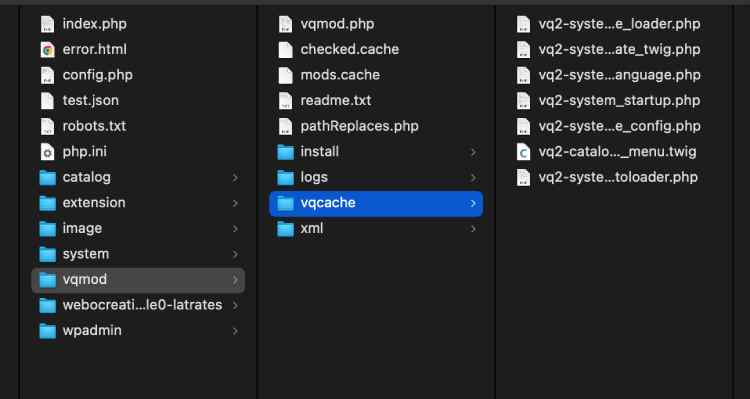
To remove the VQMoD cache, go to vqmod/ and vqcache/ folder and remove all the files and folders except index.html.

Vqmod cache

How to remove the twig template cache in the OpenCart?

1. Click this setting icon on the dashboard
2. Then this popup shows then off the cache and clicks the refresh button

Another way is:

Open system\library\template\Twig\Environment.php, in the constructor:

public function __construct(Twig_LoaderInterface $loader = null, $options = array())
{
    if (null !== $loader) {
        $this->setLoader($loader);
    } else {
        @trigger_error('Not passing a Twig_LoaderInterface as the first constructor argument of Twig_Environment is deprecated since version 1.21.', E_USER_DEPRECATED);
    }

    $options = array_merge(array(
        'debug' => false,
        'charset' => 'UTF-8',
        'base_template_class' => 'Twig_Template',
        'strict_variables' => false,
        'autoescape' => 'html',
        'cache' => false,
        'auto_reload' => null,
        'optimizations' => -1,
    ), $options);

    $this->debug = (bool) $options['debug'];

Find the following line of code:

$this->debug = (bool) $options['debug'];

and change it to:

$this->debug = (bool) true;

Then your template file caching will be removed.

Another way to do this:

Open to system\library\template\Twig\Cache\Filesystem.php, and find the following lines of code

public function load($key)
{
    if (file_exists($key)) {
        @include_once $key;
    }
}

Comment out as in the following code:

public function load($key)
{
    // if (file_exists($key)) {
    //      @include_once $key;
    // }
}

This will remove the template cache of the twig and recreate it every time, once development is over you have to remove the comment.

Hope it will help your development time so that you don’t have to keep clearing the cache for each test. In this way, you clear the cache in Opencart, and Vqmod. Hope you liked this article, please subscribe to our YouTube Channel for Opencart video tutorials. You can also find us on Webocreation Twitter and Webocreation Facebook. Please let us know if you have any questions or concerns.

Show Module Link at Left Menu Admin OpenCart 4, 3, 2

Show Module Link at Left Menu Admin OpenCart. Save your time while you develop or install or edit modules/extensions. For installation just upload the module and you are set.

Download for Opencart veriosn 4.0.1.1

Download for free OpenCart Version 3

For OpenCart version 2 please download from below:

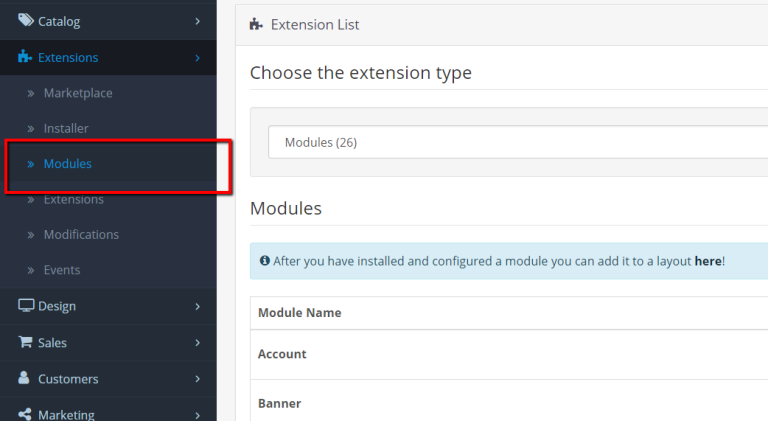
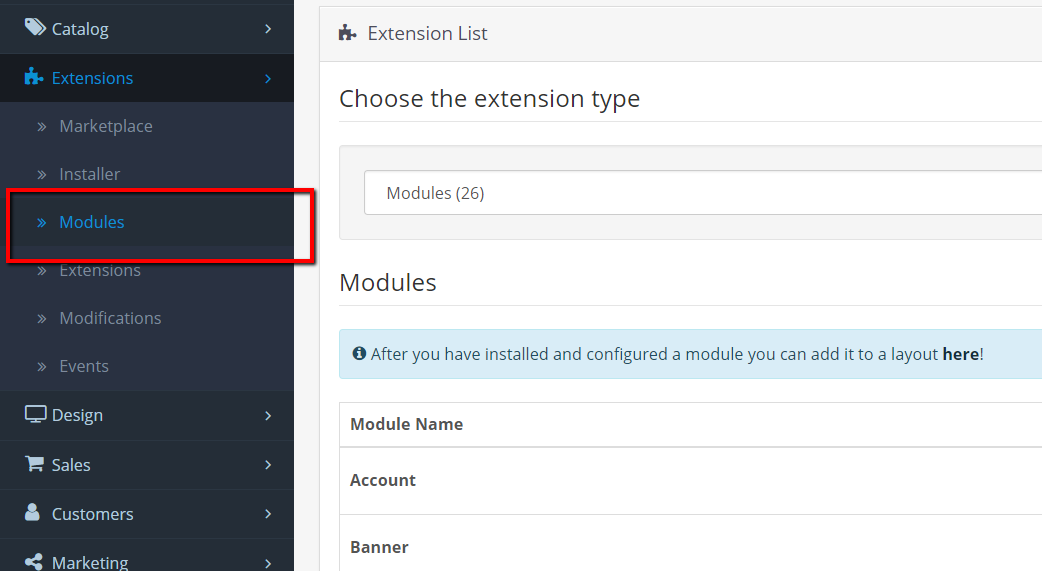
Module link in the left menu of Admin

The code for Opencart version 4 is below:

extension/showmoduleinleftmodule4011/admin/controller/module/menulink.php

<?php
namespace Opencart\Admin\Controller\Extension\showmoduleinleftmodule4011\Module;

class MenuLink extends \Opencart\System\Engine\Controller
{
    public function index(): void
    {
        $this->load->language('extension/showmoduleinleftmodule4011/module/menulink');

        $this->document->setTitle($this->language->get('heading_title'));

        $data['breadcrumbs'] = [];
        $data['breadcrumbs'][] = [
            'text' => $this->language->get('text_home'),
            'href' => $this->url->link('common/dashboard', 'user_token=' . $this->session->data['user_token']),
        ];
        $data['breadcrumbs'][] = [
            'text' => $this->language->get('text_extension'),
            'href' => $this->url->link('marketplace/extension', 'user_token=' . $this->session->data['user_token'] . '&type=module'),
        ];
        $data['breadcrumbs'][] = [
            'text' => $this->language->get('heading_title'),
            'href' => $this->url->link('extension/showmoduleinleftmodule4011/module/menulink', 'user_token=' . $this->session->data['user_token']),
        ];

        $data['save'] = $this->url->link('extension/showmoduleinleftmodule4011/module/menulink|save', 'user_token=' . $this->session->data['user_token']);
        $data['back'] = $this->url->link('marketplace/extension', 'user_token=' . $this->session->data['user_token'] . '&type=module');

        $data['module_showmoduleinleftmodule4011_status'] = $this->config->get('module_showmoduleinleftmodule4011_status');

        $data['success'] = '';
        if (!empty($this->session->data['module_showmoduleinleftmodule4011_success'])) {
            $data['success'] = $this->session->data['module_showmoduleinleftmodule4011_success'];
            unset($this->session->data['module_showmoduleinleftmodule4011_success']);
        }

        $data['header'] = $this->load->controller('common/header');
        $data['column_left'] = $this->load->controller('common/column_left');
        $data['footer'] = $this->load->controller('common/footer');

        $this->response->setOutput($this->load->view('extension/showmoduleinleftmodule4011/module/menulink', $data));
    }

    public function save(): void
    {
        $this->load->language('extension/showmoduleinleftmodule4011/module/menulink');

        $json = [];

        if (!$this->user->hasPermission('modify', 'extension/showmoduleinleftmodule4011/module/menulink')) {
            $json['error'] = $this->language->get('error_permission');
        }

        if (!$json) {
            $this->load->model('setting/setting');

            $this->model_setting_setting->editSetting('module_showmoduleinleftmodule4011', $this->request->post);

            $json['redirect'] = str_replace('&amp;', '&', $this->url->link('extension/showmoduleinleftmodule4011/module/menulink', 'user_token=' . $this->session->data['user_token']));
            $this->session->data['module_showmoduleinleftmodule4011_success'] = $this->language->get('text_success');
        }

        $this->response->addHeader('Content-Type: application/json');
        $this->response->setOutput(json_encode($json));
    }

    public function install(): void
    {
        // add events
        $this->load->model('setting/event');
        if (version_compare(VERSION, '4.0.1.0', '>=')) {
            $data = [
                'code' => 'module_showmoduleinleftmodule4011',
                'description' => '',
                'trigger' => 'admin/view/common/column_left/before',
                'action' => 'extension/showmoduleinleftmodule4011/module/menulink|eventViewCommonColumnLeftBefore',
                'status' => true,
                'sort_order' => 0,
            ];
            $this->model_setting_event->addEvent($data);
        } else {
            $this->model_setting_event->addEvent('module_showmoduleinleftmodule4011', '', 'admin/view/common/column_left/before', 'extension/showmoduleinleftmodule4011/module/menulink|eventViewCommonColumnLeftBefore');
        }
    }

    public function uninstall(): void
    {
        // remove events
        $this->load->model('setting/event');
        $this->model_setting_event->deleteEventByCode('module_showmoduleinleftmodule4011');
    }

    public function eventViewCommonColumnLeftBefore(&$route, &$data, &$code)
    {
        if (!$this->config->get('module_showmoduleinleftmodule4011_status')) {
            return null;
        }

        $this->load->language('extension/showmoduleinleftmodule4011/module/menulink');
        $text_showmoduleinleftmodule4011 = $this->language->get('menu_showmoduleinleftmodule4011');

        $data['menus'][] = [
            'id' => 'menu-export-impport',
            'icon' => 'fas fa-puzzle-piece',
            'name' => $text_showmoduleinleftmodule4011,
            'href' => $this->url->link('marketplace/extension', 'user_token=' . $this->session->data['user_token'] . '&type=module'),
            'children' => [],
        ];
        return null;
    }
}

extension/showmoduleinleftmodule4011/admin/language/en-gb/module/menulink.php

<?php

$_['menu_showmoduleinleftmodule4011'] = 'Modules';

// Heading
$_['heading_title'] = 'Show Extra links';

// Text
$_['text_extension'] = 'Extensions';
$_['text_success'] = 'Success: You have modified the Show Extra links!';
$_['text_edit'] = 'Edit Show Extra links';

// Entry
$_['entry_status'] = 'Status';

// Error
$_['error_permission'] = 'Warning: You do not have permission to modify the Show Extra links!';

extension/showmoduleinleftmodule4011/admin/view/template/module/menulink.twig

{{ header }}{{ column_left }}
<div id="content">
  <div class="page-header">
    <div class="container-fluid">
      <div class="float-end">
        <button type="submit" form="form-theme" data-bs-toggle="tooltip" title="{{ button_save }}" class="btn btn-primary"><i class="fas fa-save"></i></button>
        <a href="{{ back }}" data-bs-toggle="tooltip" title="{{ button_back }}" class="btn btn-light"><i class="fas fa-reply"></i></a></div>
      <h1>{{ heading_title }}</h1>
      <ol class="breadcrumb">
        {% for breadcrumb in breadcrumbs %}
          <li class="breadcrumb-item"><a href="{{ breadcrumb.href }}">{{ breadcrumb.text }}</a></li>
        {% endfor %}
      </ol>
    </div>
  </div>
  <div class="container-fluid">
    <div class="card">
      <div class="card-header"><i class="fas fa-pencil-alt"></i> {{ text_edit }}</div>
      <div class="card-body">
        <form id="form-theme" action="{{ save }}" method="post" data-oc-toggle="ajax">
          <div class="row mb-3">
            <label for="input-status" class="col-sm-2 col-form-label">{{ entry_status }}</label>
            <div class="col-sm-10">
              <div class="form-check form-switch form-switch-lg">
                <input type="checkbox" name="module_showmoduleinleftmodule4011_status" value="1" id="input-status" class="form-check-input"{% if module_showmoduleinleftmodule4011_status %} checked{% endif %}/>
              </div>
            </div>
          </div>
        </form>
      </div>
    </div>
  </div>
</div>
{{ footer }}

extension/showmoduleinleftmodule4011/install.json

{
  "name": "Webocreation Show module link in left module 4011",
  "version": "1.0",
  "author": "Webocreation - Rupak Nepali",
  "link": "https://webocreation.com"
}

The code for OpenCart version 3 is below:

<?xml version="1.0" encoding="utf-8"?>
<modification>
    <name>Show Module Link At Left Menu</name>
    <version>3.0</version>
    <author>Rupak Nepali</author>
    <link>https://webocreation.com</link>
    <code>webocreation_show_module_link_at_left_menu</code>
    <description>Show module link at left menu</description>
    <file path="admin/controller/common/column_left.php">
        <operation>
            <search><![CDATA[ if ($this->user->hasPermission('access', 'marketplace/extension')) { ]]></search>
            <add position="after"><![CDATA[
                $marketplace[] = array(
                    'name'	   => "Modules",
                    'href'     => $this->url->link('marketplace/extension&type=module', 'user_token=' . $this->session->data['user_token'], true),
                    'children' => array()
                );
            ]]></add>
        </operation>
    </file>
</modification>

The code for OpenCart version 2 is below:

<?xml version="1.0" encoding="utf-8"?>
<modification>
    <name>Show Module Link At Left Menu</name>
    <version>2.0</version>
    <author>Rupak Nepali</author>
    <link>https://webocreation.com</link>
    <code>webocreation_show_module_link_at_left_menu_2</code>
    <description>Show module link at left menu</description>
    <file path="admin/controller/common/column_left.php">
        <operation>
            <search><![CDATA[ if ($this->user->hasPermission('access', 'extension/extension')) { ]]></search>
            <add position="after"><![CDATA[
                $extension[] = array(
                    'name'	   => "Modules",
                    'href'     => $this->url->link('extension/extension&type=module', 'token=' . $this->session->data['token'], true),
                    'children' => array()
                );
            ]]></add>
        </operation>
    </file>
</modification>

In this way, you can show the module link in the left menu of admin in Opencart. Let us know if you need any support or find any issues. Please subscribe to our YouTube Channel for Opencart video tutorials and get many other Opencart free modules. You can also find us on Twitter and Facebook

eCommerce Website: 5 Winning Design Tactics

eCommerce selling is a huge business nowadays and we have developed and analyzed multiple eCommerce websites here are our 5 winning design tactics for high sale conversions. With sales hitting the roof, anything that has to be sold on eCommerce needs some tactic to make it salable and “sellable”. For the platform of eCommerce, any listings must be optimized. This means that images must be the right size, and resolution and have workable keywords. Strategies and tactics for the design of any product sale on eCommerce must be thoroughly thought out. In the sections that follow, you will find five tactics related to design, that work on eCommerce:

1. Differentiation

This is vital, and differentiation between images that are primary and secondary count. The main image is what customers see first. This should resonate with a brand in the best possible way. Any other images may not have as much of an emotional or drastic effect when a customer views them. The first impression must create a massive positive impact.

2. Educate Buyers and Persuade them to Buy

The big deal about buying on an eCommerce website, and what makes it stand out from other eCommerce portals, is that it educates potential clients. Humans react to visual stimuli, mainly images, and videos. Rather than write about something (which you may do also), you should educate customers with images, graphics, and videos. Infographics are great to do this. Customers also positively respond to reviews, images of comparisons, and images pertaining to lifestyle.

Learn more: Build a free eCommerce website using Opencart 4

3. Personalization with Evocative Stimuli 

Design is all about evoking feelings in a potential customer. For instance, if you are trying to sell diapers to new mothers, you should show new mothers with babies the benefits of the products. A personal connection must be forged between an image or infographic (or a video) and the potential customer. The next way that you can use the influence of personalization is if you make customers feel that they are shopping with a helping hand. For instance, if clients go shopping with a friend in the physical world, they should feel this way shopping online too. What other sellers may do is recommend items, similar to preferences that customers have exhibited.

Read more: 10 eCommerce Automation Ideas

Visualization

4. Visualize the Lifestyle

Products positioned on multiple marketplaces do not exist in a void. When a product is displayed, it should be in such a way as to show how it exists in a client’s life. How can it make your customer’s life better in some way? The customer must be able to visualize any product as it would fit into their life. Consequently, “future pacing” is an effective design tool to get customers to imagine products in their lives at some point in the future (that is after they buy them). If customers can do this, they automatically see the value of the product for them. This prompts the purchase of the product.

This is a persuasion technique used in eCommerce. The other is to rate products by a number of stars. The more the number of stars, the higher the product rating.

5. Validation is the Key

Savvy customers know when they see a good design idea these days. They may not know the strategy behind using it, but they grasp how it affects them in a positive or a negative way. Ideas have to have validation, no matter how good images or videos are. You can split test any images, but not on eCommerce itself, as this would move traffic to different areas. Using a platform like PickFu, an element of the group of the creative division of eCommerce, you can test your images offline. You get to test your images with an audience sample, and not a real audience. This way, you know what images may work and which to discard.

Validation is akin to something known as “social proof”. This translates to the fact that customers model the behavior of other customers in similar situations. So, if a previous customer is satisfied with a product and posts a written or video review, other new customers are likely to buy the same product.

Read about: How e-Commerce will be affected by Web 3.0 and blockchain?

In this way, you can start your eCommerce Website design and many more. Please post your questions or comments, and you can follow us on our Twitter account @rupaknpl and Facebook page @Webocreation. Subscribe to our YouTube channel for Opencart tutorials, and click to see other eCommerce tips and tricks.

The real opportunity for Banks in the Blockchain Development

Blockchain technology started as a way to make cryptocurrencies work, but now it does a lot more than just power bitcoin or ether transactions. Blockchain is a powerful and safe technology that is being used in almost every field, from banking to medicine to the government. Forbes says the following good things about blockchain:

  • Every transaction is recorded and checked by the blockchain.
  • Blockchain doesn’t need approval from a third party.
  • Blockchain is decentralized.

The banking industry is the most common place where blockchain is used. This is because security is very important in the banking industry. So, in this article, we’ll talk about how blockchain could change the way banks work.

Here are some interesting things about blockchain in banking:

  • Crypto experts say that by 2023, the world will have spent more than $15.9 billion on blockchain solutions.
  • About 90% of banks in the United States and Europe use blockchain banking software to stay in business.
  • Most banks and businesses have spent more than $500 million on banking solutions based on blockchain.

So, if you also want to put money into making blockchain banking software, here are some of the best things you can get out of it.

Cross-Border Payments

Payments are the first and most important thing that a banking or financial system is used for. Regarding blockchain finance, both central and commercial banks worldwide are now using this new technology to process payments and possibly create their own digital currencies. Cross-border payments, which have mostly been done through Swift or Western Union until now, are also part of this trend.

With the help of a reliable blockchain development company, it’s faster and cheaper to send money across borders than with traditional systems. For example, remittance costs in the blockchain are between 2% and 4% of the total amount, while other third parties take between 5% and 20%. Also, as we’ve already said, blockchain doesn’t need approval from a third party, which speeds up the process of making cross-border payments by a lot.

Quick Transactions

It may take a few business days for bank transfers to be checked and processed. In blockchain networks, cryptocurrencies move by adding entries to a ledger. This makes transactions instant and safe. So, by using blockchain technology and banking software, financial institutions can cut down on the time it takes to settle transfers.

High Security 

Once the information is written to the block, it can’t be changed. Because of this, blockchain is very safe. Since many people use a blockchain network, it is hard to hack or shut down and can be used by anyone on the network.

>> eCommerce website security measures

Fewer Costs 

When banks use blockchain technology, they can save a lot of money. Smart blockchain contracts can cut down on the money spent on middlemen and lower the costs of maintenance and execution. Another benefit of this technology is that there will be no need for middlemen to handle and process transactions between banks. The blockchain lets people send and receive payments quickly and safely.

Better Data Quality

On the blockchain, you can store any kind of information, and you can get to it by following certain rules and procedures. Smart contracts are used in technology to automatically check and complete a transaction. This improves the integrity of the data and makes it harder for someone else to mess with it.

Protection of Data

Blockchain can be used to stop DDOS attacks, hacker attacks, and other types of fraud. Using a blockchain-based ID, financial institutions and banks can use this technology to find out who is using their services. Also, users can have more control over what information they want to share. Because there is less fraud, costs go down and financial operations get better.

Easy to Send Money

Blockchain technology has changed the business world and could make international money transfers much easier. When sending money the usual way, businesses and customers have to deal with delays, higher costs, and red tape. Blockchain, on the other hand, makes cross-border transactions easier, faster, and less expensive, which is why more and more banks are starting to work with it.

Trade Finance

Blockchain is also important in the trade finance sector, which is made up of financial activities related to business and international trade (not stock exchange trading). Even though the technology is changing quickly, many trade finance tasks still require a lot of paperwork, like bills of lading, invoices, letters of credit, etc. Even though we can do a lot of this paperwork online with many order management systems, it still takes a lot of time.

Trade finance based on the blockchain can speed up the whole trading process by getting rid of time-consuming paperwork and bureaucracy. In a traditional trade finance system, for example, each participant must keep a database of all documents related to a transaction. Each of these databases has to be checked against the others all the time, and a single mistake in one document can be repeated in all copies of that document. Blockchain gets rid of the need for multiple copies of the same document and can put all of the needed information into a single digital file that is updated in real-time and can be accessed by everyone in the network.

Syndicated Lending

Syndicated lending is when a group of lenders, usual banks, give loans to different people (a syndicate). Because there are so many people involved, it can take banks up to 19 days to process a syndicated loan. When banks deal with syndicated loans, they have to deal with the following problems:

  • Know Your Customer (KYC) is finding out who a client is.
  • Bank Secrecy Act (BSA) and Anti-Money Laundering (AML) are laws that try to stop, find and report activities that involve laundering money.

Blockchain-based financial services can speed up and make this process clear. With blockchain’s decentralized ledger, banks in a syndicate can divide tasks related to local compliance, KYC, or BSA/AML and link them to a single customer block.

Crowdfunding (ICOs)

Crowdfunding is a way to raise money by asking a large number of people, usually online, for small amounts of money. Blockchain technology is a great fit for finance in this industry. The most well-known example of blockchain-based crowdfunding is Initial Coin Offerings (ICOs), which are financial tools that help new cryptocurrencies get off the ground. ICO tokens are like shares of a company, but they don’t usually give you any ownership rights. Instead, the investors buy tokens with existing digital currencies, like bitcoins, or with physical currencies, like US dollars. If they do well, they can sell these tokens on cryptocurrency markets in the future. Like in crowdfunding, money is raised to put an idea into action when the company doesn’t yet have a product.

To Sum Up

By 2023, the world will have spent $15.9 billion on the blockchain, up from $1.5 billion in 2018. It shows how many people use technology and how quickly it is changing. This article shows how the benefits of blockchain can help banks and other financial institutions improve their services while also protecting their customers’ identities and safety.

By adding blockchain and the newest financial software technologies to your product, you can cut costs, improve security, and give yourself an edge in the business.

Will Web3 Change How We Do E-Commerce Business?

A decentralized web could lead to new ways to do business online. Web3, or Web 3.0 as it is sometimes called, is a popular buzzword. Google searches for the phrase were about 20 times higher in early December than they were a year earlier. Google Trends shows that more people are searching for “web3” these days than they were a few months ago.

Given this rise in interest, the web3 shopping website development concept may be something that owners and managers of eCommerce businesses should know about. If web3 is used by a lot of people, it could help with large, stable e-commerce transactions worth hundreds of millions of dollars.

Change on the Web

The internet began in the 1960s when it was mostly a project for schools and the military. Today, the web is social and can be used to interact. Web3 shows how this important technology could change in the future.

The CEO of Protocol Labs, Juan Benet, talked about this change in four steps.

The internet describes the rules that computers follow and how they connect to each other. “Wire and the network” is what it is.

Web 1.0 made it easier for people to share “read-only” files and information.

Web 2.0 added social media and ways for people to interact. It lets almost anyone make and share their own content. We now use Web2 for everything, from Facebook to online shopping. It’s the “read-write” web.

Web 3.0 is a software framework that, according to its supporters, reimagines web applications in a way that spreads power, checks identity and intent, and builds a better, more sustainable set of tools that everyone can share and use.

Web3 is not the “read-write-execute” web that pioneers had in mind. It’s the “read-write-truth” web instead.

Not Trust, but Truth

Today, web2 applications rely on centralized authorities that can be trusted and a small number of security protocols that can be trusted. Everyone who uses the internet must have faith in governments and private businesses. This means trusting both what people say and what they do.

Authorities make sure that when someone types in a website address, they end up at the right site. When a person uses Facebook, they trust the company to store and share information about them. If you shop online, you have to trust the merchants, the payment processors, and the people who run the protocol. People who bank online trust more than one organization.

The problem with this setup is that these authorities and security protocols are not always reliable. Here are some things from the year 2021.

More than 100 million Android users’ personal information was made public by app developers who didn’t mean to.

About 553 million Facebook users’ personal information was scraped and made public by hackers.

LinkedIn lost control of 700 million user records, which included full names, phone numbers, physical locations, geolocation data, and more.

In addition to data breaches, which could be seen as mistakes, many customers worry about how companies and governments use the information they collect.

Because of concerns about privacy, laws around the world have changed a lot about how data is collected and how online advertising works on different devices.

Web2 apps need trust, but they don’t always deserve it. On the other hand, you can’t trust web3. The web3 framework assumes that no one or no organization can be trusted, so it always checks identity and intent.

It spreads out applications in a way that is similar to how cryptocurrencies spread out money.

In a way, web3 is meant to solve all of the problems with security, privacy, and trust on the current social and interactive web.

Or, to paraphrase Dr. Gavin Wood, the founder of Ethereum and president of the Web3 Foundation, the next generation of the web will not be based on trust, but it will be based on the truth.

“Research and development expert teams who are building the strong foundation of the decentralized web” are paid for by the Web3 Foundation.

Strong in the economy

“Web3 is an extensible framework for making applications that can be used by a lot of people and are good for the economy,” said Wood. It is also a “reliable, strong way to help an application keep working in bad situations.”

“Economically strong” is the key phrase in Wood’s definition for us. Wood says that this means it would be safe for applications to handle very large financial transactions.

Someone could pay several thousand dollars online today without giving it much thought. But for two businesses to make a deal worth $10 million, they would need lawyers and contracts.

At $10 million, Web2 eCommerce authorities just aren’t reliable enough to use. Instead, the people involved would rely on the laws of the place where the contracts are written to make sure the promises are kept.

“Software like Facebook or Twitter is not so strong in terms of the economy…

“You wouldn’t want to make deals worth hundreds of millions of dollars over Facebook,” said Wood.

“What we’re making are applications that are strong from an economic point of view and that give you strong guarantees and the ability to send strong economic signals.”

All of this is just an idea right now. But web3 and the cryptocurrencies that go with it might make it possible for new kinds of large-scale eCommerce and everyday transactions to happen. Still, not yet. Web3 has gotten people interested, but it hasn’t had the effects that Wood talks about yet. Also, almost no one thinks web3 will take the place of web2. Instead, they will live together for years.

Webocreation.com offers various web development services with an eye toward eCommerce and online marketing. Call us at (641) 455-1295 or email us at webocreation.com@gmail.com today to get more information.

@dipendra_nepal #NICASIABank #NICASIADNA #HappyTihar #RangoliOfNICASIA #Panauti #tiharaayo #tiktoknepal #foryoupage ♬ original sound – NIC ASIA Bank

10 Tips for a smooth replacement Software rollout

If you own a business, there are certain technologies that you just can’t live without such as payment processing and payroll software, cybersecurity, social media, and CRM, just to name a few. But what happens when you need to roll out a replacement software solution? What steps should you take to ensure that everyone within your organization stays up-to-date on the newest technologies? Here are ten tips for a smooth replacement software rollout.

eCommerce website site launch checklist

Test Out the Software

Use a virtual machine to test out the new software and check for compatibility issues with your existing setup. Discovering problems on a virtual machine before a company-wide replacement software rollout will save you money and will prevent potential business disasters down the line.  

Designate a Contact Person

Learning new software can take time, and questions may arise as employees work with this updated technology. Select a contact person, either within or outside of your organization, who will be in charge of gathering questions and answers while everyone learns the ins and outs of the program.

Organize a Training Session

New or updated software means changes in terms of use and capabilities. Ask everyone in your organization that will work or will be involved with the technology to participate in a training session so they know what to expect with the new product and how to use it.

Choose a deployment Strategy

Depending on the size of your business, Computer Tech Reviews notes that you may deploy the new software in batches, releasing it first to a small group of users who can report any issues they encounter to the contact person and can easily revert back to the old software, or deploy it in phases, starting with one department then moving to another.

Listen to the Users

As your employees start using the replacement software, consider checking in on them regularly to see if they’ve encountered any problems, or if any new features are lacking or missing, and SHRM suggests keeping track of their comments and concerns for implementing changes in the future rollouts.

Keep in Touch with the Designers

Even once you’re familiar with the software, bugs and glitches can and will happen. Staying in touch with the people who designed the product can be a lifesaver if you’re unable to troubleshoot a problem yourself, and reaching out to them when you encounter an issue will save you a lot of time and stress. This also rings true if you’ve hired someone to build a website for your business. Since your website is an essential part of your business tech arsenal, it’s important to keep a working relationship with the developer so they can address any problems or make improvements as the need arises.

Ask for Clear Documentation

Training sessions with your existing employees are essential, but think ahead and request all documentation, videos, seminars, user notes, etc. pertaining to your replacement software. You will be glad you have it when onboarding future hires so that they too can learn how to use the software. 

Stress the Importance of Transitioning

Some employees may be reluctant to implement changes in their day-to-day work and balk at the idea of having to learn a new program and new procedures, so make sure they understand that updating software is often crucial in terms of productivity, reliability, compatibility as well as cybersecurity, and that transition is a necessity.

Get Everyone on Board

Once you’ve decided on rolling out your replacement software, get everyone in your organization on board by clearly explaining the benefits it will provide, not only for the business but for the employees as well, be it added online security, improved features that make their jobs easier, or better technology to improve sales and performances.

Be Receptive to Feedback

Get feedback from the end users to make sure the replacement software is actually filling a need and doing what it’s supposed to do. After a trial period, if it’s not improving workflow, you may need to go back to the drawing board and find another software solution better adapted to your business needs.

Technology can help your business run easier and faster, as long as you know how to use it. So, research the tools and services that will help you and your collaborators stay at the top of your game.

Webocreation.com offers various web development services with an eye toward eCommerce and online marketing. Call (641) 455-1295 today to get more information.

Make eCommerce Customers Feel Safe on the Website

With technological advancements, customer behavior is drastically affected by the way they perceive information safety. A customer is the same customer, whether it is in a traditional market or an online market. However, it makes a major difference with online stores only by the trust you create with them. Customers in the contemporary era look for data safety, transaction safety, the right product, and an ethical way of communication. 

Customers should feel quite secure before making their first purchase from you. After all, e-commerce does not run like a standard brick-and-mortar storefront. Here, shoppers cannot walk away with multiple products at the cash counter. Every customer tends to process the aspect of safety even before entering details for registration. Shoppers click away and visit another store wherever they feel safer and more comfortable if they are hesitant about the brand, the item, or the transaction.

Gaining your customers’ trust is fundamental to maintaining your corporation in the age of significant internet fraud. However, the absence of a data security architecture is one of the major errors that e-commerce businesses make. The majority of junior players consider they are too minor to be challenged. It is not enough to give customers tempting products or exceptional service. If your website experiences a massive violation or customers believe you are not preserving their data, they purchase from elsewhere. Regulatory issues, marketing privacy, and new and developing technologies are some of the viable solutions to obtaining shoppers’ trust.

9 Ways to Make Customers Feel Safe

Reveal your Company Details

When operating an eCommerce store, it is vital to connect with customers in a personal manner. Here, you need to display vital pieces of company information through mass communication. Your About US page should clearly define the company, its location, and its vision. Customers can feel safe when they gain the trust of people operating the business. For this, you can do the following processes.

  • Always stick to the language from the first person point of view (I and We).
  • Create a personal connection by using the right words that depict the trust and problem-solving nature of the company.
  • Include photographs of your organization’s team members, directors, and important people.
  • Display a timeline as to how long you have been in the business. 
  • Be clear about your vision and mission that drive customers to your thoughts.

Avoid Storing Card Details

Credit or debit card information and buyer names are necessary for a smooth checkout during eCommerce shopping. However, it is unnecessary to keep them on an online server. Storing such private data online is equivalent to creating ways that hamper cyber security. If necessary, keep them in portable storage devices to keep them away from cyber criminals.

Opencart Securities tips and tricks

Get an SSL certificate

SSL Certificates are incredibly reliable security that guarantees the minimum price for the latest 256-bit industry encryption. If you want to make a safe environment on the website, your website should have an SSL certificate. Do not worry; SSL is not a pricy deal now.

Read more: Install a free SSL certificate on Opencart Let’s Encrypt™

Ensure Regular Security Patches

A security patch involves adding code to systems, programs, or software to “patch” the weakness. This strengthens the system’s security against attack. Hackers that enjoy the benefits of the loopholes in older software versions can probably carry the vulnerable act of data hack or a severe cyber-attack. Hackers mainly possess unpatched software that permits them to monitor websites and uncover vulnerable systems or web pages.

Lay Importance on Strong Passwords

Customers are more likely to trust a particular eCommerce store when the website asks them to put in passwords that are more robust. Customers are the principal guardians of their private data. Hence, any platform that helps set complex passwords will likely gain their confidence. Strong passwords that are impossible to break become customer security’s first line of defense. A customer-focused online store should require its shoppers to create secure passwords with various letters, numbers, and symbols.

Setup Cloudflare easily for eCommerce websites like Opencart

Create a Good Website Interface 

A poorly constructed, disorganized, or incomplete website conveys the impression that the business is also poorly organized. No customer wants to navigate through multiple tabs to find the right product. A customer is not likely to place an order, considering the risk associated with a poorly structured website.

  • Your website should have a straightforward, appealing design that encourages people to explore deeper.
  • Ensure the website is quick and responsive towards customer queries, loading, and waiting time for each section to appear with clarity. 
  • Make sure every product has transparent pricing, comprehensive and appealing product information, and elevated images, so customers know precisely what they are purchasing. 
  • Try and test all your links are operational and have someone else proofread your content to ensure that it is clear and free from errors.

Use Two-Factor Authentication

Most essential accounts, especially those that handle customer information, should use two-factor authentication. Businesses can assist prevent theft and illegal access by asking users to submit their login details and a code received by them via the preferred channel of communication.

Users must provide their login information and an additional piece of information, such as a code sent to their phone, to use the secure communication known as two-factor authentication. You can prevent the theft or compromise of consumer information by always opting for two kinds of authentication. This creates a sense of faith in customers because they need to make an extra effort for their data safety.

Be PCI-DSS Compliant

An information security guideline for businesses that deal with branded credit card payments from the main card schemes is called the Payment Card Industry Data Security Standard. The council’s foundation is the PCI DSS since it offers the methodology required for creating an overall payment card data security process that includes prevention, identification, and adequate awareness of security issues. Thanks to PCI Compliance, your standing with acquirers and payment companies can easily improve. 

Opencart in google cloud for free for one year

Build Relationships with Customers

Customers do not keep checking your eCommerce platform now and then. You are responsible for keeping them aware of fresh products, enhanced services, minor changes in terms and conditions, or basic changes in the user interface. Stay connected to your customers through blog posts, social media, or Mailers that help them understand your business. 

Conclusion

Increasing consumer trust requires continual work. Throughout the purchasing process, consumers have a variety of worries. Security measures can be applied as a new beginning for achieving total e-commerce security while improving client experience. You develop trust by consistently living up to promises and doing what you say you will do.

Building a trustworthy community of stakeholders and employees also benefits from routinely training personnel on how to safeguard client information and follow corporate policies and procedures.

Laravel Vs. Symfony: Checkout right PHP framework for your project

Are you planning to do build a website or a platform for your business? If yes, then you can choose a PHP framework when beginning a new PHP project so that the code is well-structured, maintainable, and reusable. With the PHP framework, expanding your app over time is simple. 

Several PHP framework solutions are available on the market, including Laravel and Symfony. The hardest part of developing an application in its early stages is picking an appropriate framework. In general, businesses select a PHP framework depending on their comfort levels, experience, popularity of the framework, etc. 

In the past, Symfony was constantly brought up when people discussed the finest PHP framework. However, it has been observed that PHP Laravel has rapidly gained popularity over the past couple of years. To do your project, you need to hire a Laravel developer who is an expert in the PHP framework. In that case, which PHP framework is appropriate for your project? Here look at the fundamentals of these two frameworks before analyzing this:

Laravel Vs. Symfony: Overview

Laravel

An open-source framework with model view controller architecture is called Laravel. It generates a web application by merging already existing components from several frameworks. With the help of a PHP Laravel developer, it is feasible to separate the code for business logic and the code for displays. Laravel is quicker at fixing bugs and makes it easy to change the appearance.

Laravel supports third-party tools as well, making the process of creating high-quality websites simpler and quicker. Additionally, it helps correct the most important security problems in web applications, including SQL injection, cross-site scripting, and cross-site request forgery. It is simple to test web applications by automating code testing with PHPUnit.

Symfony

An open-source PHP project is called Symfony. Additionally, MVC architecture is used, which facilitates the creation of scalable web applications. Further, the MVC methodology ensures that your project has a logical structure. The building blocks of web development projects are the reusable and decoupled PHP libraries that make up Symfony. You can carry out common tasks with these components without writing a lot of code. By mapping an application’s operations and activities on the back-end website, Symfony profiler, one of the best tools for tracking behavior, enables developers to follow the behavior of any application.

Laravel vs. Symfony: Popularity

The Laravel PHP framework is much more popular than the Symfony PHP framework. This framework is used to create more than 1 million websites on the internet. Also, only approximately 15,000 websites use the Symfony PHP framework. The best option is if the popular PHP framework is appropriate for your project. This is because a large developer community will be available to assist you at all times.

Laravel vs. Symfony: Speed

PHP Symfony uses various techniques to maintain and manage the speed of the application actively. For instance, developers can control the speed of a particular feature or an entire application by deleting features that are not necessary for the core operation or by improving the code. There are no unique features in the PHP Laravel Framework that help to maintain speed. It primarily provides a suitable version management capability, facilitating future application migration.

Laravel vs. Symfony: Security

Symfony has a strong security system, but it might be challenging to set up. It has a good authorization system and supports a number of different authentication techniques. In most cases, basic security mechanisms are sufficient, while Laravel takes a more direct approach. To get perfect security, you can hire expert Laravel developers for a direct approach to safety.

Laravel vs. Symfony: Learning curve

The learning curve for Laravel is relatively easy. Developers have a variety of ways to learn about this framework, such as through tutorials, videos, and documentation. So, you need to hire a Laravel developer who is aware of the learning ways. It is more challenging to learn Symfony than Laravel. Although there is documentation, there are fewer tutorials or community help than with Laravel.

Key features of Laravel:

  • Authentication

One of the essential aspects of a web project is authentication. Due to the built-in authentication system in the Laravel PHP framework, authentication is quick and simple. To successfully execute your web app, you must hire dedicated Laravel developers to set up models and controllers.

  • Effective ORM (Object Relational Mapping)

Developers can search the database table using a simple PHP syntax due to the built-in ORM in the Laravel framework. You do not need to create any SQL code. The ease with which this framework can be integrated with Laravel is its best feature.

  • MVC architecture support

MVC-based apps are developed using Laravel’s MVC architecture. A model can have numerous views with this PHP framework, facilitating faster development. There is no code duplication since Laravel divides the code for business logic from the code for presentation logic.

  • Command-Line interface for Artisan

One of Laravel’s great features is this. The repetitive programming duties are handled by Artisan, a command-line tool incorporated into Laravel. The skeleton code, data structure, and data migration can be developed using these command lines. In this way, this system facilitates database management. Web designers can also write their commands using Artisan.

Key features of Symfony

  • Structured MVC

Symfony, the most popular framework, uses MVC, which is perfect for scalable and organized web development apps. By separating the business and presentation layers, this design enables a faster development process. Users can implement new features without spending additional time or effort.

  • Reliability

In terms of dependability, Symfony has performed better when compared to other frameworks. Because of this, Symfony is the framework of choice for most web developers when building high-performance online applications.

  • Powerful debugging

Debugging is simple with Symfony’s powerful and expandable debugging toolbar. Every new line of code must be tested using this toolbar to guarantee the reliable operation of an application.

  • Extensibility

Developers using Symfony can reuse bundles because everything adds functionality and is a bundle. There is no need to alter the Symfony framework because only the bundle may be customized to your specific project needs.

Final Thoughts

As listed above, both Laravel and Symfony are feature-rich frameworks that may be used for various web development tasks. But when it comes to developing web applications quickly, Laravel is, without a doubt, the most excellent option. However, Symfony beats Laravel when it comes to creating complex and sophisticated web applications.

How will Web3 and NFTs impact eCommerce?

Do you see it? There is a rapid change occurring on the Internet. You may have heard that anonymous cryptocurrency founders are turning conventional money ideas, and teenagers are selling “digital assets” for millions of dollars. 

You might think you hear a foreign language when you hear cryptocurrency, blockchain, Web3, and non-fungible tokens (NFTs). But, these expressions may change the course of e-commerce in the future.

Digital innovations like cryptocurrency, blockchain, Web3, and NFTs give customers novel ways to communicate, transact, and build relationships; they may also have far-reaching effects on how consumers interact with brands.

The third generation of the Internet, or Web3, places privacy and security under the control of its users. Non-fungible tokens (NFTs) are digital tokens used to prove ownership of a specific good or service. When used in tandem, these two innovations may well change the face of online shopping forever.

What is Web3 – The Next Generation of Internet

Web3 may be the future wave, but it has already altered the online shopping landscape. To enhance the user experience, industry leaders like Shopify are adopting NFTs. Currently, it has a “token gated” commerce program that rewards fans and VIPs. Those who hold NFTs are eligible for various perks and discounts that aren’t available to the general public.

Flipkart has also made the transition to Web3. The newly formed Flipkart Labs is investigating practical applications of metaverse technology.

For the most part, Web3 consists of these three parts or innovations:

Blockchain: Blockchain is a distributed public ledger that can be used to verify ownership without exposing the user’s personal information to third parties. Before the advent of blockchain technology, establishing rights was done through centralized database ledgers. Blockchain technology links together “chunks” of data in a linear fashion to verify ownership without relying on a central database.

Cryptocurrencies: Cryptocurrencies, or “Crypto” for short, are digital currencies that use the blockchain to record transactions. In addition to increasing the safety of online transactions and purchases, this also decentralizes the ownership of monetary assets.

NFTs: Non-fungible tokens (NFTs) are digital “receipts” in a blockchain system. They are the ledgers that keep track of who owns what digital assets.

What role will Web 3.0 and new financial technologies play in the future of eCommerce?

Web 3.0 will have far-reaching effects on the entire e-commerce industry. The reason for this is that it will facilitate communication between buyers and sellers. This has many benefits, but the two most important are increased transaction security and increased privacy for buyers and sellers.

In Web 3.0, the asset will function as a fourth party in every transaction. Using a non-fungible token (NFT) identifier, this asset will be kept on a blockchain (like Ethereum). This eliminates the need for a middleman by allowing the buyer and the seller to communicate directly.

Potential use cases of blockchain-based NFTS in the eCommerce Industry

Monitoring product information over time

NFT technology is one way to hasten digital sales and provide previously impossible lifetime product data tracking.

NFTs may be able to promote unique products by using blockchain-based alternatives to software development kits (SKUs). It’s possible that this could also pave the way for a system of equitable profit distribution, which would be especially helpful for up-and-coming businesses in the e-commerce sector.

Products create anticipatory interest before their release

Before releasing a new product, almost every company is concerned with building anticipation for it. NFT tokens can be used to build anticipation for a new product’s release and exposure for the merchant, all while attracting a dedicated following of early adopters.

Rewarding NFT activity can drive research and development

Motivating consumers to participate in the discovery phase of a brand’s creation is invaluable for gaining insight into consumers’ pain points and desired features. This means that NFTs can be used as an incentive for customers to participate in activities like surveys and beta tests. Owning NFTs may provide holders with exclusive voting rights in the brand’s product development roadmap, early access to product releases, and even a cut of the company’s profits.

Promote Individualized purchasing activities

Retailers could also provide augmented reality (AR) customization options to aid customers in pondering the potential of NFTs. Take sneakers as an example; like any other eCommerce product, they can be represented virtually by simply taking a picture of the physical piece, allowing people to view them from the comfort of their homes as holographic projections and gain a unique, individual experience and perspective on sneakers.

Methods of increasing customer devotion to a brand through social interactions

CRM 3.0 (Customer Relationship Management) is also part of Web 3. It has a social component that allows businesses to incorporate customer interactions and dialogues from social networking sites into the CRM process.

Read more: Final year college projects ideas

Ecommerce NFT examples to learn from

Who is demonstrating the efficacy of these new tools in the e-commerce sector? And how can you apply those lessons to your own company?

  • The Hundreds
  • BreakingT
  • RTFKT
  • Asics & Adidas
  • Liquid Death
  • MeUndies
  • Gucci
  • Dolce&Gabbana
  • BIGFACE
  • Crypto Packaged Goods

What advantages does Web3 have for eCommerce platforms?

Unlike their legacy counterparts, blockchain-based marketplaces offer significantly higher levels of security for their users. They can keep users’ information and privacy safe using cutting-edge techniques like encryption and decentralized storage.

Using Web3 solutions, online stores are made more user-friendly and open to more people. Users have easy access to secure sign-in options. They can shop without the hassle of lengthy sign-up processes either. Alternatively, they can submit digital signatures generated by their Web3 wallets.

Cryptocurrency-based payment methods can be integrated into Web3 e-commerce platforms. As a result, there is much less resistance, and the shopping process is streamlined.

Web3 encourages user-driven retail ecosystems where shoppers have a real voice in the direction of the service. They can have a voice in how companies like Starbucks and Uber make decisions for their products and services.

How can Businesses start preparing for this change now?

As a first step, businesses can adopt decentralized applications to prepare for the coming shift (dApps). DApps are apps that can be used on a blockchain network like Ethereum. DApps have many potential uses, including data storage, asset management, and transaction processing.

Now is the time for businesses to start using dApps to be ahead of the competition when Web 3.0 and NFTs become commonplace. This will also provide a safe environment for companies to test cutting-edge technologies and determine how best to incorporate them into their operations and end-user experiences.

Conclusion

Because of the increased privacy and reliability that Web 3.0 and NFTs provide, they may prove to be a game-changer in online commerce. Now is the time for businesses to use decentralized applications to prepare for this shift (dApps). dApps are apps that can be used on a blockchain network like Ethereum. dApps have many potential uses, including data storage, asset management, and transaction processing. As Web 3.0 and NFTs gain traction, businesses that have already begun using dApps will be in a prime position to take advantage of them. Moreover, it will provide a safe environment for companies to test out cutting-edge technologies and learn how to incorporate them into their operations to enhance their offerings. 

The latest generation of eCommerce applications can be created with the help of web3 eCommerce website development. Because of its user-friendliness, dependability, and scalability, it is the ideal environment to develop decentralized applications. Businesses can benefit from Web 3.0 and NFTs with experts’ assistance.