AI Code Review and Autofix: Can AI Fix Your Security Bugs?
For years defenders have been buried in findings they could not fix fast enough. AI code review and autofix promise to change that. Here is what works today, what does not, and how to adopt it responsibly.
 Rupak NepaliPublished Nov 19, 2026
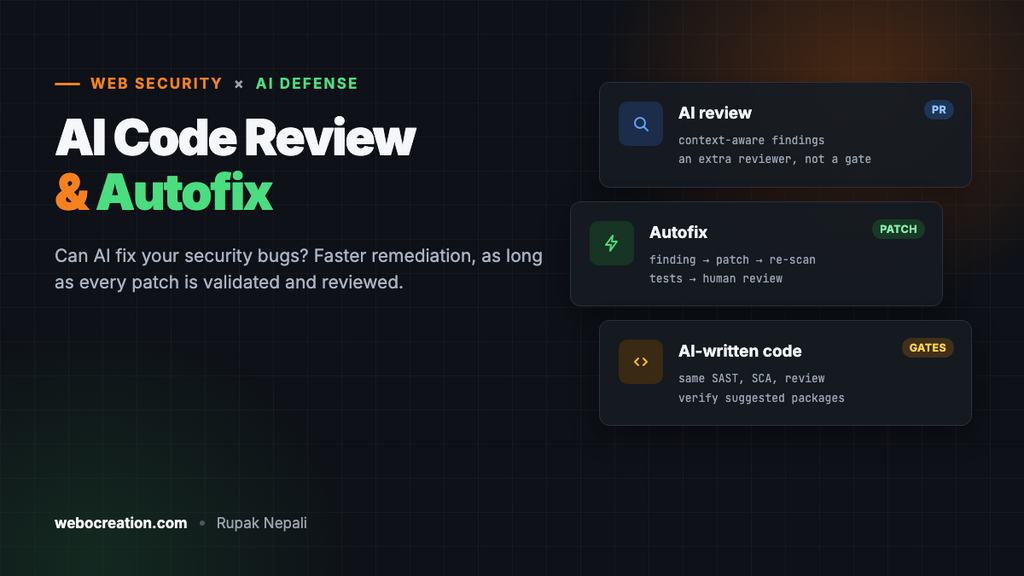
Here is the life of a typical vulnerability in a mid-sized company. A scanner flags it. The finding joins hundreds of others in a dashboard. Weeks later, someone triages it. More weeks pass before a developer has time to understand the code and write a fix. Meanwhile, attackers armed with AI are turning new disclosures into exploits faster than ever.
Defenders have never been short of findings. They have been short of time. AI is starting to change that, at every stage from review to remediation.
AI-assisted code review
LLM-based reviewers can read a pull request and comment on security issues. Compared to rule-based static analysis, they can:
- Understand context, such as noticing that a new endpoint is missing the authorization check every other endpoint uses.
- Catch logic flaws that do not match any fixed rule.
- Explain issues in plain language that developers actually read.
They also have real weaknesses. Results are inconsistent from run to run. They produce false positives and miss things. And because they read the code they review, they can be influenced by it: a comment crafted to manipulate an AI reviewer is a form of prompt injection.
The practical approach: treat AI review as an extra reviewer, not a gatekeeper. Run it alongside deterministic SAST, give it repository context, measure its precision on your own codebase, and keep human approval for merges.
Deep code auditing
Beyond reviewing diffs, agentic systems can explore entire codebases, trace data flows, form hypotheses, and write test cases to confirm suspected bugs. Research projects and competitions, including Google’s Big Sleep and DARPA’s AI Cyber Challenge, have shown AI systems finding previously unknown, real vulnerabilities in mature open-source software.
The best of these systems share one feature: dynamic validation. The model proposes a vulnerability, and a fuzzer, test harness, or sanitizer confirms it by actually triggering the bug. That step is what separates real findings from plausible-sounding noise.
How autofix works
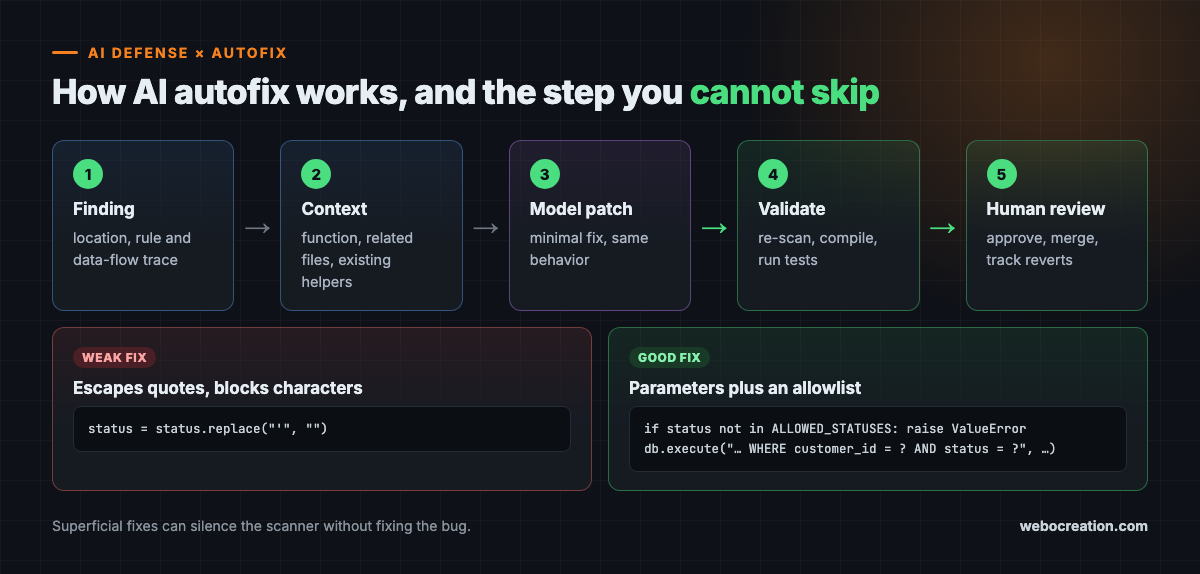
Platforms such as GitHub Copilot Autofix (for CodeQL findings), Semgrep, and Snyk now propose patches automatically. A typical system:
- Receives a finding with its location, rule, and data flow trace.
- Gathers context: the function, related files, and existing helpers.
- Asks a model for a minimal patch that removes the bug without changing behavior.
- Validates the patch by re-running the analyzer, compiling, and running tests.
- Presents the patch with an explanation for a developer to review.
Vendors report big reductions in time to remediate, especially for classes with well-known fix patterns like injection, XSS, and path traversal.
What a good AI fix looks like
Given this SQL injection:
def search_orders(db, customer_id, status):
    q = f"SELECT * FROM orders WHERE customer_id = {customer_id} AND status = '{status}'"
    return db.execute(q).fetchall()
A weak fix escapes quotes or blocks certain characters. A good fix addresses the root cause and follows the codebase’s conventions:
ALLOWED_STATUSES = {"pending", "shipped", "delivered", "cancelled"}

def search_orders(db, customer_id: int, status: str):
    if status not in ALLOWED_STATUSES:
        raise ValueError("invalid status")
    return db.execute(
        "SELECT * FROM orders WHERE customer_id = ? AND status = ?",
        (int(customer_id), status),
    ).fetchall()
Why every AI fix still needs review
- Superficial fixes can silence the scanner without fixing the bug.
- Regressions can break legitimate features, especially with thin test coverage.
- Incomplete fixes patch the flagged line and miss identical patterns elsewhere.
- New vulnerabilities can appear when the model restructures code.
Require fixes to pass tests and re-scans, keep humans in the loop, and track how often accepted fixes are later reverted.
The other side: AI-generated feature code
AI coding assistants now write a large share of new code, and research since 2021 has repeatedly found that they produce insecure code in a meaningful fraction of security-relevant cases: string-built SQL, missing authorization checks, weak crypto, hardcoded secrets, CORS wildcards, and disabled TLS verification added to “make it work.” Developers using assistants can also feel more confident about security than the code justifies.
What helps:
- Same gates for all code. Review, SAST, SCA, secret scanning, and tests apply to AI-written code with no exemptions.
- Give assistants secure context. A repository instructions file that states your conventions makes safe output much more likely. For example: “Use
repo.query(sql, params), never f-strings. Every route uses@require_permission. Usesafe_fetch()for user-supplied URLs.” - Verify suggested dependencies before installing them, to avoid slopsquatting.
- Lock down coding agents. Run them in sandboxes, limit which commands run without approval, restrict network access, and keep secrets out of their environment.
AI in security operations
AI is also reshaping the SOC: triaging alerts, summarizing investigations, drafting detection rules, and digesting logs during incidents. Two risks stand out. Logs and alerts contain attacker-controlled text, so an AI analyst can be prompt-injected through the very data it investigates. And automation bias tempts people to accept confident AI conclusions without checking.
Machine learning has long powered WAFs, bot detection, and fraud prevention, and those defenses keep improving. But they work best on top of well-built applications, not in place of them.
Adopting AI defense responsibly
- Start with assistance, not autonomy.
- Measure results on your own code and alerts.
- Keep deterministic controls as the foundation.
- Constrain agents with least privilege and sandboxes.
- Keep investing in human expertise, the thing that notices when the AI is wrong.
Key takeaways
- AI review catches context-dependent bugs but is inconsistent. Pair it with SAST and human approval.
- Agentic auditing with dynamic validation has found real vulnerabilities in mature software.
- Autofix speeds remediation, but every patch needs tests, re-scans, and review.
- AI-generated code must pass the same security gates as human code.
- In the SOC, treat analyzed data as untrusted and guard against automation bias.
Go deeper with the book
This article is adapted from Web Security in the Age of AI: Attacks, Defenses, Tools, and Bug Hunting for Modern Web Applications and LLM Systems by Rupak (see Chapter 25, “AI-Driven Security Fixes and Defense”).
The book pairs every attack with its fix across 27 chapters, from core vulnerabilities and professional tools to bug bounty hunting, attacking and defending LLM applications, and lessons from real breaches. It includes hands-on labs, review questions, a full testing checklist, a security headers reference, and an LLM red teaming playbook.
Related reading
- Software Supply Chain Security: From Log4Shell to Slopsquatting
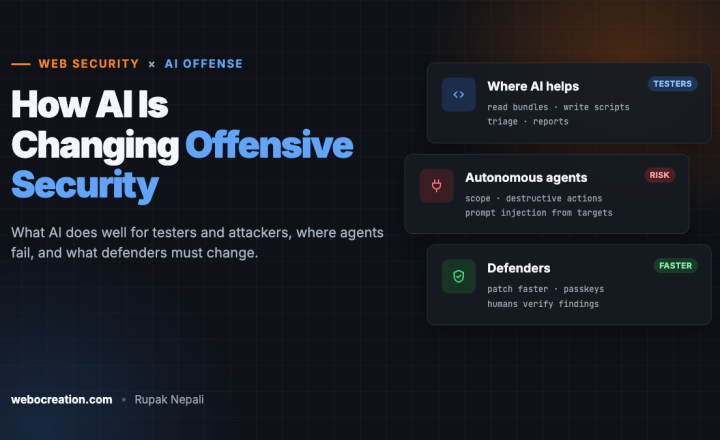
- How AI Is Changing Offensive Security (and What Defenders Must Do)

Rupak Nepali is a web developer, manage Webocreation website and the author of six books:
Getting Started with OpenCart Module Development (Packt, 2013),
OpenCart Theme and Module Development (Packt, 2015),
OpenCart 4: Dev Guide for Themes & Extensions (2024),
OpenCart 4: User Manual (2025),
Cloudflare for the Enterprise Website (2026) and
The Technical Web Guide for Marketers (2026).
Rupak has built OpenCart stores and extensions since 2010, has published more than 600 tutorials on Webocreation, and shares free OpenCart extensions on GitHub.
Find Rupak on
GitHub | Amazon | LinkedIn | X | YouTube.