Hardening Your Checkout: AVS, CVV, 3‑D Secure, and When to Turn Them Up
 Rupak NepaliPublished Jun 27, 2026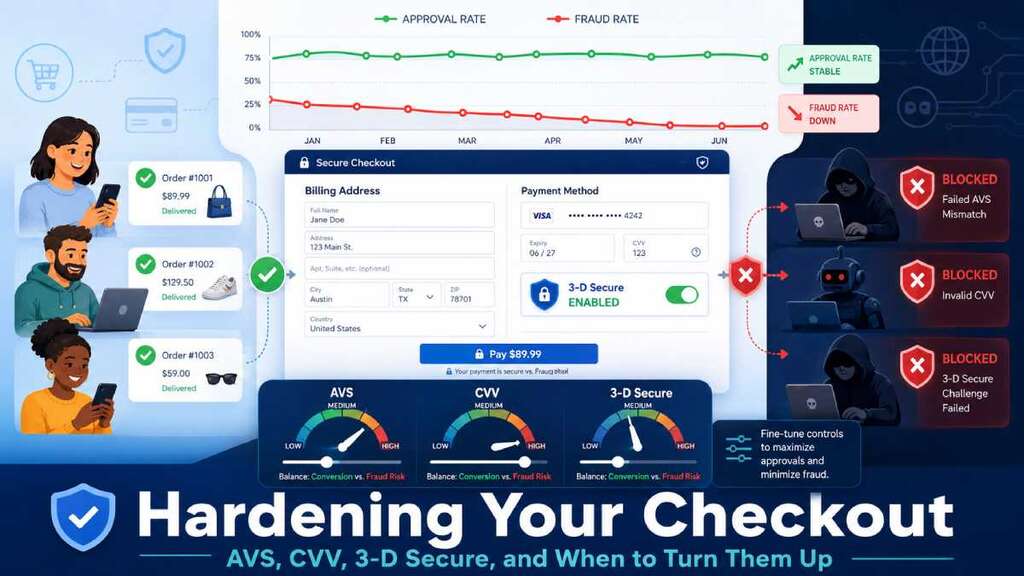
When you “turn up” AVS, CVV, or 3‑D Secure, you’re really turning the dials between conversion, fraud loss, and chargeback/processor risk—not just “more security.” This post walks through how each control works, where it helps most, and how to be analytical about those trade‑offs instead of guessing.
Start with a simple measurement framework
Before you change any setting, decide how you’ll measure whether it helped or hurt.
For each checkout change, track at least:
- Authorization rate – approved transactions ÷ attempts.
- Checkout conversion – completed orders ÷ sessions that started checkout.
- Fraud rate – confirmed fraud or fraud chargebacks ÷ approved transactions.
- Chargeback ratio – chargebacks ÷ total transactions, especially card‑scheme ratios.
Then, when you tweak AVS/CVV/3DS, compare before/after windows (for example, 2–4 weeks) and by segment (country, device, product type) so you see where you’re helping or hurting.
AVS: address checks as a blunt but powerful filter
Address Verification Service (AVS) compares the billing address your customer enters to the address on file with the issuer. You typically get results like “full match”, “ZIP only”, “street only,” or “no match.”
Fraud teams like AVS because:
- Stolen card data often does not include full, correct billing addresses.
- “No match” responses correlate strongly with card‑not‑present fraud and carding attempts.
But it’s imperfect:
- Legitimate customers move and forget to update their bank.
- International AVS coverage is patchy, especially outside North America and the UK.
How hard should you lean on AVS?
Think of AVS as a slider, not a switch. You choose what happens on each result.
Common patterns:
- Full match → auto‑approve (subject to other checks).
- Partial match (ZIP only or street only) → approve but possibly route to higher 3DS risk or manual review on high‑value orders.
- No match → decline outright on high‑risk segments (e.g., new customers, cross‑border, high‑ticket), or send to strong authentication.
Analytically, you want to:
- Measure fraud by AVS result.
For a recent period, calculate fraud and chargeback rates separately for full match, partial match, and no match. - Measure approval/conversion by AVS result.
See how many legitimate approvals live in the “partial match” bucket, especially in countries where AVS is unreliable. - Adjust rules where the gap is worst.
For example, if “no match” has 10× the fraud rate of “full match” but only 1–2% of your approved volume, treating “no match” much more strictly likely improves your risk with little conversion impact.
In contrast, if “ZIP only” has only slightly higher fraud than “full match” but a big chunk of your international revenue, you probably don’t want to auto‑decline that entire bucket.
CVV: low friction, high value verification
The CVV is the 3–4 digit code printed on the card that is generally not stored in databases or on magnetic stripes. Because CVVs often aren’t present in large data breaches, a fraudster may have a card number without the correct CVV.
Requiring CVV:
- Adds very little friction—customers are used to entering it.
- Provides strong evidence that the cardholder physically has the card.
- Reduces card‑not‑present fraud by making simple number‑only attacks harder.
Most guidance treats “always require CVV” as a baseline for CNP ecommerce.
When and how to “turn up” CVV
You have two main decision points:
- Always require CVV vs. sometimes skip
- Always requiring CVV is recommended for standard ecommerce transactions because it provides extra protection and is widely supported.
- Some merchants consider relaxing CVV for returning customers or subscription rebills to reduce friction, but this can open the door to account takeover abuse if logins are compromised.
- What to do with CVV mismatches
- Many gateways let you choose whether to decline on mismatch, accept but flag, or send to review.
- Since CVV responses are more reliable than AVS, mismatches are often treated as a strong fraud signal, especially combined with AVS failures or high‑risk geos.
Analytically:
- Measure fraud and approval by CVV result (match vs mismatch vs not provided) over a few months.
- If “mismatch” transactions show much higher fraud and very low genuine approval volume, you can justify auto‑declining them, at least for high‑risk segments.
- If you choose to accept some mismatches, consider routing them to adaptive 3DS or manual review for higher amounts.
In practice, many merchants end up with a very strict CVV policy (“must match, otherwise fail or challenge”) and use AVS and 3DS as more nuanced levers.
3‑D Secure: big dial with big consequences
3‑D Secure (3DS) adds an extra authentication step—like approving in a banking app or entering a one‑time code—so the issuer can verify the cardholder before authorizing the transaction.
Properly used, 3DS:
- Reduces certain types of card‑not‑present fraud, especially stolen card details abuse.
- Shifts chargeback liability from merchant to issuer in many schemes, protecting your ratios.
- Helps you stay below monitoring thresholds (such as the 0.3% chargeback ratio often cited in scheme programs).
But there are real trade‑offs:
- Forcing 3DS on every transaction adds friction and can reduce approval and conversion rates if misconfigured.
- Mobile implementations can be clunky in some markets, hurting cart completion.
Expert guidance now strongly favors adaptive or dynamic 3DS, where only higher‑risk transactions get challenged, while low‑risk ones pass without extra steps.
How to decide when to “turn up” 3‑D Secure
Instead of “3DS on everything” vs “3DS on nothing,” use these axes to decide when to challenge:
- Risk signals – high AVS/CVV risk, unusual device, new account, IP or geo anomalies.
- Ticket size – high‑value orders tolerate more friction; customers expect extra checks on expensive items.
- Customer segment – new customers vs trusted repeat buyers; cross‑border vs domestic.
- Fraud and chargeback posture – if you’re near scheme/program thresholds, 3DS becomes more valuable as a risk‑reduction tool.
Analytically, aim for:
- Baseline metrics without 3DS (or with current 3DS mix):
- Fraud rate, chargeback ratio, approval rate, and checkout completion.
- Segmented tests where you “turn up” 3DS for a specific slice:
- For example, only cross‑border orders over a certain amount, or only orders with AVS “no match.”
- Compare the unit economics:
- How many additional orders did you lose from added friction?
- How many fraud losses and chargeback fees did you avoid (plus softer benefits like staying under monitoring thresholds)?
Industry practitioners note that poorly configured 3DS can knock a few percentage points off approval or conversion, while good adaptive setups can cut fraud and chargebacks significantly with minimal impact on overall conversion.
Putting it together: a risk‑based checkout strategy
Once you understand each tool, you can combine them into a tiered decision engine that balances fraud vs conversion:
- Low‑risk transactions (known customer, domestic, full AVS & CVV match, normal behavior)
- Require CVV.
- AVS result: full match.
- 3DS: usually skip to keep the flow frictionless.
- Medium‑risk transactions (new customer, partial AVS match, mid‑ticket)
- Require CVV and decline outright on a mismatch in higher‑risk regions.
- Allow some partial AVS matches but route them to adaptive 3DS rather than auto‑approve.
- High‑risk transactions (no AVS match, strange IP/geo, high‑ticket, or you’re close to chargeback thresholds)
- Require CVV and treat mismatches as hard fails.
- Require 3DS challenge; consider declining if authentication fails or friction is refused.
Operationally, this gives you dials:
- When fraud or chargebacks spike (for example, during a carding wave or campaign abuse), you tighten rules: more transactions flow to 3DS or get declined based on AVS/CVV.
- When fraud is under control, and you’re missing revenue in a specific market or channel, you can relax specific segments: allow certain partial AVS matches or reduce 3DS challenges for trusted repeat customers, then watch conversion and fraud metrics.
How to iterate safely (lots of analytical examples)
To keep iterations safe and data‑driven:
- Always A/B or time‑box changes.
Apply new rules to a small subset of traffic or for a limited time, then compare against a control. - Evaluate changes with multi‑metric views.
Look at authorization rate, conversion, fraud rate, and chargeback ratio together; a “win” is rarely visible in a single metric. - Drill down by segment.
A rule may be great for domestic desktop traffic but terrible for cross‑border mobile; adjust by geography, device, and customer cohort.
Concrete ways to experiment:
- AVS test: For a month, treat “no match” as auto‑decline for new customers in a high‑risk region and compare fraud/approval there to regions where you kept current rules.
- CVV test: If you currently accept some “mismatch” results, start declining them for high‑value orders only and watch chargeback rates for those SKUs.
- 3DS test: Turn on adaptive 3DS just for cross‑border orders over a threshold and measure how much fraud and chargebacks drop versus how much conversion moves in that slice.
Each of these gives you a measurable ROI story: “We added friction here, and here’s how much fraud/chargeback cost we avoided relative to the revenue we gave up.”
The bottom line
AVS, CVV, and 3‑D Secure are not just generic “security features”—they are adjustable levers in your checkout economics. The goal isn’t zero fraud at any cost; it’s an acceptable fraud and chargeback profile that keeps you safe with issuers and schemes while maximizing good customer conversion.
If you treat each control as a dial, measure the impact on approval, conversion, fraud, and chargebacks by segment, and iterate in small, analytical steps, you can harden your checkout intelligently instead of guessing and hoping.

Author of four Opencart book.
The recent are Opencart 4 developer book and Opencart 4 user manual