Carding Attacks 101: How Stolen Card Testing Hits Your Ecommerce Store
 Rupak NepaliPublished Jun 24, 2026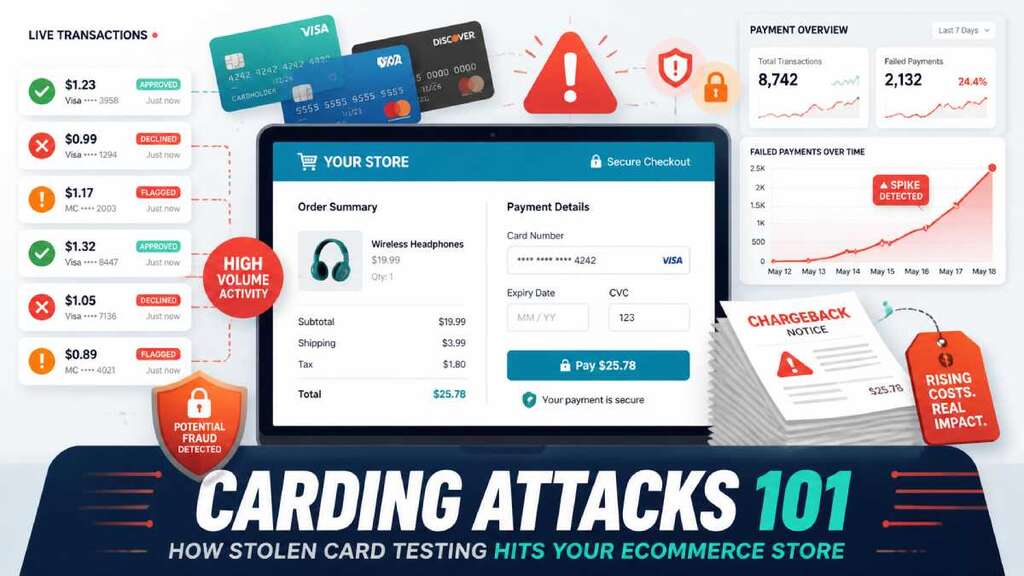
Carding attacks are one of the most common—and least understood—ways fraudsters abuse ecommerce checkout forms, quietly racking up fees, chargebacks, and reputational damage before anyone notices. This post walks through what carding looks like in practice, how it hits your payment processor relationship and chargebacks, and the first‑line defenses every store should have in place.
What a carding attack actually is
At its core, carding (or card testing) is the process of taking stolen card data and running small, automated transactions to find out which cards are still “alive.”
- Fraudsters buy or harvest large batches of card numbers, expiry dates, and sometimes billing details from breaches or the dark web.
- They then use bots or scripts to push those cards through your checkout or payment form—usually for very low‑value purchases—to see which ones authorize successfully.
- Any card that works is added to a “validated” list that can be resold at a premium or used later for high‑value fraud (electronics, gift cards, resellable items).
Because the test transactions are tiny and spread across many merchants, they often fly under the radar—until chargebacks and processor warnings start rolling in.
What carding looks like in your ecommerce store
From your point of view, a carding attack doesn’t look like a Hollywood hack. It looks like “weird checkout behavior.”
Common symptoms include:
- Spikes in failed or low‑value transactions
You suddenly see lots of tiny orders (cents to a couple of dollars), many of which are declined or reversed.
These often cluster in short time windows and off‑peak hours, without a matching rise in normal site traffic. - Rapid‑fire attempts from the same source
Multiple payment attempts from the same IP, device fingerprint, or small IP range in minutes—not normal shopper behavior. - Odd billing data patterns
Many transactions where ZIP, country, or address do not match card issuer records (AVS mismatches), or obviously fake names and emails. - Chargebacks and disputes on tiny charges
Cardholders spot random “test” charges and dispute them, turning even low‑value tests into chargebacks for your business.
In more advanced attacks, carders pair card testing with credential stuffing—logging into real user accounts and then testing the saved cards on file, which can look even more like legitimate traffic at first glance.
How carding impacts your payment processor and chargebacks
Carding doesn’t just cost you a few dollars in fraudulent charges; it hits you at multiple layers of the payments ecosystem.
1. Direct financial costs per attempt and chargeback
- Processors charge fees even on declines.
A high‑volume carding run with thousands of declines generates gateway and network fees with zero revenue. - Successful tests become chargebacks.
When cardholders dispute unauthorized test transactions, each chargeback hits you with a fee (often tens of dollars) plus the loss of the transaction amount.
Industry analyses estimate that every dollar of fraud often costs merchants multiple dollars when you include chargebacks, fees, and operational overhead.
2. Chargeback ratios and monitoring programs
Payment schemes and acquirers closely monitor your chargeback ratio and other risk signals:
- Carding attacks can generate a burst of disputes in a short period, pushing your chargeback ratio above thresholds that trigger fines and monitoring programs.
- Visa’s updated VAMP (Visa Acquirer Monitoring Program) specifically calls out high‑volume card testing (“enumeration”) as a basis for penalties, including per‑chargeback fees if enumeration exceeds certain ratios.
If your chargeback and enumeration ratios stay elevated:
- You may be reclassified as a high‑risk merchant, facing higher processing fees, rolling reserves, and stricter approval rules.
- In extreme cases, processors can freeze funds or terminate your merchant account altogether, leaving you scrambling for a new (more expensive) provider.
3. Collateral damage to legitimate customers and revenue
Carding also hurts good customers:
- Legitimate transactions may get declined more often as processors tighten risk rules or your own fraud tools become more aggressive in response.
- Customers experiencing unexplained declines or seeing your store associated with card fraud lose trust and may not come back.
So even if the fraud amount itself looks “small,” the downstream impact on your payment’s reputation and customer experience can be huge.
First‑line defenses against carding attacks
Completely eliminating carding risk is impossible, but basic hardening will make your store a much less attractive target. Many carders simply move on to the next, easier merchant once friction and controls increase.
Think of defenses in three layers: checkout configuration, traffic and bot controls, and monitoring & operations.
1. Harden your checkout and payment configuration
These are “table stakes” settings you should review with your payment provider today:
- Require AVS and CVV checks
Turn on Address Verification Service (AVS) and make CVV mandatory. Carders often lack full billing details even if they have card numbers.
Configure your gateway to decline mismatched AVS or CVV where appropriate for your market. - Use 3‑D Secure / SCA where available
Implement schemes like Verified by Visa or Mastercard SecureCode that require an extra step (e.g., SMS code), shifting liability in many regions, and blocking many automated tests. - Set sensible minimum transaction amounts
Because carding often uses very small test charges, setting a minimum order value just below your cheapest real product makes micro‑tests uneconomical.
This is especially important for donation or “pay what you want” pages, which are a common target. - Limit or re‑think guest checkout in high‑risk flows
Requiring an account for certain payment flows adds friction for bots and allows you to monitor behavior per user as well as per IP.
Work with your acquirer or gateway—they often have additional rulesets and tools (velocity checks, risk scoring, Radar‑style tools) that can be toggled or tuned for card testing scenarios.
2. Control automated traffic before it reaches payment
Since carding is heavily bot‑driven, controlling automated traffic is a primary defense.
Baseline controls include:
- CAPTCHA or similar challenges on payment forms
CAPTCHA on checkout or high‑risk payment endpoints can block many simple scripts and low‑effort bots while remaining tolerable for real users. - Rate limiting on payment attempts
Enforce velocity limits such as:- Max X payment attempts per IP or account per minute/hour
- Max Y declines per card before blocking further attempts
Humans rarely attempt dozens of payments in quick succession; bots often do.
- WAF and bot management in front of your store
Web Application Firewalls (e.g., Cloudflare and similar services) can detect and throttle known botnets, suspicious user agents, and abusive IP ranges before traffic hits your app or gateway.
Dedicated ecommerce security platforms analyze behavior patterns and fingerprints to distinguish real shoppers from sophisticated bots. - Geo and network‑based rules
If you do not sell into certain high‑risk regions, consider blocking or challenging traffic from them, especially on checkout.
These controls dramatically reduce the number of test transactions that ever reach your payment provider.
3. Monitor, respond, and clean up quickly
Even with defenses, you should assume you’ll see some attempts—and treat them like incidents.
- Monitor for early indicators
Set alerts for:- Sudden spikes in declines or low‑value transactions
- Unusual checkout activity outside normal traffic patterns
- Clusters of attempts from the same IP, ASN, or device fingerprint
- Respond fast when you spot carding
Recommended steps from payment and security experts include:- Immediately notify your processor; they can help identify patterns and mitigate risk on their side.
- Block or challenge suspicious IPs and routes using your WAF, bot tools, or firewall rules.
- Temporary measures like disabling vulnerable “donation” or “name your price” products, and turning off saved‑card features if they’re being abused.
- Refund suspicious successful transactions proactively
Quickly reversing likely test charges reduces the chance they turn into chargebacks, which protects your ratios and reputation. - Review and update your rules after each incident
Post‑attack, tighten fraud rules, update velocity thresholds, and adjust CAPTCHA or geo rules based on what you learned.
Bringing it all together
Carding attacks are appealing to criminals precisely because the damage is diffuse and delayed: lots of tiny, automated tests spread across many merchants, with the real hits—chargebacks, higher fees, stricter monitoring—showing up weeks later.
By recognizing what carding looks like in your own metrics, understanding the downstream impact on your processors and chargeback ratios, and putting solid first‑line defenses in place at checkout and at the edge, you dramatically reduce the odds that your store becomes an easy card‑testing playground.

Author of four Opencart book.
The recent are Opencart 4 developer book and Opencart 4 user manual