Top Legacy System Modernization Trends in 2026
 Rupak NepaliPublished Apr 26, 2026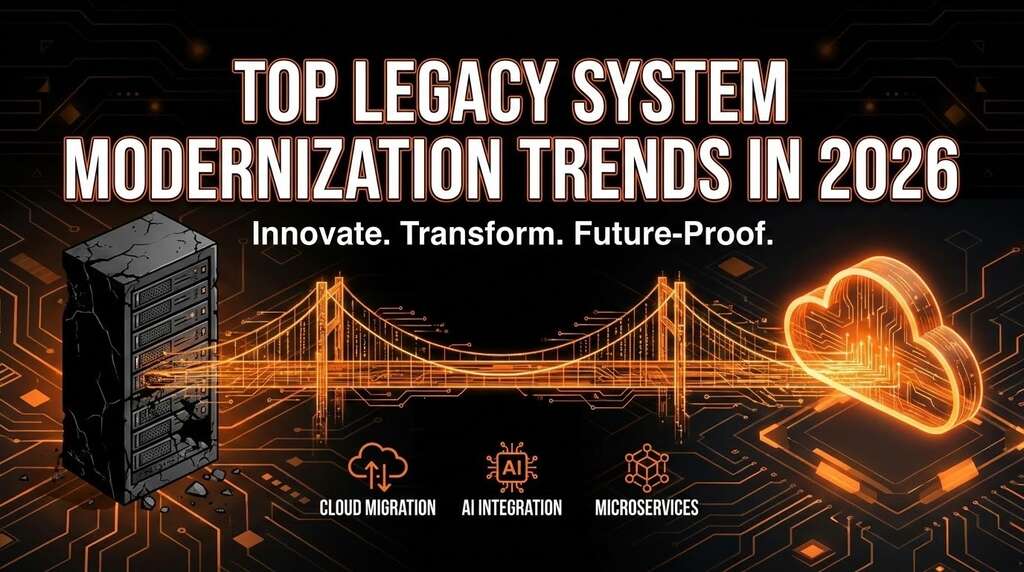
Technology never waits. Although a few companies have been riding the digital transformation wave over the years, many organizations continue to run on outdated infrastructure, silently bleeding productivity, increasing security risks, and limiting innovation. Professional Legacy System Modernization services have become a strategic consideration for businesses that wish to remain competitive in 2026. Never has there been a greater urgency to modernize– nor have strategies to do it been wiser.
You may be a CTO who needs to assess your next IT roadmap, or you may be a business leader just trying to keep up with the times; knowing the direction modernization is taking can guide your decisions. And now, let’s dissect the trends that are defining the industry.
1. Cloud-Native Migration Is Not an Option.
Several years ago, relocating to the cloud was a strategic benefit. Nowadays, it is a minimum requirement. As of 2026, companies will go beyond mere lift-and-shift migrations. They are re-architecturing applications to be cloud-native – built to the ground, optimizing to exploit scalability, elasticity, and microservices architecture.
Companies that have not migrated sooner are paying higher costs to support moaning in-house systems than the migration costs. The economics have reversed, and firms that adopt cloud-native models are experiencing an accelerated deployment process, less downtime, and better cost control.
2. It is being accelerated by AI-Powered Modernization.
Among the most thrilling changes that are currently underway is the introduction of artificial intelligence to accelerate the process of modernization itself. The AI tools can now analyze old codebases, detect dependencies, highlight vulnerabilities, and even automatically produce documentation, tasks that previously required months of manual effort.
This is especially useful with systems developed in COBOL, RPG, or other older programming languages, where expert programmers are becoming a rarity. AI does not replace the human know-how required to make critical decisions, but it drastically reduces the time and cost of assessment and migration planning.
3. API-First Strategies Are Making the Gap between old and new.
A complete system overhaul cannot be done in all organizations overnight. This is the reason why API-first modernization has been one of the most viable methods in 2026. Rather than tearing out legacy systems wholesale, businesses are encasing them in new APIs that enable new applications and digital frontends to interact with older backends.
This “strangler figure” strategy allows the companies to modernize in a gradual way – introducing new capabilities without interfering with the existing operations. It is a risk-controlled process of evolving, and it is working in businesses such as banking, healthcare, logistics, and more.
4. Security-Based Modernization Is Starting to Take Priority.
The issue of cybersecurity is driving modernization up the boardroom agenda. The legacy systems tend to be based on old protocols, incompatible software versions, and architectures not originally designed to address the current threat environment. Over the next several years, more organizations are starting to take security vulnerabilities in aging infrastructure as a direct business risk, rather than an IT issue.
There is also pressure of regulation. Data privacy and protection compliance frameworks are increasingly becoming tougher worldwide, and legacy systems are often not able to meet current demands. Efficiency is not the only reason why modernization is accelerating; there is also a need to remain legally and operationally safe.
5. Expanding Access is through Low-Code and No-Code Platforms.
The modernization space has conventionally needed extensive technical competence, which is costly and lengthy. However, with the emergence of low-code and no-code platforms, the role of people who can join in the modernization process is shifting. Now, business analysts, operations workers, and domain specialists can create workflows and interfaces without a line of code.
This democratization of development implies that modernization projects are undertaken at a quicker pace, and with more involvement of the people who use the systems on a daily basis. It also lessens dependency on the limited talent of developers; this is one of the biggest bottlenecks in large-scale IT transformation projects.
6. Modernization of Data Is Growing inseparable from System Modernization.
You cannot discuss updating systems without discussing the data present within systems. Organizations are realizing in 2026 that it is not possible to modernize the application layer without modernizing the data layer, which introduces new issues. Any modern front-end that is built upon siloed data or won’t work with other data formats or other proprietary databases limits the usefulness of the data.
Modernization of data. Data modernization (such as migration to cloud data warehouses, adopting data lakehouse architectures, and real-time data pipelines) is now being planned alongside system upgrades, as opposed to an afterthought.
Keeping on top of a fast-changing environment.
The most progressive organizations are not merely responding to these trends of modernization of their legacy systems; they are constructing internal organizational cultures and forms of governance that view modernization as an ongoing activity, not as a project. Technology Debt is a silent killer, and the longer it is left unchecked, the more costly it becomes to deal with.
The companies that will be leaders of their industries in the years to come are those that are investing in the present in infrastructure that is flexible, secure, and designed to meet the speed of change that is characterized in modern markets. It is time to evaluate your system’s position – and plot a practical course.

Author of four Opencart book.
The recent are Opencart 4 developer book and Opencart 4 user manual