OpenCart vs Shopify vs WooCommerce in 2026: A Sober Look from a Developer’s Perspective
 Rupak NepaliPublished Jun 9, 2026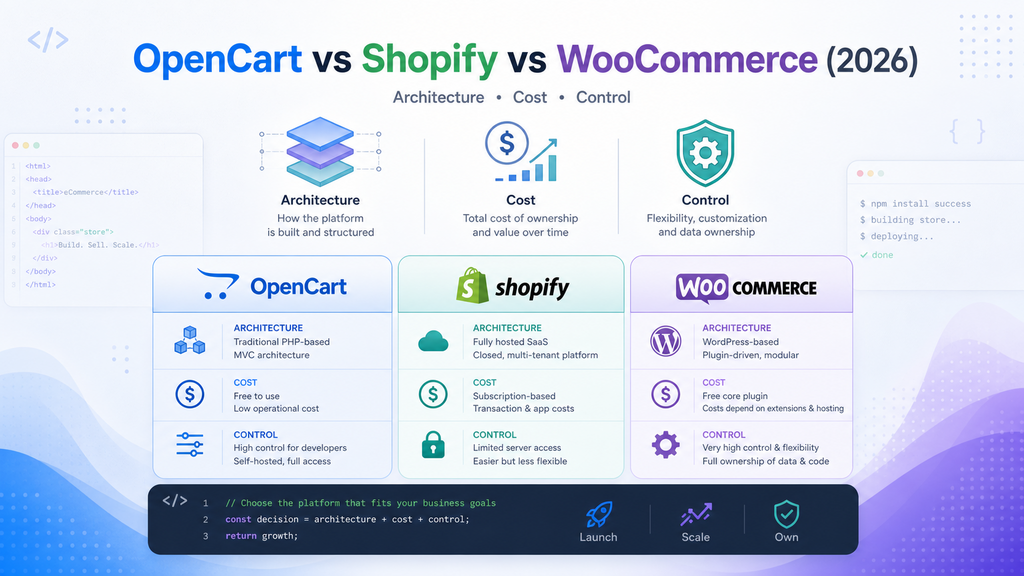
Stop asking “which is best?” — ask how much control you really want
In 2026, you don’t need another surface‑level pros/cons list of OpenCart, Shopify, and WooCommerce. You need clarity on architecture, cost, and control.
All three can power serious stores; the real question is: who owns the stack, who eats the complexity, and what will it cost you over the next 3–5 years, not just at launch.
The three axes that matter: architecture, cost, control
From a developer’s perspective, the platforms line up along three practical axes:
- Architecture – How opinionated is the stack? Can you treat it as a component in a bigger system, or does it want to be the system?
- Cost – Not just “free vs subscription,” but hosting, apps/extensions, payment fees, and developer time.
- Control – Who owns the code, the infra, the data, and the roadmap? How hard is it to move away later?
Let’s look at each platform through those lenses.
Architecture: what are you actually deploying?
Shopify: hosted monolith with clean edges
Shopify is a fully hosted SaaS: you deploy configurations, Liquid templates, and apps, not servers.
- Core stack, scaling, database, and security are all handled by Shopify.
- You extend via themes, the app store, and API/webhook integrations, not by modifying core.
- Their Online Store, Checkout, and Payments are deeply integrated; you integrate your logic around them, not inside them.
This is fantastic if you want a stable, opinionated commerce core and you’re happy to live inside its boundaries.
WooCommerce: WordPress plugin with a big ecosystem
WooCommerce is an open‑source ecommerce plugin that turns a WordPress site into a store.
- Runs entirely on your WordPress stack: PHP, MySQL/MariaDB, your chosen hosting.
- High‑Performance Order Storage (HPOS) is now the default, moving orders out of the WordPress posts table into dedicated tables for better scalability.
- You inherit the entire WordPress ecosystem: themes, plugins, and dev patterns—good and bad.
Architecture‑wise, WooCommerce is flexible but tightly coupled to WordPress. If WordPress is already your CMS, this can be a big win.
OpenCart: standalone, focused ecommerce app
OpenCart is a standalone open‑source ecommerce platform written in PHP, with its own admin and storefront, independent of WordPress.
- You run it like a traditional PHP application: web server, PHP, database, your hosting.
- The core offers solid catalog, order management, and multi‑store support out of the box.
- Extensions exist, but the ecosystem is smaller than WordPress/WooCommerce.
Architecturally, OpenCart is simpler than “WordPress + WooCommerce + everything else” and less opinionated than Shopify, but you’re closer to the metal for scaling and hardening.
Cost: where the money actually goes
Ignore sticker price for a moment. Look at TCO: subscription + hosting + payments + apps/extensions + developer time.
Shopify: predictable subscription, variable fees
Shopify’s pricing is subscription‑based plus transaction fees.
- As of 2026, the Basic plan is roughly 29–39 USD/month depending on billing cycle, with higher tiers (Grow, Advanced, Plus) scaling up for volume, reporting, and advanced features.
- Card processing via Shopify Payments is typically around 2.9% + fixed fee on Basic, with rates improving on higher plans.
- “Hidden” cost is the app store: many serious stores run multiple paid apps (reviews, upsells, subscriptions, etc.) adding 5–50 USD per app per month.
Upside: very low infra and maintenance cost; you’re buying predictability and time. Downside: you pay a premium for that and share margin on every transaction.
WooCommerce: free core, you own the hosting bill
WooCommerce core is free under GPL, but you pay for everything around it.
- You’re responsible for hosting, domain, backups, caching, security, and scaling.
- Many essential extensions (subscriptions, bookings, advanced shipping, some payment gateways) are commercial.
- Payment fees are between you and your gateway/PSP; Woo doesn’t take a cut, but you don’t get bundled negotiation either.
If you already have strong WordPress operations and a good host, WooCommerce can be economical at scale; if you don’t, you’ll pay in ops and developer time.
OpenCart: low software cost, higher ops attention
OpenCart core is also free and open source.
- You pay for hosting, maintenance, and any commercial extensions you adopt.
- Out‑of‑the‑box functionality is often enough for simple stores, which can reduce extension sprawl.
- At the same time, fewer high‑quality, maintained extensions mean more custom dev for advanced needs.
OpenCart can be extremely cost‑effective for lean stores with straightforward requirements and access to PHP talent; it becomes less attractive when you want Woo‑level marketing integrations or Shopify‑level polish without paying for development.
Control: who really owns the store?
This is where opinions get strong.
Shopify: you rent the rails
With Shopify, you do not own the platform, but you own your data within it and can export products, orders, and customers.
- You can’t fork Shopify or run it on your own infra.
- Checkout, core performance, and many platform behaviors are controlled by Shopify.
- If Shopify changes pricing, policies, or APIs, you adapt or leave.
For many businesses, that’s an acceptable trade: you trade infra control for stability and focus.
WooCommerce: full code and data ownership (within WordPress)
WooCommerce is open source. You can inspect, extend, and fork the code and you fully own your store data and hosting environment.
- You choose hosting, PHP version, database, and the surrounding stack.
- You can build custom plugins, override templates, and integrate deeply with other internal systems.
- Migrating away is non‑trivial but fully possible; you’re not locked into a vendor data silo.
If “I want to own the whole stack and integrate ecommerce into a broader custom architecture” is the requirement, WooCommerce fits that mindset well.
OpenCart: similar ownership, narrower ecosystem
OpenCart also gives you full ownership of code and data on your own hosting.
- You can modify core (not recommended), build extensions, and integrate however you like.
- Multi‑store support from a single admin gives you interesting control patterns you don’t get out‑of‑the‑box with WooCommerce.
- However, you’re more on your own in terms of best‑practice patterns, documentation, and high‑quality extensions.
OpenCart is appealing when you want open‑source control but don’t want WordPress in the mix at all.
Ecosystem and trajectory in 2026
Market momentum matters, especially for plugin quality, talent availability, and long‑term bets.
- WooCommerce powers the majority of WordPress stores and a huge share of online shops overall; estimates put it at around two‑thirds of open‑source ecommerce installs.
- Shopify dominates the hosted SMB and mid‑market segment and continues to invest heavily in apps, themes, and partner tooling.
- OpenCart remains a niche but active project with a smaller user and developer base compared to Woo.
In practice, that means:
- Easier hiring and more ready‑made solutions in the Shopify and Woo ecosystems.
- More greenfield space but fewer polished off‑the‑shelf modules in OpenCart land.
Developer‑centric comparison table
A quick, opinionated snapshot from a dev/ops viewpoint:
| Dimension | Shopify | WooCommerce | OpenCart |
|---|---|---|---|
| Architecture | Hosted SaaS, opinionated core, API/app‑driven | WordPress plugin, runs on your LAMP stack | Standalone PHP app on your LAMP stack |
| Core cost | Monthly subscription + card fees | Free core; pay for hosting + premium extensions | Free core; pay for hosting + some extensions |
| Infra & scaling | Shopify’s problem | Your problem (choose host, manage caching/CDN) | Your problem (choose host, manage caching/CDN) |
| Extensibility | Apps, themes, APIs, limited low‑level control | Themes, plugins, full code access, very extensible | Extensions, code access, smaller ecosystem |
| Data ownership | Platform‑hosted; exportable but not self‑hosted | Full ownership of store and database | Full ownership of store and database |
| Ecosystem size | Huge, commercial‑driven app ecosystem | Massive WordPress + Woo ecosystem | Niche but focused community |
| Best fit mindset | “I want commerce as a service” | “I want full control, integrated into WordPress/content” | “I want open‑source ecommerce without WordPress” |
So, what should you actually choose?
From a sober developer’s perspective:
- Pick Shopify if you want to minimize infrastructure and maintenance, move fast, and you’re okay trading deep control and some margin for speed and stability. Ideal for teams without strong dev/ops resources or those who want to keep ecommerce as a bounded product, not a platform engineering project.
- Pick WooCommerce if you’re already invested in WordPress, care about owning the entire stack, and are comfortable managing hosting, updates, and scaling yourself (or via an agency). It’s the most flexible for content‑heavy sites and custom integrations, with the strongest open‑source ecosystem behind it.
- Pick OpenCart if you want a focused, standalone open‑source ecommerce app, don’t want WordPress, and are happy to write or commission more of your own functionality instead of relying on a gigantic plugin marketplace. It’s a good fit for lean, technically supported stores that value simplicity over ecosystem size.
The “right” answer isn’t which platform wins a feature checklist. It’s which stack you’re willing to own for the next several years—and how much you’re prepared to pay, in both cash and engineering time, for the control you think you need.

Author of four Opencart book.
The recent are Opencart 4 developer book and Opencart 4 user manual