Chapter 9: Privacy, First-Party Data, and Modern Measurement
By the end of this chapter you will be able to:
 Rupak NepaliPublished Nov 10, 2026

Learning objectives
By the end of this chapter, you will be able to:
- Explain why tracking-based measurement has become less complete, and what has and hasn’t changed with cookies.
- Build a first-party and zero-party data strategy that customers trust.
- Implement consent correctly and understand how Consent Mode and modeling fill gaps.
- Use server-side tagging, enhanced conversions, and conversion APIs to recover signal responsibly.
- Choose between attribution, incrementality testing, and marketing mix modeling.
- Design a practical measurement framework that combines these methods.
The era of signal loss
For years, digital marketing measurement relied on tracking individuals across websites and apps with cookies and device identifiers. That model has eroded:
- Browsers: Apple’s Safari and Mozilla’s Firefox block third-party cookies by default and limit some first-party cookies.
- Mobile apps: Apple’s App Tracking Transparency framework (introduced in 2021) requires apps to ask permission before tracking users across other companies’ apps and websites, and many people decline.
- Consent requirements: privacy laws such as GDPR in Europe and a growing number of US state laws require consent or opt-outs for many forms of tracking and ad targeting.
- Ad blockers and privacy tools prevent many tags from firing.
- Email: Apple Mail Privacy Protection inflates open rates (Chapter 13).
What about Chrome’s third-party cookies? Google spent several years planning to remove third-party cookies from Chrome and developing “Privacy Sandbox” alternatives. It ultimately decided not to remove them, and in 2025 it wound down most of the Privacy Sandbox technologies. But this does not restore the old world: Safari, Firefox, app platforms, consent rules, and ad blockers still remove a large share of signal. Plan as if individual-level tracking will always be incomplete.
The consequence: platforms and analytics tools see only part of each customer journey. Marketers who rely on a single attribution report are increasingly making decisions on partial, biased data.
Data types: zero, first, second, and third party
| Type | Definition | Examples | Value today |
|---|---|---|---|
| Zero-party | Data customers intentionally share | Quiz answers, preferences, stated interests, survey responses | Very high: accurate, consented, great for personalization |
| First-party | Data you collect directly from interactions | Purchases, site and app behavior, email engagement, CRM records, support tickets | Very high: the foundation of modern marketing |
| Second-party | Another company’s first-party data shared through a partnership | Co-marketing partner’s audience data, retail media data | Situational, through clean rooms or partnerships |
| Third-party | Data aggregated by companies with no direct relationship to the person | Purchased audience segments, data broker lists | Declining in quality, availability, and legal safety |
The strategic direction is clear: invest in first-party and zero-party data, collected transparently, in exchange for genuine value.
Building a first-party data strategy
1. Create reasons to share
People share data when they get something worthwhile: personalized recommendations (Brightleaf’s coffee quiz), loyalty rewards, exclusive content, faster checkout, saved preferences, early access, or useful tools.
2. Collect progressively
Don’t ask for everything at once. Ask for an email address first, preferences in the welcome series, and more details over time as trust grows.
3. Unify the data
Connect your e-commerce platform, email platform, CRM, support desk, and analytics into a single customer view (Chapter 17), with clear rules for which system is the source of truth for each field.
4. Activate it
- Personalization: emails, website content, and recommendations based on behavior and preferences.
- Advertising audiences: upload consented customer lists (platforms hash them for matching) to build retargeting, exclusion, and lookalike audiences.
- Conversion signals: send accurate conversion data, including offline sales, back to ad platforms to improve optimization.
- Insight: analyze customer data to understand segments, lifetime value, and churn drivers.
5. Protect it
Limit access, minimize what you collect, set retention periods, honor deletion and opt-out requests, and document how data is used.
Prompt 9.1: First-party data strategy Act as a customer data strategist. Our business is [description]. We currently collect [list data and where it’s stored]. Design a first-party and zero-party data strategy that includes: value exchanges that motivate customers to share data, a progressive profiling plan across the customer journey, a unified customer profile (fields and source of truth), activation use cases for personalization, advertising, and insight, and privacy safeguards. Flag any practices that may need legal review in [regions].
Consent done right
Consent isn’t just a legal checkbox; it’s a trust moment. A respectful consent experience explains clearly what you collect and why, offers a genuine choice (including an easy “reject all” where required), and remembers the choice.
Implementation essentials:
- Use a consent management platform (CMP) configured for the regions where you operate.
- Make sure tags actually respect consent choices; audit them, because misconfigured tags that fire regardless of consent are a common and serious compliance failure.
- Implement Google Consent Mode (v2) so Google’s tags adjust behavior according to consent. In “advanced” mode, tags send cookieless pings when consent is denied, which Google uses to model conversions; in “basic” mode, tags don’t load until consent is given. Google requires consent signals for advertisers using its personalization features with users in the European Economic Area.
- Update your privacy policy to accurately describe your data practices.
Modeled conversions
When consent or browser restrictions prevent direct measurement, platforms like Google Ads, GA4, and Meta use modeling to estimate the conversions they couldn’t observe, based on patterns from users they could. Modeled data is not fabricated; it’s a statistical estimate. Understand when your reports include modeling, and don’t treat small differences as precise.
Recovering signal responsibly
Three techniques improve data completeness while respecting consent:
- Server-side tagging: instead of loading many third-party tags in the browser, the site sends data to a server container you control (for example, Google Tag Manager server-side), which forwards it to analytics and ad platforms. Benefits include more reliable data, better site performance, and more control over exactly what data each vendor receives. It requires some technical setup and hosting costs.
- Enhanced conversions (Google) and conversion APIs (Meta, TikTok, LinkedIn): send hashed first-party data (such as email address at purchase) and conversion events from your server so platforms can match conversions more accurately (Chapter 6).
- Offline conversion imports: upload sales that happen in a store, by phone, or in a CRM (such as a B2B deal closing) and connect them to the ad clicks that started them.
All of these must operate within your consent framework and privacy policy.
Three ways to measure marketing impact
No single method tells the whole truth. Modern measurement combines three complementary approaches.
1. Attribution
Attribution assigns credit for conversions to the touchpoints a user interacted with (Chapter 7). It’s fast, granular (down to campaign and ad), and useful for day-to-day optimization. Its weaknesses: it only sees trackable touchpoints, it confuses correlation with causation, and each platform’s version favors itself.
Use it for: tactical optimization within channels, such as which ads, keywords, and audiences perform best.
2. Incrementality testing
An incrementality test measures what caused additional results by comparing a group exposed to marketing with a similar group that wasn’t.
- Platform lift studies: Meta Conversion Lift, Google’s lift measurement for some campaign types, and similar tools randomly hold out part of the audience from seeing ads.
- Geographic (geo) experiments: turn advertising off (or up) in a set of matched regions and compare outcomes with control regions. Google’s open-source tools can help design and analyze them.
- Holdout groups: for email and personalization, keep a random group out of a program and compare results (Chapter 13).
Use it for: answering “Is this channel actually driving incremental sales?” and calibrating how much to trust attribution.
Example: Brightleaf pauses all Meta ads in 10 randomly chosen regions for four weeks while keeping them running in 10 matched regions. Sales in the paused regions fall 9% compared with the control regions. Meta’s own reporting had attributed about 15% of sales to Meta ads in those regions. The team concludes Meta is genuinely driving sales, but that platform reporting overstates its contribution by roughly 40%, and adjusts its planning accordingly.
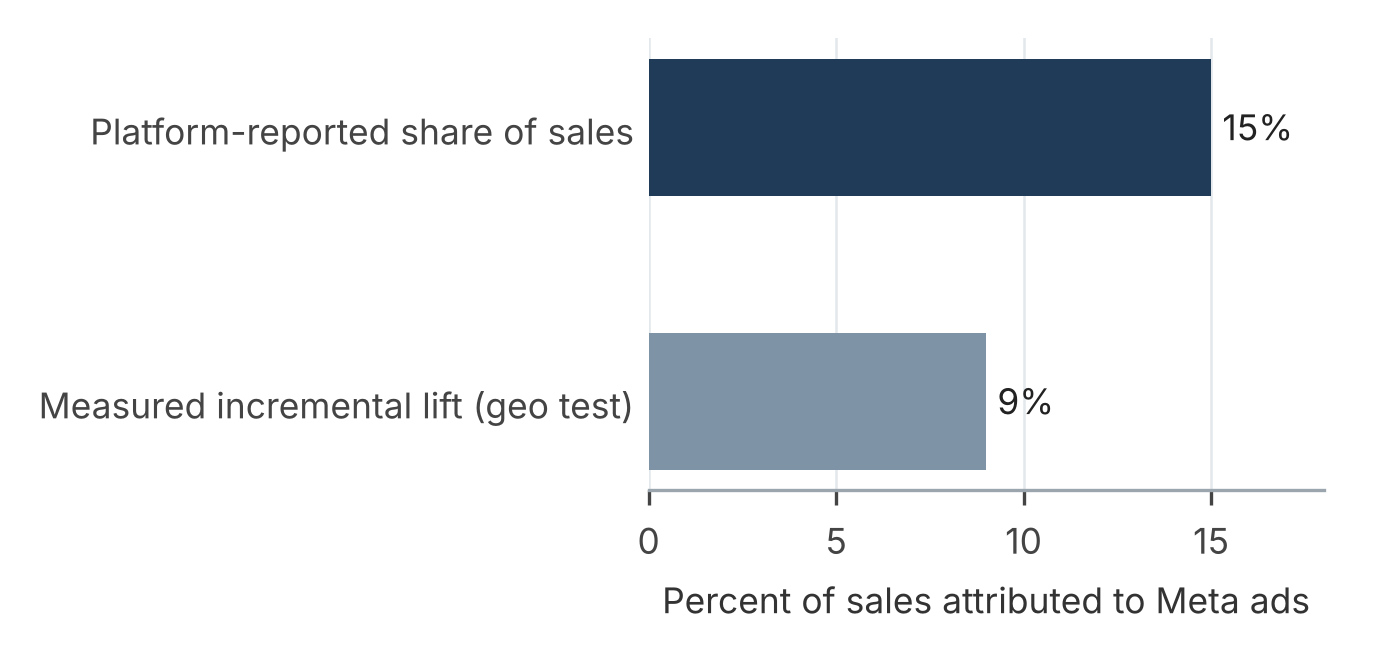
Figure 9.2: In the Brightleaf geo test, Meta’s own reporting credited it with 15% of sales, while the holdout measured 9% incremental lift (illustrative)
3. Marketing mix modeling (MMM)
MMM is a statistical method that uses aggregated historical data (weekly spend by channel, sales, prices, promotions, seasonality, and external factors) to estimate how much each channel contributes to outcomes and how returns diminish as spend increases. It needs no user-level tracking, so it’s resilient to privacy changes, and it captures offline channels too.
Once the preserve of large advertisers and specialist consultancies, MMM has become more accessible thanks to open-source tools such as Google’s Meridian and Meta’s Robyn, and to vendors offering lighter-weight MMM products. It typically needs two or more years of weekly data and enough variation in spend to produce reliable estimates, and its results should be validated with incrementality tests.
Use it for: strategic budget allocation across channels, forecasting, and planning.
Triangulation
| Method | Speed | Granularity | Causal? | Privacy resilience | Best use |
|---|---|---|---|---|---|
| Attribution | Daily | Ad, keyword, campaign | No | Low to medium | Tactical optimization |
| Incrementality tests | Weeks per test | Channel or campaign | Yes | High | Validating channels, calibrating attribution |
| Marketing mix modeling | Monthly or quarterly | Channel | Partly (model-based) | High | Strategic budget allocation |
Mature teams use all three together: attribution for daily decisions, MMM for annual and quarterly budgets, and incrementality tests to calibrate both.
Prompt 9.2: Measurement framework Act as a marketing measurement lead. Our business is [description], spending [amount] per month across [channels], with [data available]. Design a measurement framework that combines attribution, incrementality testing, and marketing mix modeling. Include: which decisions each method will inform, a 12-month testing calendar of incrementality experiments prioritized by spend and uncertainty, data requirements and readiness for MMM, the blended KPIs we should report (such as blended CAC and MER), and how we’ll reconcile differences between methods.
Prompt 9.3: Geo experiment design Help me design a geographic holdout test for [channel] in [country]. We have weekly sales data by [region type] for the past [period]. Explain how to choose and match test and control regions, how long to run the test, how to estimate the minimum detectable effect, what to do about spillover between regions, and how to analyze the results. List the pitfalls that commonly invalidate geo tests.
Data clean rooms and retail media
Two newer developments are worth knowing:
- Data clean rooms let two parties (for example, an advertiser and a retailer or platform) match and analyze their data without either side seeing the other’s raw customer data. Google’s Ads Data Hub, Amazon Marketing Cloud, and independent clean room providers are examples. They’re mainly used by larger advertisers for measurement and audience planning.
- Retail media networks (Amazon Ads, Walmart Connect, Instacart, and many others) let brands advertise to shoppers using the retailer’s first-party purchase data, often with closed-loop measurement that connects ads to sales.
A practical framework for smaller teams
You don’t need a data science team to measure well. A small business can:
- Get the basics right: GA4 key events, UTMs, server-side conversions where easy (Chapter 7 and Chapter 6).
- Track blended metrics weekly: total revenue, total marketing spend, MER, blended CAC, and new customer count.
- Ask every new customer “How did you hear about us?” and track answers over time.
- Run one simple incrementality test per quarter on the biggest channel (such as a two-week geo pause or a platform lift study).
- Compare platform-reported results with back-end sales monthly, and note the ratio.
- Revisit budget allocation quarterly using all of the above.
Hands-on exercises
Exercise 9.1: Consent audit (30 minutes). Visit three websites from a private browser window. Reject all non-essential cookies, then use your browser’s developer tools (Network tab) or a tag inspection extension to see which marketing tags still fire. Record what you find.
Exercise 9.2: Value exchange design (30 minutes). Design three zero-party data value exchanges for Brightleaf (or your business), specifying what customers get, what data they share, and how you’ll use it.
Exercise 9.3: Blended metrics (20 minutes). For this month, Brightleaf spent $14,000 on marketing, generated $63,000 in revenue, and acquired 410 new customers. Calculate MER and blended CAC. (Answer: MER 4.5; blended CAC about $34.)
Strategic assignment: privacy-first measurement plan
Deliver a Privacy-First Measurement Plan: a first-party and zero-party data strategy; a consent implementation checklist and tag audit; a signal recovery plan (server-side tagging, enhanced conversions, conversion APIs, offline imports); a measurement framework combining attribution, incrementality, and MMM; a 12-month experiment calendar; a blended KPI dashboard outline; and an AI log.
Key takeaways
- Individual-level tracking will always be incomplete, regardless of what happens to Chrome cookies.
- First-party and zero-party data, collected in exchange for real value, are the foundation of modern marketing.
- Implement consent properly and understand that modeled conversions fill some gaps.
- Recover signal responsibly with server-side tagging, enhanced conversions, conversion APIs, and offline imports.
- Triangulate: attribution for tactics, incrementality tests for causality, and marketing mix modeling for strategic budgets.
- Small teams can measure well with blended metrics, customer surveys, and simple quarterly tests.

Author of four Opencart book.
The recent are Opencart 4 developer book and Opencart 4 user manual