Struggling to Transform an Idea into a Startup? Here Are the Keys to Navigating the Startup Journey

Most entrepreneurs have the natural ability to come up with unique business ideas. But turning these ideas into a tangible business venture isn’t always as easy as it sounds.

Turning an idea from a simple concept into something that can be monetized and can support a business model can be challenging for anyone. But for business owners who take the right first steps, they’ll be more likely to improve their success rate.

Validate Your Idea

The first step every new business owner should take before getting started is to validate their ideas. This involves having a deeper understanding of the market and how much demand is currently out there. This will help businesses from investing too heavily in ideas that may not result in the necessary returns.

One effective way this can be handled is through market research. Market research lets businesses identify who their potential customers are while getting a clearer understanding of any specific pain points they may be experiencing. 

This doesn’t need to be an overly complex process and can be done by conducting surveys or simply asking for feedback from a small group of close friends or family. The most important part is to identify whether or not there seems to be an actual need for the solution you intend to in order, and of course if people think it’s something worth buying.

Develop a Business Plan

After you’ve done the necessary legwork to validate your idea, you’ll want to start developing a detailed business plan that can help you transform it into a profitable business. These documents can and should be fairly detailed, outlining everything from how you’ll structure the business to relevant market trends or financial forecasts. 

A business plan should be viewed as a construction blueprint. When a new home build or renovation project is underway, blueprints are essential to ensuring that all the necessary steps are followed correctly. 

It’s no different in business, and a well-constructed plan can make sure that as your company grows, it takes the right approach to its sales and operations efforts while still ensuring the company stays within budget.

Secure Funding

An essential element of running a successful startup company is having adequate funding. This is where a new business owner will need to weigh their options and decide whether or not they’re willing to give up equity to an angel investor or decide to fund the startup primarily on their own. 

There are pros and cons associated with either decision, and the path you choose will be dependent on how much control you want to maintain with the business over time. In any event, you’ll want to draft a persuasive pitch for your business that highlights how and why it’s unique in the industry and the goals you’re looking to achieve.

When approaching an investor, it’s important to remember that potential backers aren’t necessarily investing in a product – they’re investing in you. This means that while numbers and figures may be important, your enthusiasm or knowledge of the industry is what tends to attract the most attention.

Build a Strong Team

For your startup to succeed, you need a great team backing you. This isn’t always the easiest thing to do since startup companies typically don’t provide the level of stability that many employees look for in an employer. Still, working with a small (but growing) organization has a lot of upside for new employees, and finding the right mix of passion and skillsets can be a game changer.

For you to find and keep the talent you need, especially through the challenging initial stages, it’s important to quickly establish a positive working culture. Show that you value communication early on and make your team feel like they’re a big part of moving the business forward.

Network and Build Partnerships

As a new business, it’s important to take the time to grow your network regularly. This includes creating mutually beneficial partnerships that can help you establish credibility out of the gate. 

Networking events or tradeshows are a great place to start when looking for like-minded brands to connect with. Even if you don’t start working with your new connections right away, getting to know as many professionals as possible in your niche gives you great exposure as your business starts to carve out its path.

You can also use different online platforms to promote your brand and communicate more regularly with your potential customers. Professional social media sites like LinkedIn can be a great source of industry information and let you connect directly with other brands in your industry. 

Protect Your Intellectual Property

When many new business owners launch their new ideas, they aren’t always focused on the legal components of their business and instead put most of their energy into getting things up and running. Still, it’s important to take the necessary steps to make sure your business is protected long-term.

It’s critical to protect your assets from unwanted trademark or copyright issues down the road. As your business grows and you start to own more market share, you’ll no doubt get more attention from other established companies or aspiring business owners who might want to capitalize on your ideas.

By investing some of your resources early and going through the necessary legal process, you can protect your long-term business interests and provide better assurances to your potential investors.

Focus on Sales and Marketing

There can be a bit of a mental struggle early on for entrepreneurs when it comes to balancing product development with sales and marketing initiatives. Every business owner views these priorities differently. While some want to put more focus and energy into quality assurance and innovative design concepts, others are more interested in seeing quick returns.

Still, it’s important to have a strong go-to-market strategy that can be executed early on. This makes sure you’re not swimming in debt before revenues start to come in. There are a lot of different marketing avenues you can explore which will depend on your budgeting needs.

The important thing to remember is that you’ll no doubt be up against many competitors. And the longer you wait to start marketing yourself, the longer it will take to see financial rewards.

Prepare for Scale

Every business owner wants to see their company grow. Still, if you’re not ready for the changes you’ll need to make to support that growth, you’ll probably not see the benefits you were hoping for.

To scale properly, you’ll need to have the right structure in place. This may involve investing in different areas of your business, including your IT infrastructure as well as staffing resources.

To simplify this, you can look for business solutions like cloud-based systems or SaaS (Software-as-a-Service) platforms that are designed to scale up or down with your business as needed. This, along with deciding to work with remote teams, can help you avoid having to make expensive upfront investments to get your business running.

Get Your Startup Idea Off the Ground

Make no mistake – beginning a startup company isn’t an easy process. It takes patience and an organized process to make sure your business idea successfully translates into a profitable venture.

However, if you go in with the right mindset, carefully construct your business plan, and surround yourself with a great team, you’ll have the foundation you need to watch your company grow. 

The load balancer in Kubernetes

To work as efficiently as possible with Kubernetes, the workload must be distributed in a manageable way between different pods. This is where the load balancer takes center stage.

What is a load balancer in Kubernetes?

A load balancer is used to distribute the load to be handled by servers or virtual machines to improve overall performance Usually, a load balancer is placed in front of servers to prevent overloading of individual servers. However, we must distinguish between two types of load balancers in Kubernetes:

  • Internal Kubernetes load balancers
  • External Kubernetes load balancers

Internal Kubernetes load balancers

Although the internal Kubernetes load balancers are briefly presented, the article will focus on the external ones. Compared to classic load balancers, an internal load balancer takes a different approach and ensures that only applications running in the same virtual network as your Kubernetes cluster can access it.

External Kubernetes load balancers

External load balancers assign a Kubernetes cluster service node its IP address or DNS name so that it can receive external HTTP requests. This load balancer is a special type of Kubernetes software development service and routes external traffic to individual pods in your cluster. In this way, the best distribution of incoming requests is ensured.

There are several algorithms for configuring load balancers in Kubernetes. The choice depends entirely on how you want to use it. 

What is the Kubernetes load balancer for?

A Kubernetes load balancer defines a service that runs on the cluster, accessed over the public Internet. For a better understanding, you have to take a look at the Kubernetes architecture. A cluster contains multiple nodes, which in turn is made up of multiple pods. Each of these pods is assigned an internal IP that is inaccessible from outside the cluster. This also makes sense, since pods are created and deleted automatically, with IPs reassigned.

A Kubernetes service is often required for software running on pods to be used with a fixed address. In addition to the load balancer, there are other services that are suitable for various application scenarios. But all custom software development services have in common that they attach several pods into a logical unit and describe how to access them:

The Kubernetes load balancer serves to optimally distribute external traffic to the pods of your Kubernetes cluster. Therefore, it can be used in numerous situations, for almost any purpose. The fact that Kubernetes load balancers can direct traffic to each of the pods ensures that the cluster has high availability. If a pod stops working or has errors, the load balancer distributes the tasks among the other pods.

With load balancers, scalability is also improved. If incoming traffic is determined to require less or more resources than are currently available, Kubernetes can respond by automatically creating or deleting pods.

We explain how to create a load balancer for Kubernetes

To create a Kubernetes load balancer, you need your cluster to run in a cloud or an environment that supports setting up external load balancers.

When creating a Kubernetes load balancer with IONOS, the cluster node receives a static IP that allows the service to be addressed from outside the cluster. 

The configuration of a Kubernetes load balancer could, for example, look like this: The service groups pods with the web app selector. Incoming traffic that has used port 8080 along with the load balancer IP is distributed to the individual pods.

A Comprehensive Guide to Mastering Flutter

Google recently launched Flutter, a new technology that promises to be an ideal solution for building high-performance, highly realistic applications.

What is Flutter?

Flutter is defined as a cross-platform framework for user interfaces (UI), as well as an open-source software development kit (SDK). In other words, it allows you to develop applications for different platforms and operating systems, including iOS, Android, web, Windows, macOS, and Linux. Everything, from integrated code.

Advantages of using Flutter

  • Share code across different platforms – The ability to reuse code makes it easy for teams, even those without web development experience, to apply their knowledge in building mobile and desktop apps. The result? More optimized use of code. 
  • Wide variety of customization options: With Flutter, it is possible to customize the web application to improve the user experience on each platform. 
  • Focus on accessibility: Users look for accessible applications. Flutter excels at enabling precise designs and components, contributing to the development of an interface that meets a wide range of needs. 

Why should you choose Flutter for your company?

Flutter is perfect for customers and enterprise software development companies for several reasons: 

For customers: 

  • Hot reload: This functionality allows you to view changes to the code instantly, without having to restart the application. 
  • Cost-effectiveness: Developers manage a single code base for iOS and Android, reducing costs. 
  • Improved user and brand experiences: With its extensive set of fully customizable widgets, native interfaces can be designed in minutes. 

For developers: 

  • Single code base: facilitates time savings and ensures consistency across platforms. 
  • Rich feature set: Gives you the freedom to create exceptional user interfaces with complex, custom widgets. 
  • Strong community: Provides ongoing support to developers, making it easy to find solutions. 

The Flutter Development Process: A Simplified Guide

Starting a project in Flutter can be challenging at first. For this reason, here we provide you with a simple guide that covers several key points. From SOLID and Clean Architecture to specifications, CLI tools, and project templates. We explain how to simplify the custom enterprise software development, testing, and release process. 

SOLID

This theory is based on five basic rules of resource management (single responsibility, open closure, Liskov substitution, interface partitioning, and dependency inversion). In this way, each element must have a single responsibility and maintain a marked separation of interfaces in order to avoid direct dependencies. 

Clean Architecture

This concept focuses on greater abstraction and modularity, allowing the software to be easily modified and updated without interrupting its operation. 

Specifications

Also known as configurations, custom project parameters are defined here. These can be set in several ways, either by completing a file or during interaction between the command line interface (CLI) and a user. For example, when configuring a project, we could specify options such as the project template, run tools, or even integration with Git (Specifications Config <run> CLI tool <git> Project template).   

Command Line Interface (CLI) Tool

This tool is automatically activated when starting a new project to configure the options in GitHub, essential for code generation. 

Project Outline 

For architecture, we suggest starting with schematics that show the connections between classes and interfaces in the software. Using a legend helps detect and resolve potential problems by incorporating UML elements used. 

Additionally, it is vital to understand your tool to have a Swimlane diagram. These diagrams are important in representing processes, as they detail specific actions and their operation. 

A clearly established process, divided into products with detailed activities for each level, will make it easier to track the algorithm’s journey. 

Development

First things first: 

  • Config: Details the creation of a new project. The user sets values ​​and parameters by interacting with the Command Line Interface (CLI). 
  • ConfigBuilder: facilitates the creation of objects sequentially, adding configuration parameters progressively. 
  • MinimalConfigBuilder: This component implements the builder interface and adapts its methods to efficiently configure a basic structure, corresponding to a Minimum Viable Product (MVP). It is characterized by its minimalist approach, using only the fundamental parameters required for its operation. 
  • Creator: This interface manages the creation of Projects, transforming an initial layout of templates into a specific configuration. It implements various behavioral scenarios while maintaining the standard interface, complies with the Liskov Substitution Principle (LSP) in SOLID, and optimizes future code management. 
  • Job: used in the generation of the project, it allows adding sequences to form a more complex structure. For example, it is possible to modify a task, reorganize executions, or incorporate new elements without interfering with previous work. 

Testing and Launch

To test the tool, upload it to pub.dev, share the repository, and distribute it to the team. Documents everything: architecture, state management, and lint regulations. 

Design Considerations

Flutter offers advanced customization, ideal for designing dynamic interfaces. Its robust SDK is perfect for mobile app development.  

Featured Features: 

  • Impeller and Flame graphics engines: with this, you can render 3D objects and complex in-app graphics, maintaining a constant performance of 60-120 FPS. 
  • In-app animations: Animations improve the user experience. With Skia and Impeller, implement fluid animations and perform real-time testing. 
  • Material and Cupertino Widgets – Two styles available. Material for all platforms and Cupertino for an iOS style.  
  • Precise Rendering: This feature allows designers to avoid SDK-specific settings. Flutter renders every pixel so the UI looks consistent across devices. 

Development Considerations

After reviewing the Flutter development process, let’s look at some essential requirements for building an application on this platform. 

  • Flutter SDK: First, get the Flutter SDK from its official site and follow the instructions for your operating system. 
  • IDE: It is important to have an editor that offers compatibility with Flutter and Dart through various plugins and extensions. For example, we recommend Visual Studio Code (VS Code).   
  • Flutter Doctor Command: Verify the Flutter configuration by running Flutter Doctor to ensure everything is correct. 

How to select a provider for your Flutter project 

When selecting a provider for your project, verify that they have the required skills and experience to develop the application according to your requirements. 

Consider the following: 

  • Native mobile development: experience is key. A provider with a track record in native applications understands mobile environments better and finds efficient solutions. 
  • Multiplatform experience: a provider specialized in iOS and Android ensures a dual launch and knowledge of the particularities of each system. 

Focus on Learning: since Flutter is an emerging and constantly changing software development solution, a provider that stays up to date and knows the optimal solutions for each case is vital.

Streamlining Enterprise Operations: Leveraging ERP for Enhanced Efficiency

In the modern business world, organizations are constantly looking for innovative ways to boost productivity and keep a competitive advantage. Integration of enterprise resource planning (ERP) is one such technique that is gaining popularity. Adetive Solution, renowned for its innovative technology and creative solutions, provides ERP solutions that smoothly integrate to optimize business processes.

Understanding ERP Systems to Maximize Efficiency

ERP Enterprise resource planning systems are comprehensive software solutions designed to integrate and streamline numerous factors of commercial enterprise operations. It gives a centralized platform to manipulate various aspects of the company. The integration of ERP systems represents a significant shift in how companies perform, from finance and human sources to supply chain management and customer relationship management, ERP systems consolidate information and tactics, presenting a complete view of the organization’s operations. 

Adetive Solution has a specialty in developing ERP solutions to meet the precise needs of businesses. It can leverage the power of ERP systems to maximize the organization’s efficiency throughout various of its operations. With Adetive’s tailored solutions, businesses can automate repetitive tasks, get rid of manual tactics, and ensure seamless communication among distinct departments. This not only enhances efficiency but additionally reduces the chances of errors and delays, in the end leading to improved productivity.

Adetive’s expertise ensures easy implementation and customization, aligning ERP Enterprise resource planning solutions with the precise needs of every enterprise. With enhanced visibility and real-time insights, companies could make informed decisions to acquire sustainable growth.

Benefits of ERP Integration:

  1. Efficient Resource Management: Adetive Solution’ expertise in enforcing ERP solutions allows businesses to efficaciously manipulate their resources. By centralizing facts and automating processes, businesses can allocate resources more effectively, leading to financial savings and stepped-forward decision-making.
  2. Streamlined Workflows: Adetive’s proficiency in technology integration ensures seamless workflows across departments. With ERP systems, redundant duties are minimized, and data flows smoothly, resulting in faster response rates and more desirable collaboration amongst teams.
  3. Enhanced Productivity: Adetive Solution allows businesses to increase productiveness through ERP implementation. By automating routine responsibilities and offering actual-time insights, employees can recognize value-added activities, using standard performance and overall efficiency.

Adaptive Expertise in Technology:

Adetive Solution brings extraordinary expertise in technology integration to the desk. With a deep knowledge of ERP Enterprise resource planning systems and their abilities, Adetive helps companies leverage the whole potential of these solutions. From custom-designed solutions to seamless implementation and support, Adetive Solution empowers organizations to unlock the entire ability of ERP systems.

By prioritizing scalability and adaptability, Adetive guarantees that ERP solutions can evolve alongside the business, accommodating growth and changing requirements. With Adaptive as a trusted partner, corporations can navigate the complexities of technology integration with confidence, driving innovation and efficiency at every step. 

Whether it’s integrating existing systems or developing customized modules, Adetive Solution offers a comprehensive approach to ERP implementation, ensuring maximum efficiency and minimal disruption to enterprise operations. Adetive guarantees a seamless revel in for its customers.

Adetive Solution empowers corporations with real-time insights into their operations. This allows informed decision-making, as stakeholders have get right of entry to accurate and updated information at their fingertips.

Case Study: Optimizing Operations with Adetive Solution:

Let’s consider a manufacturing organization struggling with disjointed structures and manual processes. By partnering with Adetive Solution, the organization applied an ERP system tailor-made to its precise requirements. The results were splendid: manufacturing procedures have been streamlined, lead times have decreased, and inventory management improved. Adetive’s ongoing assistance ensured smooth operations, allowing the organization to stay ahead of the competition.

Conclusion

In Conclusion, the integration of ERP Enterprise resource planning systems provides a transformative opportunity for corporations to streamline their operations and increase productivity. With Adaptive Solution as a strategic partner, businesses can unlock the whole capability of ERP technology and might leverage ERP capabilities to optimize procedures and enhance productiveness.  Businesses can then open up new growth possibilities and navigate the complexities of modern business with ease.

Top 7 WordPress Web Development Trends for 2024

The domain of WordPress web development is dynamic as we venture into 2024, ushering in pioneering trends and technologies that redefine the construction and consumption of websites. Whether you are an experienced developer or an individual seeking to hire WordPress developers, being abreast of these trends can set you apart from the competition. In this piece, we take a closer look at the 7 major WordPress web development trends likely to make waves throughout 2024.

1. Headless WordPress

Gone are the days when headless WordPress was mere industry jargon; it now signifies a pivotal revolution in website handling and dissemination. When the front-end and back-end are uncoupled, developers achieve liberty in employing diverse technologies for UI development yet retaining WordPress as the CMS. Such methodology enhances performance quality, moreover presenting a consistent user journey irrespective of platform.

  • Advantages:
    • Flexibility: It uses frontend such as React.Js & Vue.Js.
    • Performance is better: quicker loading times are achieved due to the front-end rendering being optimized.
    • Scalability: Rescale your application easily, without worrying about WordPress architecture.

Although one might think of it as a headache, properly implemented headless WordPress could become a relatively advanced and scalable platform with the right tools and expertise. Looking at this challenge as too difficult, you could hire WordPress developers who can implement headless architecture to do the job at hand.

2. AI and Machine Learning Integration

Artificial Intelligence and Machine Learning are the most trending things that find their way into WordPress development. From chatbots to personally recommended content, AI and ML can improve user engagement in several ways while smoothening operations.

  • AI Applications:
    • Chatbots: Real-time customer support, and enhanced user experience.
    • Content Personalization: Deliver tailored content to users based on their behavior and preferences.
    • Analytics: Understand more about user behavior on interaction towards performance improvement of websites.

Integrating AI and ML into your WordPress site can be incredibly effective at enhancing user satisfaction and driving conversions. This trend is very effective in the domain of e-commerce websites where personalized experiences will be important for retaining customers.

3. Progressive Web Apps (PWAs)

PWAs combine the most significant parts of two worlds: web apps and mobile apps, offering an uninterrupted experience across the web. The main reasons why PWAs are gaining in popularity are that they work in offline conditions, load at amazingly zippy speeds, and provide experiences like native apps without the need for users to download any app.

  • The key features:
    • Offline Access: This allows access to content regardless of whether connectivity is available.
    • Fast Loading: PWAs load quickly and provide good user retention.
    • Responsive Design: PWAs provide the same user experience across devices.

You can increase user engagement by a large margin and retain more of them if you turn your WordPress site into a PWA. For businesses looking to stay ahead, collaborative partnerships with a WordPress development company specializing in plugin implementation will make all the difference.

4. Improvements in Security Measures

With increasing cyber threats, improvement in website security lies at the core of all WordPress developments. By 2024, we may see more complex site protection mechanisms implemented to secure websites from activating bad players and keep websites safe from sophisticated attacks.

  • Security Trends:
    • Two-Factor Authentication (2FA): An additional layer of security for user logins.
    • Regular Updates: Keeping WordPress core and the themes and plugins updated helps to mitigate vulnerabilities.
    • SSL Certificates: Be sure to encrypt all data sent between the user and the server.

Security is a place where one cannot afford to take shortcuts, especially when you are doodling with sensitive user data. The least you can do is have good security in place and listen to website audits frequently to mitigate potentially hazardous situations. You could employ the services of a WordPress development company specializing in security services and undertake detailed security measures every time.

Read more: Website security measures for eCommerce

5. Optimize for Voice Search

Optimizing your WordPress website for voice search is increasingly important as smart speakers and voice assistants see increasing usage. Voice search optimization is done to locate content users find easily and can be accessed via commands spoken through voices.

  • Optimization Strategies:
    • Natural Language Processing: Write content in a conversational light, mimicking how people speak.
    • Featured Snippets: Be sure to feature in Google’s featured snippets, often read in voice search.
    • Structured Data: Tapping schema markup into action to help search engines understand your content better.

It’s time for a change in the game of how users are going to experience websites, so it has become quite critical for any business to evolve. This inclusion of voice search optimization into your SEO strategy may make your site further visible and accessible.

Read more: Voice Search input box implementation

6. Advanced Custom Fields and Gutenberg Blocks

The introduction of Gutenberg has revolutionized content creation in WordPress. With advanced custom fields and custom Gutenberg blocks, it empowers developers to make extensively customized, very dynamic content layouts.

  • Benefits:
    • Customization: A facility for creating bespoke content blocks customized to your website’s needs.
    • Efficiency: Simplify the content creation process with reusable blocks and fields.
    • Flexibility: The capability for easy updating and change of content without the administration of extensive coding.

These tools can integrate more functionality into your site, adding increased interactions to improve the user experience. This is especially true for sophisticated customizations, for which hiring WordPress developers would ensure that they bring aboard expertise in ACF and Gutenberg, among other areas of development relating to sites.

7. Sustainable Web Development Practices

Sustainability is fast becoming a significant factor in web development. As environmental awareness increases, more and more developers are now moving over to web development practices that help reduce the carbon footprint of websites.

  • Sustainable Practices:
    • Efficient Coding: The programmer should write clean, efficient code that helps to reduce server load and energy consumption.
    • Green Hosting: Opt for those hosts that make use of renewable sources of energy.
    • Optimized Images and Videos: Allow media file compression for iconic delays and energy saving.

Web development should be as sustainable as possible—not another trend. Contribute to a greener internet by making your website more eco-friendly and boosting performance.

FAQs

  1. What is Headless WordPress?

Headless WordPress decouples the frontend from the backend, which allows different technologies at the user interface while retaining WordPress as a CMS.

  1. How do AI and ML help in my WordPress site?

AI and ML will enhance customer engagement by implementing chatbots, personalized content, and deep analytics.

  1. What are Progressive Web Apps?

PWAs provide an integrated and native app-like experience on the web—first, they work offline and then load within a second.

  1. Why is WordPress website security important?

Advanced security measures protect your site against cyber threats and ensure the hassle-free safety of user data.

  1. How do I optimize my WordPress site for voice search?

Speak in natural language, shoot for featured snippets, and then set up structured data to give your local SEO a boost in voice search.

Conclusion

Staying updated on the latest WordPress web development trends could be helpful if you want to maintain your competitiveness in 2024. From embracing headless architecture and integration with AI to optimization for voice search, every trend opens specific possibilities to improve functionality and enhance the user experience. Remember that working collaboratively with a well-aware WordPress development company will enable you to get past the current trends and focus on applying them appropriately. So, fasten up your seatbelts and get ready to ride the wave of innovation in the WordPress ecosystem!

Cloudflare solution – Access to fetch at ‘*’ from origin ‘*’ has been blocked by CORS policy: No ‘Access-Control-Allow-Origin’ header is present on the requested resource.

We were working to show the webocreation.com blog post to the rupaknepali.com.np but it keeps on showing the CORS policy error. So to fix that we implemented some transform rules in the Cloudflare as the webocreation.com was configured with it.

JavaScript Code to fetch RSS feed URL and convert it into the HTML

The code below fetches the content from https://webocreation.com/feed/ converts it into HTML and adds it to the rss-container div.

<div id="rss-container"></div>
<script>
const RSS_URL = `https://webocreation.com/feed/`;
fetch(RSS_URL)
.then(response => response.text())
.then(str => new window.DOMParser().parseFromString(str, "text/xml"))
.then(data => {
    console.log(data);
    const items = data.querySelectorAll("item");
    let html = ``;
    items.forEach(el => {
    html += `
        <div class="event row">
        <div class="col-sm-3 col-xs-12 event-left wow fadeInUp" data-wow-duration="1s"
            data-wow-offset="200">
            <h4>Nov 2017</h4>
            <i class="fa fa-diamond fa-fw"></i>
        </div>
        <div class="col-sm-9 col-xs-12 event-right wow fadeInUp" data-wow-duration="1s"
            data-wow-offset="200">
            <div class="content-wrapper">
                <h4><a href="${el.querySelector("link").innerHTML}"
                    target="_blank">${el.querySelector("title").innerHTML}</a></h4>
                <div class="separator"></div>
                <p class="job-title">${el.querySelector("category").innerHTML}</p>
                <p class="para">
                <p>${el.querySelector("description").innerHTML}</p>
                <p>The post <a href="${el.querySelector("link").innerHTML}">${el.querySelector("title").innerHTML}</a> appeared first on <a rel="nofollow" href="https://webocreation.com/blog">Webocreation</a>.</p>
                </p>
            </div>
        </div>
    </div>
    `;
    });
    document.getElementById('rss-container').insertAdjacentHTML("beforeend", html);
});
</script>

Read more: Setup Cloudflare for eCommerce website

CORS Policy error

We see the following error

Access to fetch at 'https://webocreation.com/feed/' (redirected from 'https://webocreation.com/feed') from origin 'https://rupaknepali.com.np' has been blocked by CORS policy: No 'Access-Control-Allow-Origin' header is present on the requested resource. If an opaque response serves your needs, set the request's mode to 'no-cors' to fetch the resource with CORS disabled

Cloudflare CORS

Fix: Access to fetch from origin has been blocked

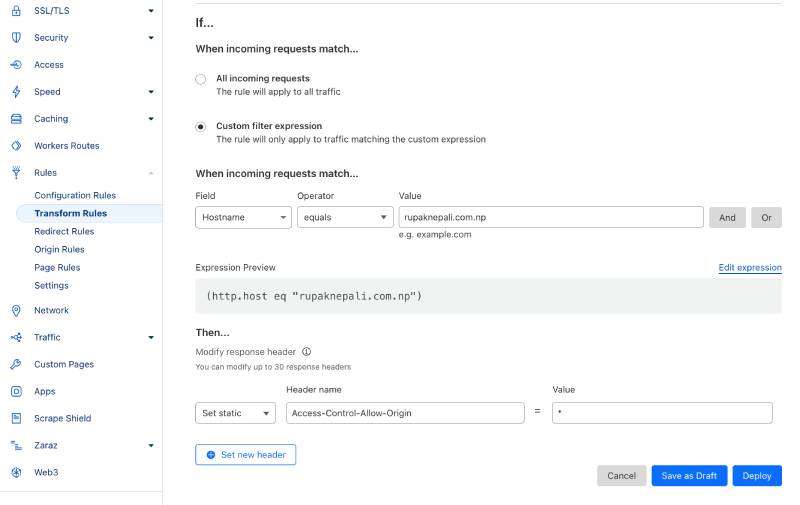
As webocreation.com uses Cloudflare to fix the CORS issue we need to configure it into Cloudflare. For that go to Cloudflare Admin >> Rules >> Transform Rules

Cloudflare CORS

Output

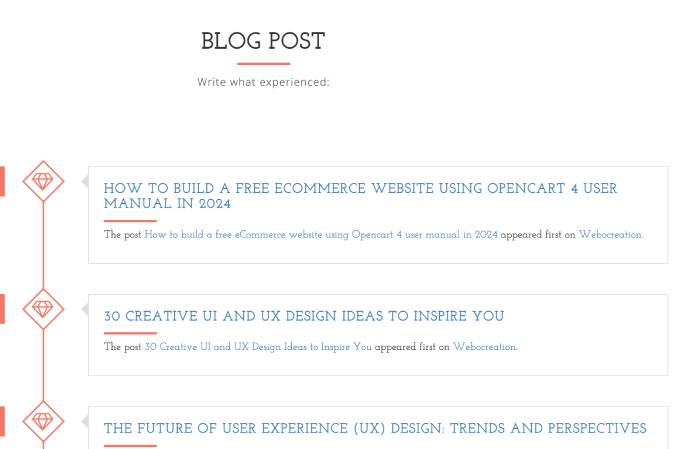
The output seems like the following:

RSS fetch JavaScript

In this way, we fixed the access to fetch at ‘https://webocreation.com/feed/’ (redirected from ‘https://webocreation.com/feed’) from origin ‘https://rupaknepali.com.np’ has been blocked by CORS policy: No ‘Access-Control-Allow-Origin’ header is present on the requested resource. Please don’t forget to post your questions comments or errors so that we can help you. You can follow us on our Twitter account @rupaknpl. Subscribe to our YouTube channel for Opencart tutorials, and click to see all Opencart user manuals.

Strategic Keyword Placement: How HTML Tags Boost SEO

In the digital landscape, where visibility and discoverability are crucial for online success, search engine optimization (SEO) plays a pivotal role in driving organic traffic to websites. While various factors influence search engine rankings, strategic keyword placement within HTML tags remains a fundamental aspect of effective SEO strategies. In this article, we delve into the significance of HTML tags for SEO and explore best practices for leveraging strategic keyword placement to enhance online visibility and drive targeted traffic.

Understanding HTML Tags and Their Role in SEO

HTML (Hypertext Markup Language) tags are the building blocks of web pages, defining the structure and content of a website. From headings and paragraphs to images and links, HTML tags provide search engines with valuable information about the content and relevance of a web page. Properly optimized HTML tags not only improve user experience but also signal to search engines the key topics and themes of a page, influencing its ranking in search results.

Key HTML Tags for SEO and Their Impact

Several HTML tags play a crucial role in SEO by providing search engines with valuable information about the content and context of a web page. Here are some key HTML tags and their impact on SEO:

  • Title Tag (<title>): The title tag is one of the most important HTML tags for SEO, as it appears as the clickable headline in search engine results pages (SERPs). Strategic placement of target keywords within the title tag can improve the relevance and visibility of a web page in search results, driving click-through rates and organic traffic.
  • Meta Description Tag (<meta name=”description”>): While not a direct ranking factor, the meta description tag provides a concise summary of the content on a web page and appears beneath the title tag in SERPs. Including relevant keywords and compelling language in the meta description can entice users to click on the search result, improving click-through rates and indirectly impacting SEO performance.
  • Heading Tags (<h1> to <h6>): Heading tags, particularly the <h1> tag, help structure the content of a web page and provide hierarchical information about the importance of different sections. Strategically placing target keywords within heading tags not only improves readability and user experience but also signals to search engines the main topics and themes of the page, influencing its ranking in search results.
  • Image Alt Attribute (alt=” ): The alt attribute of an image tag (<img>) provides alternative text for visually impaired users and search engine crawlers. Including relevant keywords in the alt attribute can improve the accessibility and SEO performance of images, helping them appear in image search results and enhancing the overall relevance of the web page.
  • Anchor Text (<a>): Anchor text, the clickable text within a hyperlink, provides context and relevance to both users and search engines. Using descriptive anchor text that includes relevant keywords can improve the SEO value of internal and external links, helping search engines understand the topic and relevance of linked pages.

Also Read: Role of a Career Coach: 8 Ways They Can Boost Your Career

Best Practices for Strategic Keyword Placement

To maximize the SEO impact of HTML tags, it is essential to follow best practices for strategic keyword placement:

  • Research and Identify Target Keywords: Conduct keyword research to identify relevant and high-value keywords for your website and target audience. Choose keywords with sufficient search volume and moderate competition, considering factors such as relevance, search intent, and user behavior.
  • Place Keywords Naturally and Strategically: Incorporate target keywords naturally within HTML tags, ensuring they fit contextually within the content and enhance readability. Avoid keyword stuffing or over-optimization, as this can negatively impact user experience and trigger search engine penalties.
  • Optimize Title Tags and Meta Descriptions: Craft compelling title tags and meta descriptions that accurately reflect the content of the web page while incorporating target keywords in a meaningful way. Keep title tags concise (under 60 characters) and meta descriptions informative (under 160 characters) to maximize visibility in SERPs.
  • Structure Content with Heading Tags: Use heading tags to organize content into logical sections and sub-sections, incorporating target keywords in the <h1> tag for primary headings and <h2> to <h6> tags for subheadings. This helps both users and search engines understand the structure and hierarchy of the content.
  • Optimize Image Alt Attributes: Include descriptive and keyword-rich alt text for images to improve accessibility and SEO performance. Describe the content and context of the image concisely, incorporating relevant keywords where appropriate.
  • Diversify Anchor Text: When linking to internal and external pages, use a variety of anchor text that reflects the context and relevance of the linked content. Incorporate target keywords naturally within anchor text while maintaining diversity and avoiding repetitive or spammy linking practices.

Conclusion

Strategic keyword placement within HTML tags is a foundational aspect of effective SEO strategies, helping websites improve their visibility, relevance, and ranking in search engine results. By optimizing key HTML tags such as title tags, meta descriptions, heading tags, image alt attributes, and anchor text, webmasters can enhance the SEO performance of their websites and attract targeted organic traffic. By following best practices for strategic keyword placement and continuously monitoring and refining their SEO efforts, businesses can stay ahead in the competitive online landscape and drive sustainable growth and success.

5 Mobile App Development Trends for 2024

Mobile app development is an ever-changing field that evolves with the increasing demand for better and faster mobile application development services products. Therefore, to survive in the modern development environment, app developers must stay abreast of the latest trends and understand how the industry is evolving.

Remember when cell phones were a luxury that only a handful of humans could afford? Or after that, when they were more widespread but as big as a brick and as unwieldy as a sword? And do you remember thinking about how advanced technology was at that time? Imagine, a couple of decades later, we would have mobile phones with cameras, which can store thousands of images and fit comfortably in our pocket. And sure enough, in a couple more decades, we’ll be looking back on our iPhones with endless nostalgia and imagining how we could have been so impressed with such archaic pieces of technology. But that’s how it works in today’s world, where technology evolves at breakneck speeds. Smartphones have fundamentally transformed into little extensions of our minds, and modern business models now rely heavily on mobile apps and websites running seamlessly from within them. As a result, we have become more demanding in what those apps can do and how quickly they can do it, putting intense pressure on the app development industry. As a result, modern app developers must deliver better and faster mobile products. The only way to achieve such a task is to base our development practices on the latest mobile app development trends.

With that in mind, innovative app developers must constantly evolve alongside technological advances and adapt them efficiently and effortlessly to our daily work. I mean, there’s no way around it: if we want to remain relevant today and stand the test of time, we need to be aware of the mobile app development trends for 2024 and incorporate them into our development processes for this year and beyond. . So let’s get to the point, but first, a little context.

State of the mobile application market by 2024

2024 has just begun, but we are already beginning to witness the trends that will shape how this year ends for our industry. To start, we now have over 4.8 million mobile apps available across all app stores, of which Google’s Play Store has 2.87 million and Apple’s App Store has almost 2 million. Global revenue from these mobile apps increased significantly from 2019, when the market value was $154 billion , to reach $318 billion in 2020 . That number is expected to nearly double to reach $613 billion by the end of 2025. And if that were not enough, studies show that in 2021, in-app purchases across all app stores reached more than $130 billion , a a mind-boggling figure that represents a year-over-year growth of 19.7% compared to the $111.1 billion spent in 2020. The same study reveals that the App Store takes the lion’s share of that $130 billion, and users spend almost $85 billion on Apple’s platform. a figure that grew by 17.7% from the $72.3 billion they spent in 2020 and represented around 1.8 times more than other platforms. Google’s Play Store didn’t see that figure, as users paid just $38.8 billion on the platform’s in-app purchases. However, studies claim that Google’s market will see a rise of 23.5% by 2024. However, paradoxically, Google’s Play Store took the lead in user downloads with over 99 billion downloads in 2021 compared to 37 .4 billion from Apple, a difference of almost 60 billion downloads between the two!

As if the popularity of the mobile app market wasn’t evident from the figures above, we can now see users around the world shifting their attention – and their credit cards – to mobile platforms. By the end of 2021, consumers spent more than $320,000 every minute in app stores, a staggering increase of more than 20% compared to 2020. Additionally, according to Forbes, by the first quarter of 2024, users around the world More than 37 billion apps have already been installed, which represents an increase of 11% compared to the same time period studied in 2021, the majority of which belongs to Google with around 28 billion. The most installed mobile application on the Android platform is Facebook, which tops the charts with around 500 million downloads , while Apple’s leading mobile product is TikTok, with almost 746 million installations.

It seems evident that mobile products and their popularity are increasing and will continue to increase. In fact, upcoming technology trends will drive an increasing number of businesses to go mobile. In contrast, those that have already done so will likely continue to leverage modernizing IT-based technologies and tools to grow and scale their mobile solutions. At the same time, application developers will continue to adopt evolving technologies to strengthen their development practices. As a result, they will stay on track to deliver high-tech and cutting-edge mobile application development services that outperform their technologically challenged competitors and remain relevant and prosper for a long time. Herein lies the importance of adopting the upcoming mobile app development trends and encouraging them without any delay. On that note, let’s take a closer look at the mobile app development trends for 2024.

5G

If you’re a fan of the internet (aren’t we all?), you already know that 5G technology has been around for a while and was certainly a mobile app development trend for 2021. However, it wasn’t until recently that it really caught on. generalized. It has now become a buzzword in the app development industry, and this year it is in the spotlight as a backdrop for modern mobile app development processes. Because? Basically, 5G is the new technological standard for cellular telecommunications and wireless cellular networks. It features wider, more adaptable bandwidths that encourage faster downloads (around 100 times faster than 4G), better cellular connectivity, and more reliable, latency-free data exchange. What these elements bring to the app development industry with respect to connectivity, technology integration, and speed is unprecedented.

On the one hand, 5G was designed to promote better and faster mobile connectivity, meaning it can effectively connect everyone and everything: humans, smartphones, and internet-powered machines and devices. As a result, app developers can now easily integrate advanced technologies such as Artificial Intelligence (AI), Augmented Reality, virtual reality, 4K streaming, cloud computing, high-definition graphics, and interconnected IoT devices into our mobile apps. In doing so, the mobile ecosystem will see the rise of smart cars, immersive AR experiences for gaming, sports, education and healthcare applications, streaming services and more advanced training programs, and the emergence of an IoT ecosystem where thousands of millions of devices can connect. and communicate without problems. As a result, human-to-machine and machine-to-machine interactions are not a distant dream, but rather an immediate reality that application developers can make a reality without incurring additional storage or processor demands.

Additionally, 5G can support up to one million connected devices per square kilometer. This feature means that lag, latency and slow mobile network connections will no longer prevent developers from building heavier and more robust applications with all modern technologies integrated seamlessly and seamlessly. It also means that modern applications will have a broader reach because an increasing number of users will have access to 5G networks and devices and will be able to download them without worrying about the capacity of their connections. And, with 5G connections expected to cross the one trillion threshold worldwide by the end of 2024, we can safely say that 5G-enabled mobile apps will soon become the norm. Therefore, it can be said that 5G is one of the most promising and exciting mobile app development trends this year.

Blockchain

Blockchain is a distributed, immutable and decentralized digital ledger that stores data and enables the secure recording of transactions. Blockchain technology is ideal for rapid data sharing and recording because it provides immediate transfer and recording of blocks of information that can only be accessed by authorized members. Additionally, any changes made to recorded information are visible to all members of the blockchain, making it a secure and efficient tool for countless businesses that need to ensure data security. Thanks to these features, and for some years now, blockchain technology has been the cornerstone of cryptocurrencies, smart contracts, online financial transactions and everything related to FinTech applications. However, blockchain has come a long way since its cryptocurrency days. Since not long ago, countless industries such as healthcare started witnessing the advantages of blockchain technology and slowly started adopting it, making it a promising mobile app development trend for 2024.

Thanks to blockchain, app developers will now be able to create mobile products with a decentralized database, preparing them against fraud and making them completely resistant to data breaches and hacking. As you can guess, doing so is not only beneficial for FinTech applications, but also for any type of product that requires data protection, which, let’s face it, these days, is pretty much every application out there. For this reason, blockchain represents a paradigm shift in the way application developers approach the security and integrity of their products and this is why digital ledger technology will undoubtedly become the right hand of the mobile application development services world in the next few years. But for now, it is taking a pivotal role and slowly infiltrating the mobile healthcare environment, oil and gas industry, retail applications, supply chain management and logistics, and has even been adopted by the travel and transportation sector.

Another important but still emerging way in which blockchain is becoming a major mobile app development trend is decentralized apps (apps) . Thanks to blockchain, app developers can now ship apps that run entirely on blockchain technology and do not depend on a single computer, but on a network of them. In other words, thanks to blockchain, we now have mobile applications that are not controlled by a single authority, are open source, and ensure unparalleled security, data governance, and identity protection. And although dapps are not yet widespread or popular, they are worth considering as an interesting side effect of the increased adoption of blockchain by 2024.

AR/VR integration

Development ecosystem. We’ve all heard one or both of these terms before and have probably even worked with them in the past. However, it wasn’t until recently that its popularity skyrocketed and companies around the world began scrambling for the opportunity to inject one or both technologies into their mobile products. For example, studies show that AR has demonstrated unprecedented growth recently, with its market value reaching $15.3 trillion this year and projected to reach $73 billion by 2024. Part of this staggering growth is likely due to internet giants like Apple , Google and Facebook turning to AR and VR devices to bolster their business efforts, possibly turning the AR/VR industry into a huge boom this year. Therefore, we anticipate AR and VR to become one of the most prominent mobile app development trends by 2024.

Initially, AR and VR were inherently tied to gaming experiences. When you think about virtual reality, you immediately go to those glasses or cabins where you “ride” a roller coaster or “fly” an airplane. That was it. Now, with the arrival of 5G networks, and as AR and VR technologies advance, they have become more relevant to the development of mobile applications because they become more malleable and adaptable to function optimally under the mobility inherent to the products. mobiles. For example, a few years ago it was unthinkable to be able to tour a store virtually from our phones. Today we have the Ikea app and a website where you can reinforce the benefits of AR to tour their showrooms and try out how their furniture would look in your home. At the same time, we will begin to see schools and universities turning to AR and VR-powered mobile applications to change the educational paradigm and enhance, or even replace, the traditional classroom learning scenario. AR and VR mobile apps have the potential to provide immersive educational experiences ranging from virtual high school class trips to museums to AR surgery learning in medical schools or hospital training!

Equally exciting is Apple’s announcement that its AR glasses and a new AR/VR headset could both be hitting shelves soon. The tech giant’s AR glasses will join Google, Microsoft, and Facebook in the race to win the device market and could redefine how we view wearable devices and their impact on mobile experiences. Still, these devices and their widespread integration with mobile devices are not yet mature or economically viable enough. However, they represent a promising AR application and could open the door for these new technologies to continue advancing and soon take over the world of mobile app development. For our part, application developers will undoubtedly begin to have greater possibilities to leverage these technologies better and faster so that we can offer revolutionary products and unique experiences to our users.

AI and ML Integration

You may be thinking, so what’s new here? Unless you’ve been living under a rock, you’ve heard of Artificial Intelligence (AI) and Machine Learning (ML). In reality, there is almost no one in the app development industry who hasn’t heard of or worked with some form of either of these two technologies. AI and ML have been making waves in the app development industry for several years. We’ve all used Alexa, Siri and Cortana. We’ve interacted with chatbots and virtual assistants and enjoyed the benefits of automation in the countless applications we use or develop every day. However, this year, and beyond, AI and ML have begun to evolve and are now laying the foundation for sophisticated integrations that make them an outstanding mobile app development trend for 2024.

Starting this year and next, AI and ML technologies will significantly surpass themselves and go far beyond voice assistants and chatbots. And since both technologies can help reduce human error, app developers will begin to leverage them to improve and speed up countless app development processes. Some of the most promising AI and ML applications in the development world for 2024 are:

NLP: AI will begin to become an essential component of voice and face recognition, speech recognition and Natural Language Processing (NLP) , bringing modern mobile applications to an unparalleled level of innovation and sophistication.

Improved Security: Application developers will now be able to leverage AI-powered behavioral algorithms to further improve the security and reliability of their products. AI and ML are incredibly proficient in analyzing user behaviors and identifying them to detect frauds, hacking events, and suspicious activities. And while some development companies have already used AI and ML as security enforcers, they will become more popular as security guardians in mobile apps this year.

E-commerce apps: Although they are nothing new, since the beginning of the pandemic, e-commerce apps began to become a necessary tool for businesses, startups, and customers around the world. AI and ML have recently begun to become invaluable accomplices for these types of applications. They will play a bigger role in making highly personalized suggestions by studying user preferences and customer intent. In this way, mobile apps powered by AI and ML will drive customer engagement, be more personalized, and have a level of specificity that will make them the right hand of buyers around the world.

Environmental issues: AI solutions are rarely linked to environmental issues. However, some companies and governments have begun to implement AI-powered solutions to help them address the ecological impact they have on the planet. These AI solutions can help reduce carbon emissions and make businesses more sustainable and environmentally friendly. For example, a few years ago, Google began applying ML solutions to the cooling systems of its data centers to reduce their energy consumption by 40%!

Healthcare Apps: Last but not least, healthcare apps are one of the most important ways developers can apply AI and ML. These two technologies are invaluable tools to help hospitals and practices around the world provide mobile medical services and expand their coverage without the need for in-person interactions. Recently, AI and ML have been integrated into healthcare applications to power virtual education and training programs and promote automated medical services. They may even begin to play a critical role in the diagnosis and treatment of life-threatening diseases such as cancer and AIDS.

Beacon technology

Beacons are small Bluetooth radio transmitters that interact with a user’s smartphone by sending signals that translate into ads, messages, and other information relevant to the app’s location. Beacon technology has traditionally been used in marketing and retail with wonderful results. Picture this: you walk into your favorite shoe store and start looking around. Instantly receive a notification on your phone indicating your location, current sales they are having, discounts, partnerships with other brands, size charts and more. Granted, you need to have the Store app installed on your phone beforehand, but that’s usually not a problem. Great, huh? This. However, beacon technology has been around for a while, since 2013 to be exact, so what’s new here?

Since Apple launched its iBeacon almost a decade ago, retail has always been the primary focus area for beacon technology. Now, beacon technology has spanned a wide range of industries, from healthcare to education, and is slowly evolving into a valuable marketing and data-sharing tool for businesses and institutions around the world. The technology has grown so much that experts estimate the beacon market is worth nearly $52.5 billion by the end of the year. And it’s not just retail apps and their users that will reap its benefits. Beacons have advanced so much that they are now capable of adding advanced level functionality and features to any store or institution with a mobile application. For example, in healthcare scenarios, beacons are beginning to be deployed to deliver hospital maps, real-time room and patient status, physician availability, mobile patient check-in services, clinical status notifications, and much more. At the same time, universities and schools are also beginning to reap the benefits of beacon technology. They now offer campus maps, automatic library book borrowing, payments, class information, virtual field trips, digital assistance, and even academic texts and data that arrive directly at the user’s phone in a matter of milliseconds.

Beacons will become an invaluable tool for everyone who enjoys and interacts with mobile applications on a daily basis. For everyday users like you and me, beacons can improve the user experience of any mobile application and facilitate the relevance of the element for a successful interaction between user and provider, such as location services, payment gateways and the personalized data exchange. But on the other hand, beacon technology will help companies better understand their customers’ preferences and behaviors and translate them into more enjoyable and personalized on-site experiences.

Conclusion

Whether you are an app developer, product owner, or a startup developing your own mobile app development services, the truth is that staying up-to-date with current mobile app development trends becomes a more pressing matter every year. These trends are not only key to keeping up with ever-changing customer preferences, they are critical to product evolution, scale, and keeping up with the competition, which, let’s face it, is fierce in the market. world of application development. And with the COVID-19 pandemic further increasing consumers’ need for faster, better, and more efficient mobile services, the push for more personalized, technology-driven mobile experiences is at its peak. Therefore, the application development industry must focus all its efforts on meeting this need for innovation and making the lives of users easier so that they continue to adopt and love the products we offer. It sounds complicated, but mobile apps have infinite room for change and evolution, and when done right, they can adapt to any emerging technology and trends that come their way.


30 Creative UI and UX Design Ideas to Inspire You

Although UI and UX are often interchangeable or misunderstood, both UI and UX are different types of design work and should be considered accordingly. The UI UX design services, or user interface, is the design work that focuses on the design of the aesthetic elements of the product. The user interface is specifically the visual part of the product, so we are talking about things like color schemes, how the digital product is navigated, button placement, images used, animations, etc. The main objective of the user interface is to create digital touchpoints so that the user can interact with the product. In the specific case of the user interface, we talk only about digital products, while when we talk about user experience we can refer to both physical and digital products.

UX, meanwhile, is short for user experience design, which is the structural way the user moves through the product. They are the functional elements of the product from the user’s first contact with the product until the end. The goal of UX is to design the most effective product for the user. UI and UX designers collaborate closely to bring a complete product to life.

To help UI and UX designers get jobs, creating an online portfolio is an important part of showing potential clients or employers your capabilities. We have compiled 15 user interface design ideas and 15 user interface ideas that will be great for you to add to your portfolio.

Table of Contents

  1. Modo oscuro
  2. Experiencias de deslizamiento
  3. Disposiciones asimétricas
  4. Animación
  5. Tipografía
  6. Gráficos 3D
  7. Moción
  8. Estilo años 90
  9. Endomorfismo
  10. Comfort Visual
  11. El minimalista
  12. Elementos transparentes
  13. Bright UI
  14. Sin botones
  15. Responsive Designs

15 of the best UI design ideas

Having the ability to develop a really good user interface design is an impressive and coveted skill – these designs need to be attractive, impressive to look at, and easy for users to navigate. Trends are constantly changing and UI designers must continue to evolve and think outside the box to imagine different ways to develop aesthetically pleasing designs. Whether you need inspiration for a design you’re working on or are in the process of creating your online portfolio, you’ve come to the right place. Here are 15 of the best UI design ideas for you to implement in your next project:

Dark mode

A popular UI design idea is to create a dark mode version, something that has already been implemented in many designs and gives users more options about how they want to see and use your product. The problem with implementing dark mode as a UI theme is that you have to make sure that the entire interface can work in both its normal version and in dark mode, that is, that all visual elements are compatible in both schemes. color.

Swipe experiences

Adding sliding functions to designs is becoming more common and something that users really like. Swiping can take the place of buttons and act as a more interactive way for users to move around the UI layout. Many of the trends and ideas for user interface design complement each other; For example, adding animations to sliding experiences can add value to the design.

Asymmetrical arrangements

Asymmetrical designs are another increasingly popular trend: they leave a lot of room for designers’ creativity. In addition, it can add a lot of character and personality to the design. Try using white space and experiment with more dynamic compositions.

Animación

Being able to apply animation to projects is a much-needed skill for UI UX design services. It can be difficult to master the art of illustrations, but animation can allow you to reduce the word count and share information in a way that keeps users’ attention.

Tipografía

The typography, or typefaces you decide to use, will play an important role in the overall design of the user interface. Typography can be subtle or it can draw attention and become a prominent element of the design. Typography can be subtle or it can be an element that draws attention and stands out in the design. Typography is not just the type, but also how and where it is placed in the design.

Gráficos 3D

Implementing 3D graphics is a very fun way for designers to create a design that is really attractive to users. It is becoming more common and allows designers to add a 360-degree presentation of a product.

Moción

The use of motion and videos is a growing trend in the world of design, including user interface design. Try swapping your static graphics and images for moving design to capture more attention and make it easier for readers to digest the information.

90s style

This vintage trend is still in style – there’s a lot of room to play within this UI design idea. You can use different typography and graphic styles that fit into the vintage realm of 90s style. It is something that the younger generation appreciates and that provokes feelings of nostalgia in people who grew up in the 90s. It is something that the younger generation appreciates and that provokes feelings of nostalgia in people who grew up in the 90s.

Neomorfismo

One of the biggest trends we had to share was the notion of neomorphism, a combination of neo + skeuomorphism. This type of design creates the illusion of a tactile appearance by combining a monochromatic color palette with subtle shadows. It is one of the biggest UI design trends for 2023.

Visual Comfort

The comfortable images trend focuses on offering users an easy-to-view, clear, and basic design. By comfort, we mean the choice of images and color schemes with natural, serene, and simple tones. It is the opposite of bright, bold, or intense designs.

The minimalist

Minimalist designs can be very aesthetic and are very fashionable. These designs have a lot of unused space and are very simple. They force UI designers to say less, but at the same time create an interface that the user can easily navigate. If you’re not comfortable with minimalist design, take this opportunity to practice.

Transparent elements

Using transparent elements in your design is a great way to add backgrounds, work with buttons, or highlight specific parts of the design. It’s an interesting element to work with in UI designs, as it can act as either a way to draw attention to something or do the opposite.

Bright UI

A brilliant UI design is self-explanatory: to do it well, you have to have a solid understanding of color theory. It requires the use of bright colors and a careful selection of colors that contrast well. Some of the main advantages of applying it to your design are that you can really increase the brand awareness of the company you are designing for and catch people’s attention.

No buttons 

One day, buttons could be a thing of the past – try creating new and attractive UI designs without using them. Buttons were once one of the most common parts of a UI design, so reimagining interfaces without them can be difficult, but it leaves a lot of room for creativity. This type of UI design is also often framed within a minimalist design framework.

Responsive Designs

Responsive layouts can change and modify based on the size of the screen on which the product is viewed. As a UI designer, being able to develop this type of design is more important than ever, given the number of screens we use: from desktop computers to laptops, phones, and tablets.

15 of the best UX design ideas

Although user experience is often thought of in the digital realm, the truth is that it does not begin and end there: it can be used in products that include physical, voice, gestural, light, and multimodal interfaces and experiences. As technology and products advance, we can think about how to apply user experience to other products. But, to get you started we have 15 great UX design ideas that can help develop your skills as a UX designer and build a strong online portfolio.

Advanced Cursor Interactions

Cursors are an always important tool when it comes to UX design work – they’re what allow users to move through the UI design. The cursor functionality itself is also how the user will be able to navigate through the design. You can try changing the shape and layout of the cursor, adding animations, or going crazy and giving cursors the ability to do things they’ve never done before.

Sophisticated scrolling

Even something as seemingly simple as the way we scroll is evolving: it’s no longer just scrolling, but UX designs are looking at trends that include zoom gestures, asymmetric scrolling, and capabilities to rotate or move in different directions. Sophisticated scrolling is a great addition to your next UX design because it can make your product more entertaining.

Personalized experiences

Everything is moving towards personalized experiences: the streaming channel you use will select specific options for you, and your social networks will fill your feeds with content specific to your needs. As a user experience designer, it is important to think about how to customize designs for each user and their needs, to interact with them optimally.

Content generated by AI

AI is going to continue to find its way into all types of technology and play an increasingly important role, including in UX designs. AI tools will allow users to completely personalize their experience, their needs, and the preferences of each user. It’s a really important skill for UX designers to be able to add AI tools to their designs.

AI-generated chat box

AI-generated chat boxes are another AI feature that is becoming very common on websites, and as they become more widespread, user expectations of what they can do also continue to grow. Whether you are a UX designer working on app or website design, you should focus on ways to improve AI-generated chat boxes in their vocabulary, the information they are able to provide, the language they can use, etc. .

Voice search

Using voice to perform searches is another type of AI design work that is in higher demand. This UX trend is also ideal for improving product accessibility. There is also a greater emphasis on making this technology more inclusive and able to understand different languages ​​and accents.

Product Reveal Hover Effect

A product reveal hover effect is a new trend that is used as a way to add a new animation to your designs. With these effects, it can be used to give more information or reveal new information about the product. This is ideal when working with apparel, showrooms, or teasing upcoming products.

Overstimulation

From minimalism to maximalism, another Gen Z trend is to be highly stimulated and use colorful, bright UX designs. It can be a good way for designers to reach and engage a younger audience. These types of designs can be amazing and hard to ignore. As a UX designer, it’s nice to be able to work with both maximalist and minimalist designs.

3D designs

Multidimensional and 3D designs for UX designers are not new concepts or ideas to add to your interfaces, but they are still relevant and important to use. Work to make the 3D look more real or use it to show off product functionality.

Data visualization

A big part of UX and UI is the ability to tell stories in an attractive and engaging way. When thinking about ways to implement data visualization in designs, think about how it can be contextualized and easily digested by users. You want data to improve the lives of users and the way they interact with them, and you want to do all this in a way that is interactive or engaging.

Brand experiences

As a UX designer, it is important that the branding of the product you work with is central to your design work. This will help create the unique and intimate experience needed to make the brand memorable to site users. You also want your design to be able to retain the user on the page for as long as possible.

Responsive Designs

As the tech world continues to pump out new devices that change in size and scope, creating UX designs that are responsive and can adapt to anything is integral, just as important as doing so in UI. You need to make sure that your designs adapt and work well on different screens, and that they remain consistent across each screen.

Interactivo

Increasingly, UI UX design services are creating highly interactive interfaces for the user. To do this, they can use different types of menus, fun animations, and different hover effects. You can also play with different designs or unconventional ways of transmitting information.

Rationalization of information

When working with information that can be difficult to digest, UX designers have to find ways to streamline the information. Try to offer visually simplistic designs, break information into intuitive chunks, and use clear language to explain it.

Clean user interfaces

One of the trends that does not disappear and that is the basis of UX design is the use of clear interfaces. Gen Z also likes eye-catching designs, so try putting a slight spin on a clean user interface. This idea can be combined with the previous one of overstimulation.

The Future of User Experience (UX) Design: Trends and Perspectives

In today’s digital age, user experience (UX) design has taken on a vital role in creating websites and apps that are not only functional but also attractive and easy to use. This constantly evolving field is at an exciting time, where trends and perspectives point to a future full of innovation and customization.

1. Real-time personalization:

One of the trends that will mark the future of UI UX design services is real-time personalization. Companies seek to adapt the user experience according to their preferences and behaviors in the present moment, offering content and functionalities that dynamically adjust to their specific needs.

2. Integration of AI and Machine Learning:

The integration of Artificial Intelligence (AI) and Machine Learning (Machine Learning) in UX design will allow the creation of more intuitive and predictive experiences. These technologies will facilitate the automation of repetitive tasks, real-time data analysis and advanced personalization, significantly improving the interaction between the user and the platform.

3. Inclusive and accessible design:

Another key perspective in the future of UX is the focus on inclusive and accessible design. Ensuring that all users, regardless of their abilities or limitations, can enjoy an optimal digital experience will be a priority for designers. The creation of intuitive interfaces, compatible with assistive technologies and respectful of accessibility guidelines will be essential to reach a diverse and globalized audience.

In short, user experience design is constantly evolving, adapting to new technologies and changing user demands. Staying on top of emerging trends and adopting a user-centric vision will be key to ensuring success in creating memorable and effective digital experiences.

The importance of UX design in web development

User experience (UX) design is essential in today’s web development. Next, we will explore the relevance of focusing on UX design during website creation:

1. Improves usability: Good UX design ensures that users can navigate the site efficiently and without complications. This is achieved through a clear structure, intuitive navigation, and a design that facilitates interaction.

2. Increases user satisfaction: When users find what they are looking for quickly and easily, their satisfaction increases. An attractive, functional design focused on user needs creates a positive experience that can build visitor loyalty.

3. Drives conversion: A well-thought-out UX design can influence users’ decisions and lead them to meet the site’s conversion goals, whether that’s making a purchase, subscribing to a service, or filling out a form.

4. Optimizes performance: A website with a good UX design tends to load faster, be mobile-friendly, and offer a consistent experience across different browsers, which contributes to overall page performance.

5. Generates competitive advantage: In a market where competition is fierce, having an outstanding UX design can differentiate a company from its competitors and position itself as a leader in its sector.

In short, investing in strong UX design not only improves users’ experience on a website but can also have a positive impact on business results. It is a strategic investment that can make the difference between success and stagnation in today’s digital environment.

The Importance of User Experience (UX) in Web Design

Here are some reasons why User Experience (UX) is so crucial in today’s web design:

  • User retention: A good user experience keeps visitors on your website longer, which can translate into lower bounce rates and greater engagement with your content.
  • Conversions: When users have a positive experience, they are more likely to make a purchase, sign up for a newsletter, or complete any other action you want them to take on your site.
  • Brand reputation: Delivering an exceptional user experience can help build a positive image of your brand and generate trust among users.
  • Search Engine Optimization (SEO): Search engines like Google value user experience when ranking websites. Therefore, good UX can have a positive impact on your ranking in search results.

Regarding the trends and perspectives of User Experience (UX) design, it is important to be aware of the following:

  • User-centered design: More and more importance is being placed on understanding the needs and desires of users to offer them a personalized and relevant experience.
  • Integration of emerging technologies: The use of artificial intelligence, augmented reality, and other technologies is transforming the way user experience is designed, opening up new possibilities and challenges.
  • Accessibility: Ensuring that all users, regardless of their abilities, can access and use a website is an increasingly important aspect of UX design.


In short, investing in a well-designed user experience not only improves user satisfaction but can also have a significant impact on the success of your website. Being aware of the latest trends and perspectives in User Experience (UX) design will allow you to offer innovative and differentiating experiences that stand out in an increasingly competitive market.

The Importance of UX Objectives in Web Design

In the world of web design, User Experience Goals ( UX ) play a fundamental role in creating effective and satisfying websites for users. Next, we will detail the importance of establishing and following these objectives in the design process:

  • User-centered: UX objectives focus on understanding the needs, behaviors, and expectations of end users. By being clear about these objectives, you can design a website that effectively responds to these demands.
  • Improving usability: By establishing UX objectives, we seek to improve the usability of the website, facilitating user interaction with the interface. This translates into a smoother and more enjoyable experience.
  • Increased user satisfaction: When a website meets UX goals, users are more satisfied finding what they are looking for quickly and easily. This increases visitor loyalty and return.
  • Bounce Rate Reduction: By designing with UX goals in mind, you minimize the chance of users leaving the website quickly. An intuitive, user-centered design can reduce bounce rates and increase retention.

In summary, User Experience ( UX ) Goals are essential to achieving a successful web design that meets the needs and expectations of users. By prioritizing usability, user satisfaction, and retention, you can create a website that stands out in an increasingly competitive market.

Reflection on the future of user experience (UX) design

User experience (UX) design is a constantly evolving field that seeks to improve the interaction between users and digital products. Currently, trends and perspectives point towards a more user-centered approach, with the integration of emerging technologies and the personalization of experiences.

Key trends to watch:

  • Inclusive design: Accessibility and inclusivity are fundamental aspects of UX design, ensuring that all users can interact effectively with products.
  • Artificial Intelligence: AI is revolutionizing UX design, allowing the creation of more personalized and contextualized experiences for each user.
  • Augmented reality: AR offers new opportunities for creating immersive and dynamic experiences, transforming the way we interact with technology.
  • Adaptive design: Adaptability to different devices and contexts of use is essential in UX design, providing a consistent experience on any platform.

In conclusion, the future of user experience design is both exciting and challenging. It is essential to stay abreast of the latest trends and insights in this ever-evolving field to create meaningful and effective digital experiences. Are you ready to be part of the UI UX design services revolution?