
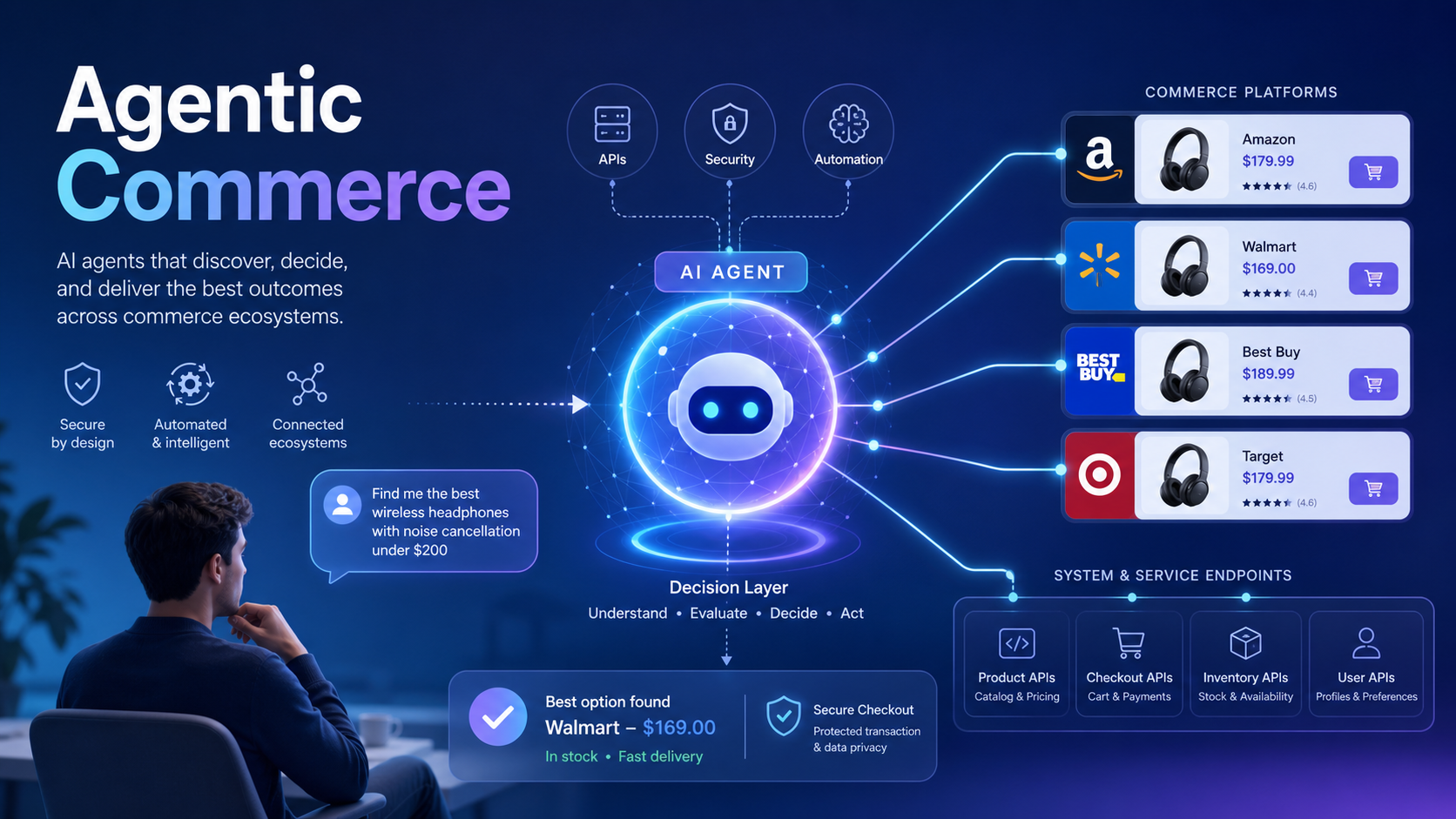

Agentic commerce is quickly shifting from buzzword to baseline expectation: AI agents are becoming your shoppers’ first stop, mediating discovery, comparison, and even checkout on their behalf. This post explains what that really means, why it’s happening now, and how to prepare your stack so you’re chosen—not just crawled.
What is agentic commerce?
Agentic commerce is an approach to buying and selling where AI agents act on behalf of consumers or businesses to research, negotiate, and complete purchases, often with minimal human intervention.
Instead of a person manually searching, comparing, and clicking through checkouts, an AI “shopping agent” can:
- Interpret intent (“find a breathable, waterproof hiking jacket under 200 dollars”).
- Scan catalogs, marketplaces, and reviews.
- Weigh trade‑offs like price, delivery date, policy, and brand reputation.
- Present a shortlist or, in some cases, execute the purchase directly.
In this model, the “buyer” is effectively a machine acting in service of a person, which changes how you design everything from product data to payment flows.
Why is this happening now
Several trends are converging to make agentic commerce real rather than theoretical:
- LLM-powered assistants like ChatGPT, Gemini, and Claude are becoming a primary discovery layer for products, not just information.
- AI‑referred traffic to retail sites has already shown explosive growth and higher conversion rates than traditional channels.
- Analysts project that by 2030, AI agents could mediate 3–5 trillion dollars in global consumer commerce, underscoring how large this shift could be.
At the same time, companies like PayPal, Google Cloud, and others are rolling out agentic toolkits and protocols that make it easier for agents to safely talk to commerce systems and payment rails.
The “front door” to your store has moved
For most of the digital era, your front door was search, social, or direct traffic. You optimized product detail pages (PDPs) for SEO and UX, and the shopper arrived on your owned surface to research and buy.
In an agentic world:
- Shoppers increasingly start with an AI assistant prompt, not a search box.
- The assistant does most of the research, then sends a small number of high‑intent clicks to a subset of merchants.
- By the time a visitor lands on your storefront, they’re often already pre‑qualified and ready to buy—if the experience matches what the agent promised.
This creates two distinct optimization problems:
- Being discovered and correctly understood by AI agents.
- Converting highly informed, AI‑referred traffic with a fast, trustworthy experience.
Ignoring either side means leaving revenue on the table.
What actually changes in the buying journey
In traditional ecommerce, the funnel looks like:
Awareness → Consideration → Evaluation → Purchase → Post‑purchase
In agentic commerce, that compresses into:
Intent → AI mediation → Transaction → Fulfillment
The AI agent collapses much of the discovery and evaluation phases by pre‑screening options, comparing attributes and policies, and filtering out noise.
As a result:
- Your brand and UX still matter—but later, as a proof point that validates the agent’s recommendation.
- Data quality, structure, and accessibility become your primary drivers of inclusion in the consideration set.
- Payments, fraud controls, and identity signals need to be machine‑recognizable, not just buried in policy pages.
From SEO to Agent Engine Optimization (AEO)
The Retail Dive piece puts it bluntly: product pages built only for human eyes and legacy SEO often fail AI crawlers entirely.
Agent Engine Optimization means making your commerce stack legible to AI:
- Structured product data. Rich attributes (materials, fit, use case, sustainability, policies) in structured form, not just copy buried in accordions or popovers.
- Clear policies. Shipping deadlines, returns, warranties, and availability are expressed in machine‑readable ways so agents can reason about them.
- Stable, performant APIs. Agents prefer reliable, well‑documented APIs over scraping fragile HTML.
If an AI agent can only see “dark roast, caramel flavor” instead of “sustainably sourced Colombian dark roast suitable for pour‑over,” you’ll likely lose the recommendation—even if your product is objectively the better match.
The three pillars: Data, identity, and trust
PayPal and others frame agentic commerce around three pillars that map well to real‑world implementation: data, identity, and trust.
Data: what agents see and understand
Data fuels every agentic decision:
- Product attributes, rich metadata, and taxonomy.
- Inventory, pricing, discounts, and time‑sensitive availability.
- Store policies and constraints (delivery windows, returns, regional limitations).
Gaps here don’t just reduce ranking—they can remove you from the agent’s shortlist entirely.
Identity: who the agent represents
Identity answers “on whose behalf is this AI acting?”:
- Unifying shopper profiles across channels so agents can personalize suggestions.
- Delegation models that let users grant explicit permission for agents to access payment methods and past purchase history.
- Verifiable digital credentials that anchor agent actions to a real person or business.
Without a strong identity, you either over‑constrain the agent (poor UX) or open yourself up to fraud and misuse.
Trust: how transactions remain safe and auditable
Trust is where agentic commerce lives or dies:
- Open protocols like A2A and AP2 are emerging to standardize how AI agents talk to each other and to payment services with verifiable proof of user intent.
- Mandates—cryptographically signed, tamper‑proof contracts—create non‑repudiable evidence of what a user authorized, reducing disputes and ambiguity.
- Established payment providers leverage their existing risk engines and brand trust to make this acceptable to consumers.
The key shift is moving from “we infer intent from behavior” to “we have deterministic, cryptographically verifiable intent attached to each agentic transaction.”
How PayPal’s MCP and Agent Toolkit fit in
You’ve already explored how PayPal’s adoption of the Model Context Protocol (MCP) gives developers a standardized way to expose commerce capabilities to agents. Building on that:
- MCP servers let AI clients (like Claude Desktop or other MCP‑aware tools) talk to PayPal services via a consistent, AI‑native interface instead of bespoke REST integrations.
- The PayPal Agent Toolkit wraps common actions—creating orders, invoices, subscriptions, disputes, tracking shipments—into agent‑friendly building blocks, reducing integration friction.
- AP2 and agentic payments layer on top of A2A and MCP to bring verifiable digital credentials and mandates into the payment flow, so each agentic purchase has a clear audit trail and accountability model.
For merchants and developers, this means you don’t have to invent a security and trust framework from scratch—there’s an emerging ecosystem you can plug into.
What this means for your stack
From a digital operations and security perspective, agentic commerce surfaces several concrete requirements:
- API-first architecture. Your commerce engine needs clean, well‑versioned APIs for product data, pricing, inventory, and order management that can withstand bursty, machine‑driven traffic.
- Edge performance and resilience. AI agents optimize for speed; slow or flaky endpoints may simply be down‑ranked in favor of faster ones.
- Nuanced bot and agent management. You’ll need to distinguish between beneficial agents (shopping assistants, aggregators) and abusive automation, shaping traffic rather than bluntly blocking all non‑human activity.
- Security and governance. As autonomous agents touch payments and PII, robust WAF rules, rate limiting, anomaly detection, and strong authentication become non‑negotiable.
In other words: your site isn’t just for humans anymore. It’s an integration surface for other machines that represent your future customers.
A practical checklist to get started
You don’t need to implement the full agentic vision on day one. But you should start moving in that direction now.
Here’s a pragmatic roadmap:
- Audit product data readiness.
- Are key attributes and policies machine‑readable (schema, JSON, APIs), not just present in copy?
- Would an AI agent have enough detail to confidently recommend your products?
- Harden and document your APIs.
- Inventory existing commerce and catalog endpoints.
- Improve performance, caching, and documentation with agents in mind.
- Clarify agent policies.
- Decide what kinds of agents you’ll explicitly support.
- Adjust bot management rules to recognize good agents instead of blocking everything non‑browser.
- Align with emerging standards.
- Track protocols like MCP, A2A, and AP2, and where relevant, experiment with sandboxes from providers like PayPal and Google Cloud.
- Instrument and observe.
- Start tagging and measuring AI‑referred traffic separately.
- Monitor conversion, latency, and error patterns specific to agent-driven journeys.
From being discovered to being chosen
The Retail Dive article frames the core challenge well: showing up in AI assistant results is necessary but not sufficient; you also need a compelling experience behind that click.
In an agentic commerce world, the winners will:
- Expose rich, trustworthy data and APIs that make agents confident recommending them.
- Provide fast, frictionless, secure experiences that validate those recommendations for human shoppers.
- Plug into standards and toolkits that solve identity and trust at scale, rather than building bespoke integrations for every new AI surface.
You’re no longer designing solely for people. You’re designing for the agents that people trust to shop on their behalf.